I first encountered Alwin Maigler’s work through his book Nocturne. As a lover of dark places and an admirer of night photography, I was immediately drawn to this unique series. The fact that Maigler’s models are dancers, and the way they seem to float effortlessly through his pictures leave an enchanting impression on the viewer – and made me eager to find out more about his way of working. Enjoy the read!
Nadine Dinter: Your latest books, Nuances and Nocturne, take us into a world of music, rhythm, and enigmatic dancers in shifting spaces. Can you tell us a bit about your approach to photography and your preferred genre?
Alwin Maigler: For most of my career, it felt inevitable to have people in front of my lens. Coming from portraiture and fashion, I learned early on that the main task of such a photographer is not simply to take the picture, but to create a space where people feel comfortable enough to open up.
Over the last few years, I have shifted toward a freer, more artistic practice that does not easily fit into a specific photographic genre. Nuances and Nocturne, for example, immerse us in the world of ballet and explore the paradox of photography as a still and static medium meeting the fluidity and ephemeral beauty of movement and dance. I was fascinated by the idea of bringing these two seemingly counterintuitive art forms together.
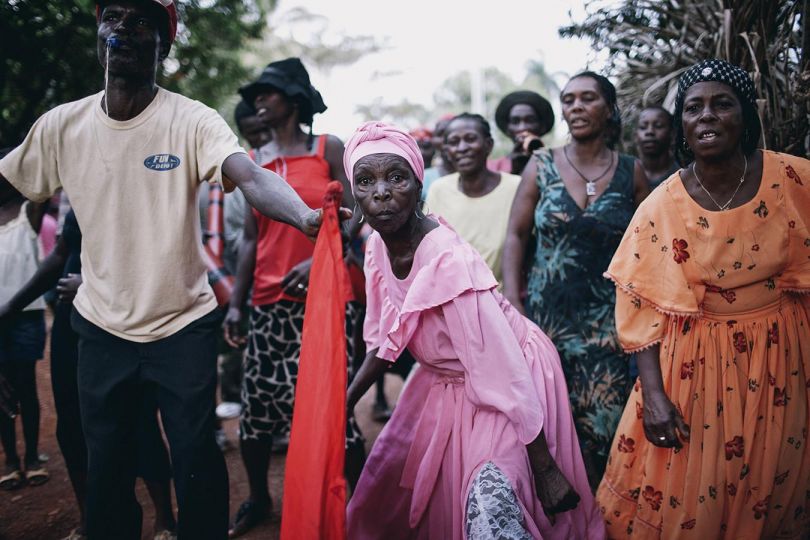
At the same time, my interests are quite broad. I am currently working on a long-term project dealing with former German colonies, which took me to Africa last year and will lead me to the Caribbean next year. I also just completed a very personal series, barefoot in the grass, photographed entirely on analogue Polaroid film. It reflects on falling in love, gender roles, intimacy, and the power of the camera and the gaze.
So, to sum it up: my preferred genre and approach are always guided by personal interest.
For these two series, you worked exclusively in black-and-white, while much of your commissioned work is in color. How do you decide which way to go, and why did you choose black-and-white for the books?
AM: The central theme in both series is movement – and the question of how to capture movement within a medium that is inherently still. For each series, I developed a kind of visual grammar that I could apply to the images. In this particular case, I asked myself: Does color contribute to making the images more dynamic and the movement more visible?
You may also notice that there are hardly any faces visible in either series. That’s not because the dancers aren’t beautiful – quite the opposite, they are all stunning. But our eyes are naturally drawn to faces. The moment we see one in a photograph, we instinctively focus on it. In my case, that would have disrupted the lines and compositions I carefully created to translate movement, expression, and the body into a certain dynamic.
So, I answered the question of color in the same way: it would have distracted the viewer from what I wanted to convey. For me, the choice between black-and-white and color always depends on the topic, the concept, and the subject. In commissioned work, however, the purpose is different: if we’re photographing for a specific product or cause, that product becomes the central interest. If color is essential to communicate what we want to express, I very much enjoy working in color as well.
How do you usually prepare for a shoot? Do you have any rituals or a particular way of approaching it?
AM: Even though I’ve been working in the industry for ten years now, I still get a little nervous before commissioned shoots. Not because I doubt my ability, but because I hold myself to very high standards and am always critical of my own work. Striving for more and for better has become part of my preparation.
With my personal projects, the process is even more complex. Sometimes it takes months, if not years, until I feel I can properly evaluate the work. To break it down step by step: first comes the nervousness, then the feeling that I could have done better, and only later the realization – oh, this is actually quite good.
In both Nocturne and Nuances, you worked with ballet dancers. What music did you play – and who chose it, you or the dancers?
AM: I always played the music the dancers wanted to listen to. We usually started with a very relaxed conversation over a cup of tea, listening carefully to what they shared with me, creating a personal connection. Only then did we begin photographing – sometimes to the sound of classical music, sometimes to dark techno, or even hardcore death metal. People often have a narrow idea of ballet and what kind of music dancers prefer, but I met some of the most interesting and diverse individuals.
How did you direct the dancers? Did you give instructions, or did you prefer to give a rough narrative and let them move freely?
AM: In both series, it was always a highly collaborative effort – almost like an ongoing conversation between the dancers and me, or between their bodies and the camera.
Nuances was shot in the studio, which created a very intimate and personal atmosphere. Nocturne, on the other hand, was photographed outdoors at night – decontextualizing the stage and challenging the visual conventions of ballet as we know it. It was highly experimental, rebellious, and a lot of fun. Watching a ballerina jump into a public fountain in the middle of the night, hoping the police wouldn’t notice our shenanigans, was both hilarious and unforgettable to capture.
Alongside your creative projects, you also take on commissioned work for Porsche, Leica, Mercedes-Benz, and the Stuttgart State Opera, among others. How do you switch between artistic and client photography?
AM: Well, photographically, it’s actually easier than people might think. Most photographers are versatile and flexible. The real challenge, I believe, lies in communicating that a strong artistic project could just as well be a commissioned one. Clients need to understand that the art of storytelling doesn’t fundamentally differ from creating a campaign for their product or strategy. Of course, commissioned work is often more focused on the product itself than on my personal interpretation. But the best assignments are those where I’m hired specifically because of my interpretation and visual signature.
No client seems too difficult, no brand too big. What’s your secret? Do you have a go-to icebreaker?
AM: Saying yes to challenges instead of giving in to the impulse of fear. Also, having a strong network of colleagues with many years of experience helps me navigate things I haven’t done before. Being open, supporting each other, and sharing knowledge is key.
Your first international solo show took place in Japan last year, and earlier this year you exhibited in Cologne. Do you notice cultural differences in how your work is received?
AM: Yes, the differences couldn’t be greater. Japan is not only literally on the other side of the globe but also rooted in a very different art-historical tradition. In Europe, fine art has been cultivated for centuries by museums, royalty, collectors, and institutions like the church. In Japan, the tradition of what we in Europe define as “fine arts” is comparatively young (acknowledging that even “art history” is a very Eurocentric term). If you visit Japan’s national museums to see their most treasured cultural artifacts, you will mostly encounter ceramics, swords, and crafts – and of course traditional Japanese calligraphy and woodblock prints.
This also extends to photography. Before my exhibition, I visited the Kyotographie, one of Japan’s major photo festivals, and received incredible feedback in advance. I was told the Japanese audience would love my Nocturne series because they had never seen anything like it before. That prediction came true when we opened to a completely full gallery in Tokyo – the response was overwhelming.
That said, even though I adapted the presentation of my work to Japanese standards – smaller formats, for instance, because of limited wall space and smaller apartments – it was still challenging to sell to collectors. Fortunately, I had been told this six months prior, so there was no disappointment or false expectations.
What’s next for you?
AM: Many exciting projects! I just photographed at Les Ballets de Monte-Carlo in Monaco. Exhibitions, talks, and
presentations of already published series and works – but also debuts of yet unpublished ones. Earlier in 2025, the Franco-
German TV channel ARTE produced a documentary about kissing and followed me to Paris, revisiting a project on this
theme that I had done a few years back. They also came to see my exhibition at Simone Klein’s showroom. So I’m very
excited to see my photographs appear on this platform.
I’m currently in the layout phase for the book publication of my upcoming series barefoot in the grass – excerpts and original Polaroids will be on view at the
Staatsgalerie Stuttgart from October 17, 2025, until mid-January 2026. It’s quite an honor to be invited by such an
institution.
And in January 2026, I’ll continue work on my project exploring German colonial history – focusing
next on St. Thomas in the Caribbean. So, as you can see, the coming months are shaping up to be very layered and diverse.
Needless to say, I’m very excited!
Any advice for photography students just graduating?
AM: Grow a thick skin – you will hear a lot of “no’s” and face many obstacles. Find a healthy balance between going full speed ahead and knowing when to step back and take breaks. Stop waiting for opportunities to come to you – nobody is going to simply hand them over. Be persistent, resilient, and creative – not only in your photographic execution but also in the way you pursue your goals. And don’t take anything for granted: a career in photography is not easy, not linear, and requires a lot of hard work, a lot of luck, and the generosity of people willing to give you chances.
Save the Dates:
July 26 – October 11, 2025
Nuances & Nocturne at Leica Gallery Porto, Portugal
October 17, 2025 – mid-January 2026
Excerpts from barefoot in the grass (original Polaroids) on view at the Staatsgalerie Stuttgart, Germany.
Throughout 2025–2026
Artist talks and book presentations in various Leica Galleries across Germany
For more information, check out Alwin’s IG account @alwinmaigler and his website at www.alwinmaigler.com.