During an intense period of some 10 years, Fan Ho (1931 – 2016) both captured and reimagined a Hong Kong that is now largely lost to history. Despite winning close to 300 international awards for his photography, most before he had reached 30, he embarked on a career as a film director, thereby diminishing his profile as a photographer not only internationally but also in Hong Kong. Still, those who had seen his images were not likely to forget them.
At the 2023 edition of Photo London, a selection of his works was shown by Hong Kong-based Blue Lotus Gallery. The gallery had taken a space on the first floor of Somerset House, which received much less traffic than the spaces on the ground floor and the temporary pavilion in the court yard. But word about the Fan Ho images spread quickly and soon the gallery space was absolutely packed. Many of the admirers of Fan Ho had only ever seen his images in books and magazines, while many of those who had never seen his images at all asked themselves, “Why have I not heard of this photographer before?” As I found out, Sarah Greene, Director of Blue Lotus Gallery, had asked herself pretty much the same question when she first came across his images.
I started my conversation with Sarah Greene by asking her about Fan Ho’s early years.
– Fan Ho was born in 1931 in Shanghai, the only son of prosperous silk traders. His father owned a large, elegant shop in Huangpu, a lively district of old Shanghai near the Bund, the waterfront along the Huang River. The family lived in the Piers Apartments in Hongkou, not far from the Bund. One of Fan Ho’s earliest photographs depicts a rain-soaked road facing the river, taken from that apartment. He was deeply loved by his family. These were the glory days of old Shanghai, a vibrant and affluent international city on the brink of upheaval as the socio-political situation deteriorated. Life in Shanghai changed on Pearl Harbor Day, 8 December 1941. Four years after entering the city, the Imperial Japanese Army finally occupied the International Settlement. War had fully erupted, and Ho Fan’s parents, stranded in Macau, where they operated factories, were unable to return until 1945. Ho Fan, then just ten years old, found himself alone in the city, cared for only by the family’s governess.
You recorded his life story over several days. What did he tell you about those years?
– It was a very scary time, not least because planes were flying over the city, dropping bombs. He frequently visited his uncle and aunt for dinner and escaped his loneliness by writing long letters to his mother, reading books, including Tolstoy’s Anna Karenina and Alexandre Dumas’ The Three Musketeers, and by going to the movies about three times a week, at a cinema called Grand Theater/Da Guong Ming, near the old race track, now People’s Park close to Nanjing Road. It was during that time that his three lifelong passions were formed. He loved movies, he loved reading; serious literature by Leo Tolstoy and the classics, tragedy and drama, and he loved photography. He was given a Box Brownie around that age and would venture onto the streets of Shanghai to take pictures. Even at that young age, he was not drawn to frivolous things but to the drama of life, as it was expressed in different art forms, and it set the tone for his later work.
When did he reunite with his family?
– His parents managed to return in 1945 to take him out of Shanghai and move the family to Guangzhou. Many merchants left Shanghai at that time, as the new Communist Party regime was confiscating businesses and property. Some people lost fortunes. Fan Ho and his family first moved to Guangzhou and then, in 1949 when Fan Ho was 18, to Hong Kong to reestablish themselves there.
Had he planned a career for himself at that stage?
– By the time the family settled in Hong Kong, he was 18 years old. He was thinking of studying literature and philosophy but his parents didn’t think it was a good idea. There’s not much money to be made as a philosopher. He was reading and reading a lot. He told me once that he had been asked to write an essay and came back with something that was essentially a book! When Fan Ho did something, it was with a lot of passion and intense effort. Today, he would probably be diagnosed with ADHD or something, his energy was endless for the things he loved.
He was in his 20s when he started producing his now famous images. There’s a story that he became more focused on photography as a result of him getting terrible headaches and that he would take long walks to alleviate the pain, always bringing his camera.
– It was on the orders of the family doctor who realised that Fan Ho’s splitting headaches were because of him reading and writing so much. “You have to give yourself a break!” the doctor told him so he decided to go for long walks but doing nothing wasn’t for Fan Ho so he would take his camera. But Fan Ho being Fan Ho, he photographed with the same obsession. Taking photographs wasn’t enough. He began reading all the literature on photography that was available. He also joined the Hong Kong Photographic Society and soon, he was put in charge of its library, reading every new book as it arrived.
He really went for it?
– He did and he was very aware of what was going on in terms of different schools of thought related to photography and the work that was produced in the rest of the world. At the same time, he kept an eye on Salon photography in Hong Kong and what was popular on the scene. He obsessively absorbed everything about photography. Still, he continued to listen to music, especially opera, and going to the cinema. Rita, his wife, told me that sometimes he would take her to the cinema to see two movies in a row. Everything was very intense with Fan Ho and it comes out in this photography.
We are into the 1950s. What was the photography scene in Hong Kong like at that point?
– It was very, very active. There was a big scene, with great photographers and they got together and learned from each other. The bar was set high, which can be seen if you see the entry level of international salon magazines of that time. As I mentioned before, Fan Ho was very active in the Hong Kong Photographic Society. He was often on its jury and also taught his peers how to look at photographs, how to photograph and how to compose an image. He started to write essays about photography, which were published in local magazines. At the age of 28, he compiled all these essays into a small book called Thoughts on Street Photography. We recently republished the book in its original Chinese language with some additional material and we hope to publish it in English at some point. He doesn’t write about how to use your camera. It’s about how to perceive the world, how to structure it, how to work with light, with compositions, how to work with subjective versus objective photography and all those principles still apply today.
In interviews, Fan Ho would often mention Henri Cartier-Bresson and The Decisive Moment but going through his images, there’s also a strong influence of modernism and he would move seamlessly between the two.
– I think that’s right. In Europe, you were either into objective or subjective photography, and you had to choose between the two. Being far away from all that, he felt freer. He had phases and would go from one style to another. Experimenting and trying new things were very important to Fan Ho. A lot of people compare him to Henry Cartier Bresson and he was also very mindful of the decisive moment. But there is still a huge difference. For Fan Ho, it was never about honouring the truth. It was more a call for poetry, storytelling and expressing emotions. He was not interested in simply documenting the streets of Hong Kong as they were. Instead, he chose the streets to create theatre and drama in his pictures and that was probably also influenced by cinema in that regard.
Some pictures he found, others he staged and directed.
– Yes, and you can see him being a movie director. In many images, it’s quite apparent that he directed them. Like the picture Private, showing two people in a window. There’s a white wall and there is a small sign at the bottom, saying, “Private”. It was a staged image. He had spotted the wall and the sign and asked two of his friends to help create the scene. He worked in different ways. Sometimes he would find an interesting view, analyse exactly when the light would be perfect and then patiently wait for something interesting to happen in that scene.
Fan Ho captured scenes and sometimes he staged them but he would also alter images in the dark room, with Approaching Shadows for instance, his most famous image, where he added a dramatic, diagonal shadow.
– For him, the result was the most important thing, however it was reached. Approaching Shadow was staged. He came across this huge wall, and having a very strong imagination, he suddenly had an idea for a story. He asked his cousin Vivian to pose against the wall and then burnt in the shadow in the darkroom. It’s the shadow of decay coming close. Youth won’t last forever. It shows that he was, in essence, a storyteller. It’s such a strong image. Once you’ve seen it, it does something to you and it remains with you. It’s like a Mona Lisa of photography. It’s also interesting that he made it in 1954 so he was still in his early 20s. It won so many awards at the time and t’s the one image that everyone remembers.
The image is also a reminder of the darkness in his work, especially compared to the work produced by the French humanist photographers such as Willy Ronis and Robert Doisneau, which is characterised by warmth, sometimes bordering on mushiness.
– Fan Ho was drawn to stories without happy endings and the inherent tragedy of life. That was what art meant to him, the source of its power. He was also deeply interested in people and the hardships they endured, their lives and their struggles.
In addition to the psychological darkness, the prints themselves are often very dark.
– True, and you might think that those images were shot at night but they were, in fact, shot during the daytime. It was because of how he developed and printed them. Fan Ho loved developing and printing. Initially, he did it in his mother’s bathroom. In addition to his vision, there was also another reason for the darkness, which was more practical. The salon juries would view photographs under super bright overhead lights so if a print was dark, all the interesting details would still be visible and would sustain the viewing experience.
I recall him saying somewhere that he never shot a lot, as film was quite expensive.
– Fan Ho was always very focused when he worked. He really liked the central market in Hong Kong because the light came in so beautifully around four o’clock in the afternoon and there was so much action and atmosphere, people rushing, dust and the smoke from cooking. It was one of his favourite spots that he would revisit it over and over again. When the central market was rebuilt, everything was torn down, except the staircase where he took so many great images, and it was kept intact in honour of Fan Ho. They also kept the railings and the big clock because the developers realised that it was important to people, and these days, it’s a tourist attraction.
He was photographing in Hong Kong, a city that was changing rapidly. After WWII and the Communist Party taking power, 1.5 million Chinese fled to Hong Kong.
– When he and his family arrived, Hong Kong had a population of only about half a million. Today, it has nearly eight million. At the time, the city’s future was deeply uncertain. Hong Kong lay in ruins, but soon afterward a large influx of Chinese immigrants marked the beginning of an industrial, and later financial, transformation. Fan Ho documented Hong Kong just before and during these early changes. Most of the streetscapes he captured have since been completely altered and are now almost unrecognisable. Although documentation was not Fan Ho’s intention, his work has become an important photographic archive of Hong Kong and its people at that moment in history.
Today, most of what he captured is gone, apart from the famous staircase.
– Yes, but sometimes I still see traces of the old city. The biggest difference is that the low-rise buildings have almost entirely disappeared, except for a few tong lau; six-story walk-ups in the older districts, now replaced by high-rises. Back then, exactly as he captured it, life unfolded on the streets: people cooked, worked, and socialised outdoors; women earned money by ironing, men repaired broken goods or wrote letters for customers, and children played in the alleys. People only went indoors to sleep. Today, the streets are simply for moving from A to B. He photographed with an almost obsessive intensity. His photographic career was remarkably concentrated, spanning only about ten years, from the age of 18 to 28, so he was still very young. There is a story about the Royal Photographic Society honouring him with its highest title. When their representatives came to Hong Kong to meet the great photographer, they were introduced to Fan Ho, and immediately asked, “Where is your father?” They simply couldn’t believe that such a young man had taken all those extraordinary photographs.
Did he ever work as a professional photographer in Hong Kong?
– No, he didn’t, because being a professional photographer at that time would have meant working for a newspaper and he had no interest in being a photojournalist, or working as a portrait or wedding photographer. He wanted to be a pure photographer, to pursue his love for photography on his own terms. The only ever paid photography job he ever did was, oddly enough, for Playboy in 1987 while he was a movie director. It coincided with him shooting one of his last movies, an erotic movie, and the magazine asked him to do a shoot. And of course, unlike today, being an art photographer wasn’t a way to create a sustainable income. Print sales were not a thing at that time.
Instead, he opted for a career in cinema, and in 1961, he was hired by Shaw Brothers, the biggest production company in Hong Kong.
– He was married, he had children, and he needed to create an income. He approached Shaw Brothers after having seen an advertisement. Shaw Brothers were looking for actors. He went to see them, “Look, I don’t really want to be an actor. I want to be a director.” They turned down his request but talked him into being an actor, as he was very good-looking. It was a start in the movie business so he signed a contract for eight years. Incidentally, Shaw Brothers changed the year of his birth from 1931 to 1936, as they wanted him to appear younger, and this has caused some confusion.
How did he fare as an actor?
– He was in quite a few movies but he hated it. I described him as a hyperactive, someone who needed to put his all his energy into something. He found it really hard to relax into a role, and he also felt uncomfortable in front of the camera so he knew he was never going to make it big. But he enjoyed being part of the movies and seeing how it was all done. When his contract as an actor finished, he decided to become a director. I think Shaw Brothers offered him to be a director but he wanted to be independent to do his own thing. Cinema was huge in Hong Kong back then. Since he was so talented, a good storyteller, a good cinematographer and a good director, he was kind of all-in-one professional and became very sought after by the various production companies. He became quite a big name but he was also frustrated. He had always wanted to be a director but he really wanted to be an ‘auteur’ like Federico Fellini. He wanted to create arthouse movies but he was struggling to find producers to give him the budgets to do that. Hong Kong cinema was more commercial oriented at that time.
He kind of did become an auteur, with the film Lost, made in 1969.
– It’s an astonishing short film. Lost is a tale of a young man who is very confused about whether he should be traditionally Chinese and conservative or embrace modernity and a western style. Those two worlds are expressed in the film by two different types of women. One is a very traditional woman residing in a traditional mansion with a large Chinese garden, spending her time playing Chinese instruments. The other is a Western-style girl in a miniskirt going out to dance at parties. The young man s conflicted, not knowing which one to choose. The film looks great but it was a low-budget production and he couldn’t find producers who would give him money to make bigger movies in that direction. Eventually, he left his career as a movie director, feeling frustrated about not achieving what he had wanted.
Did he abandon photography during the years that he worked as a director?
– Movies took up all his time and he couldn’t make a living as a photographer. Consequently, his photography sort of stopped in the mid-1960s.
The rest of his family emigrated to San Jose in the US in 1979 and when he retired in 1997, he followed suit. Was that when he got back into photography?
– Yes, because he was so bored in San Jose, American suburbia, far from all his friends. He missed Hong Kong and the late-night conversations about cinema, photography, and literature. After his family moved to San Jose, he rented a room; living alone in a big house frightened him, or more precisely, he was afraid of ghosts, so he preferred to share a home.
As I understand it, he returned to his old negatives. Not content to simply republish his award-winning work, he also created a new body of work.
– In the early 2000s his famous work was republished by Modernbook Editions. For the third book in this trilogy, he wanted to create new work. Although he had already published books and won some 300 awards, his creative spirit pushed him to keep experimenting. He began exploring his archive of negatives, constructing new images by combining elements from different shots. For example, he merged a boat scene with a street scene, creating a sort of “Hong Kong Venice.” This appeared in this third book titled Hong Kong Memoir. These images echo the way memory functions: not clearly, not as a documentary record, but blurred, layered, and intermixed. One standout piece was Longing, an extraordinary montage combining a street scene with a shadowed profile. He loved Hong Kong, missed it deeply, and missed all the friends he had left behind—and that emotion comes through vividly in these images.
When did you start working with him?
– It was in 2011. I had opened my gallery just a few years earlier. It was a small space in an industrial building, and I was working with many Hong Kong artists across different media. When I came across Fan Ho’s work, I thought, “How come I have never seen this in Hong Kong?” The photographs were extraordinary, and I knew people would respond to them. It took some time to convince those close to him to let me proceed. The first time, I showed ten small Fan Ho prints as part of a group exhibition. But once I began working with him, things started happening for me. I think it was his karma.
What happened?
– The space I had was a bit too underground, too far from the city centre. Then I connected with a Hong Kong publisher called Asia One, which owned an entire 14-floor industrial building. The owner approached me and said, “I love Fan Ho, and I’m starting a gallery in my staircase named AO Vertical. Can you help manage it?” So we became partners.
Our first Fan Ho exhibition, in 2012, was fantastic. We hung about 50 works along the staircase, creating a vertical experience for visitors, with additional photographs displayed on each landing. The show was covered across Hong Kong media, went viral internationally, and was picked up by The Guardian and The New York Times. Shortly afterward, I met Fan Ho for the first time. I showed him the exhibition’s visitor’s book, filled with comments and little drawings. He was overwhelmed, in tears. His greatest wish was for people to feel something when they saw his work; he wanted his photography to convey poetry. The visitor’s book made it clear that he still touched people from all ages, and all sorts of backgrounds deeply.
It must have been great for him to get that response even if it was very late in his life.
– Yes, it was very important, I think. We held follow-up exhibitions in 2014 in the same space, in 2017 with Sotheby’s, and in 2019 at Blue Lotus Gallery at its current location in Sheung Wan near Central. Right before the 2014 show, the Sino Group had acquired a collection of Fan Ho’s works to adorn their soon-to-open Pottinger Hotel. Every room still displays his photographs. The hotel kindly offered him and his wife a large suite to stay in during the exhibition at AO Vertical. During that visit, I became something of a bodyguard for him because there were so many people who wanted to interview him or simply meet him and shake his hand. For the book signings, we had to limit it to three books per visitor. People treated him like royalty. He summoned every bit of energy he had left to speak at length with journalists and to greet each visitor personally.
You worked with him on books and exhibitions. What were those processes like?
– Artists can be quite difficult creatures but of all the artists I’ve worked with, Fan Ho was the kindest. He knew he was good and was proud of his work, yet he remained altruistic, generous, and always open to other people’s ideas. When you have real confidence, you don’t need a big ego. When we created the book Portrait of Hong Kong, I visited him every day for several weeks to record his life story and also to look at so far unpublished work. As we began planning the book, he brought out his negatives. We needed to view the images clearly, so I went to a stationery shop and bought a light box. I cut out a square window in a piece of cardboard to place over the negatives on the light box, then photographed them with my iPhone. Using an app, I flipped them from negative to positive each evening, giving us the material we needed to continue working the next day.
Can you tell me how he cropped the images?
– Cropping was a very important part of his work, and he approached it playfully. He loved extreme crops, very narrow frames or selections using only a small portion of the negative. He didn’t want all his images to remain in their original Rolleiflex medium-format square or any other rectangular ratio. For him, cropping was a key tool to strengthen composition and remove anything unnecessary. He told me that, with painting, you start with an empty canvas and build from nothing into something. But with photography, it’s the opposite: you begin with too much information and must cut it down to the essence of the image. Being as generous as he was, he would often ask, “Sarah, how would you crop this?” I would try, and if he didn’t like it, he would never say it was wrong. Instead, he’d say, “That’s one way of doing it. But what about this way?” and then he showed me his version. And if I did it exactly as he’d envisioned, he’d say, “Oh, Sarah, you have an amazing eye!” His humanistic approach wasn’t limited to his photographs. It defined the way he treated people, too.
Fan Ho sadly passed away in 2016. What kind of archive did he leave behind?
– He kept his negatives in small plastic zip bags. When he moved to San Jose, he initially considered taking only those and leaving the vintage prints behind, but thank goodness he didn’t. I currently work with the family. I’m not responsible for managing the archive myself, but the negatives are well cared for.
What’s next for you and the work of Fan Ho?
– So far, we’ve succeeded in bringing his work to the attention of people in Hong Kong. The next chapter is to share his vision with the rest of the world. There has yet to be a Fan Ho exhibition in a major European or American museum, and I hope to change that soon. I look forward to this next stage, introducing Fan Ho’s photography to museums across Europe, the United States, and China, and ensuring his legacy reaches the global recognition it deserves.
Text and interview by Michael Diemar
This interview was first published in issue 15 of The Classic, a print and digital magazine about classic photography.
PDFs of issue 15 and the previous issues can be downloaded for free, go to https://theclassicphotomag.com
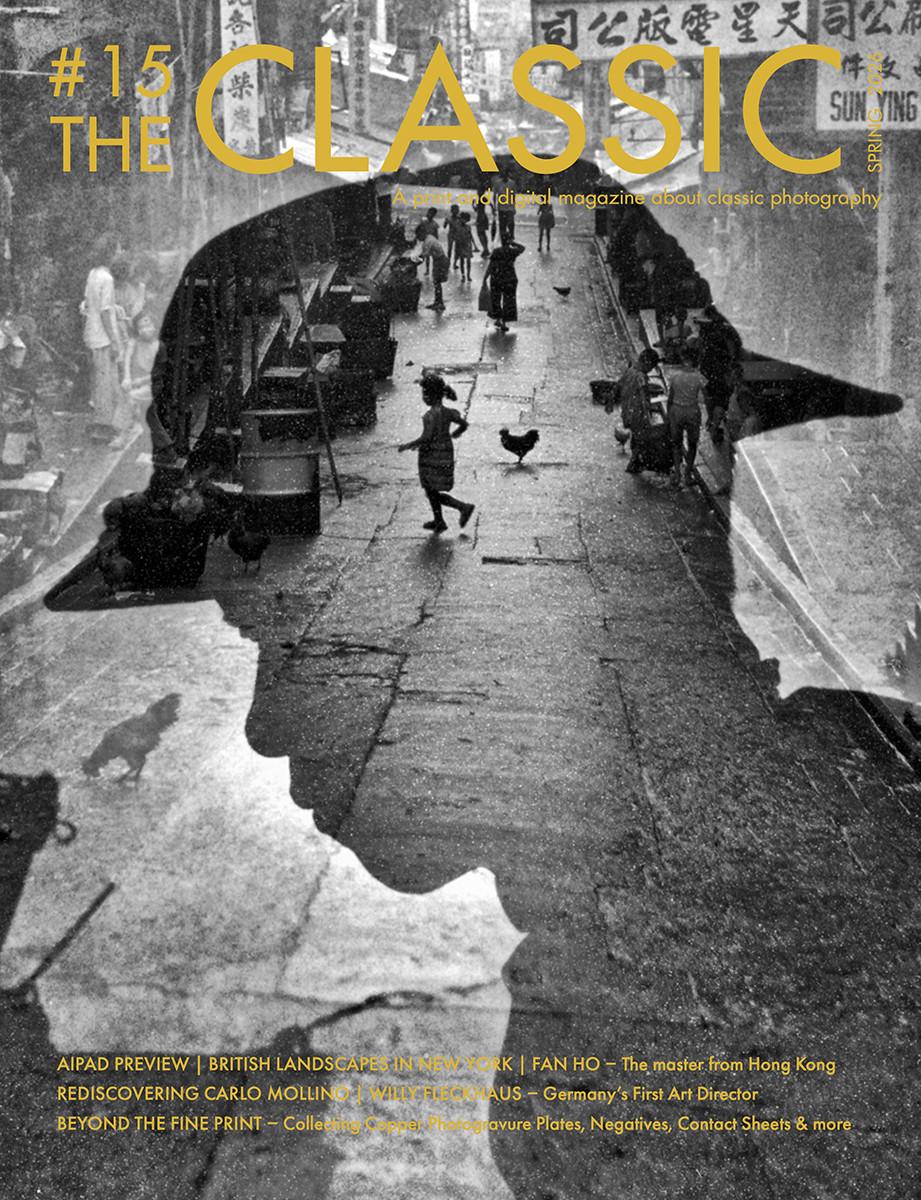
The Classic #15 – Cover – Photo Fan Ho Trust – Courtesy The Classic