This is the third episode of the conversation between Sandro Miller and Matthew Rolston, during which the photographers, based respectively in Chicago and Hollywood, reflect on their beginnings in photography, the nature of portraiture and where they’re headed next.
Next question.
“Among the photographic work you admire, is there one that stands out most?”
[Sandro Miller]
Yes, Matthew, there is. Avedon created a series of work – he traveled for five or six years through the American West – and I can’t tell you exactly how many hundreds of these portraits he created. But what he did was… these are the common folk, the ordinary people, the misfits of the world.
[screen shows five images from Avedon’s series In the American West]

Richard Avedon, Alfred Lester, dryland farmer, Charboneau, North Dakota, 1982

Richard Avedon, Boyd Fortin, thirteen year old, Sweetwater, Texas, 1979
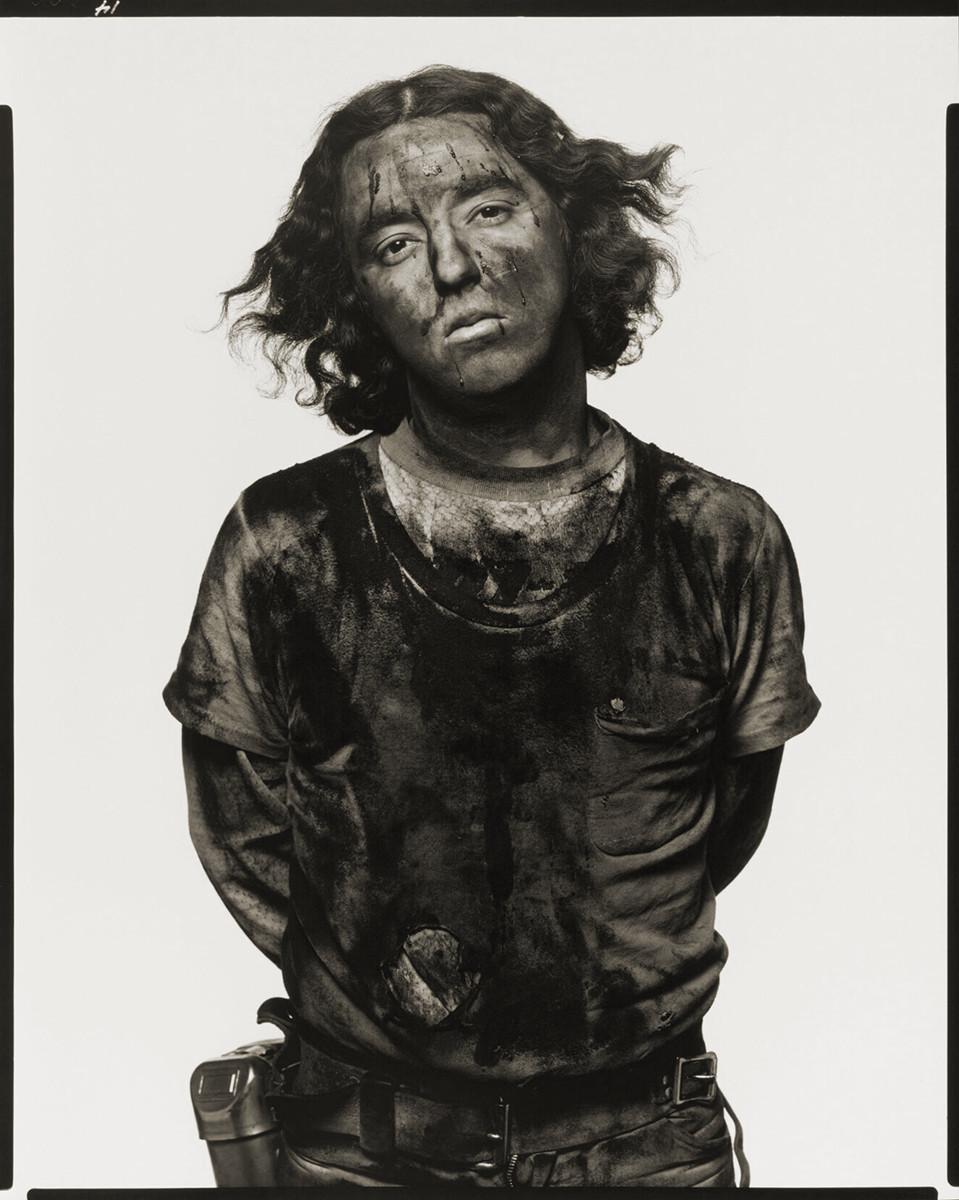
Richard Avedon, James Story, coal miner, Somerset, Colorado, 1979

Richard Avedon, Petra Alvarado, factory worker, El Paso, Texas, on her birthday, 1982
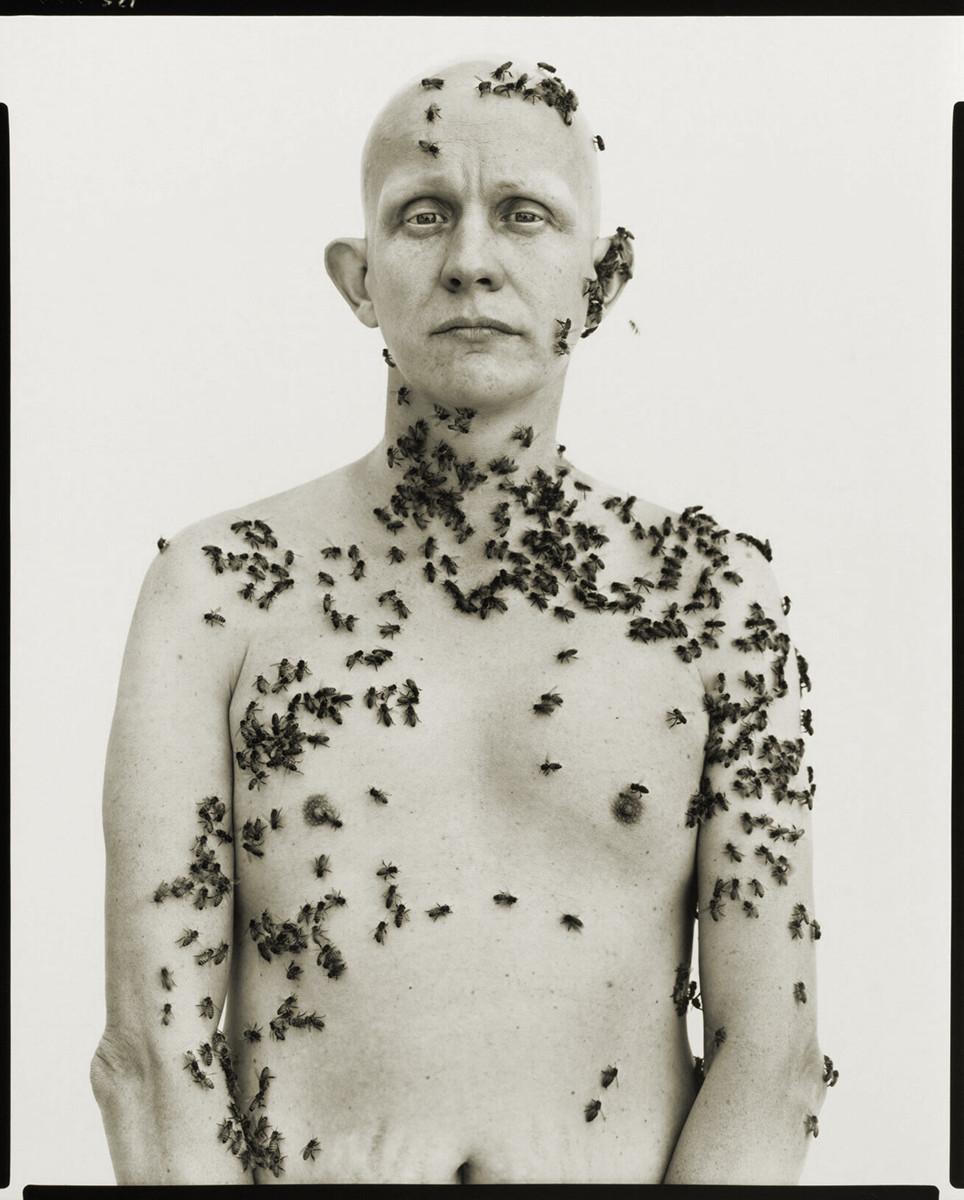
Richard Avedon, Ronald Fischer, beekeeper, Davis, California, 1981
These aren’t the people that you would normally see on your glossy pages of a magazine. Avedon gave them dignity. He gave them honor. This meant so much to me in the work that I did, because my work isn’t celebrity-based. I do celebrity portraits, but I tend to photograph much more frequently the ‘real people’, the ordinary people of this world. I learned through Avedon’s images the importance of showing respect and honor to all people. Avedon helped me to draw amazing imagery from people who aren’t used to being in front of the camera.
This series of Avedon’s, “In the American West”, is one that I’ve found to be the most important photographic series ever created.
[Matthew Rolston]
Can I share a thought about this series?
[Sandro Miller]
Absolutely, please.
[Matthew Rolston]
I’ve been really influenced by Avedon’s “American West” as well. If you take a look at my series Art People, there is some kinship with that. In fact, the picture of the coal miner is in the book’s introduction.
[screen shows Avedon’s portrait of James Story followed by the cover of Rolston’s book Art People, trade edition]
Richard Avedon, James Story, coal miner, Somerset, Colorado, 1979

Art People: The Pageant Portraits by Matthew Rolston, Laguna Art Museum, 2021
Monograph trade edition, front cover
And there’s another one that I used in that book, with permission from the Avedon Foundation. His portrait of Marella Agnelli.
[screen shows Avedon’s portrait of Marella Agnelli followed by the cover of Rolston’s book Art People, collector’s edition]

Richard Avedon, Marella Agnelli, New York, December 1953

Art People: The Pageant Portraits by Matthew Rolston, Laguna Art Museum, 2021
Monograph collector’s edition, front cover
I have a slightly different take on Avedon’s “American West”. When you photograph famous people – and I’ve had this leveled against me, “Oh, you’re good at making beautiful people more beautiful,” right? And I think Avedon suffered that same stigma. By the way, he called fashion the ‘F word’, Dick did. He told me that. I got to know him a little bit. But I think he definitively proved with the “American West” series, it’s not who you photograph, it’s how you photograph them.
And he did it with absolute minimalism. I think that style choice may also be related to the architectural movements of that time, which were minimalism and brutalism.
[Sandro Miller]
And you have to understand his reasoning behind using a white seamless background. It’s void of background. There is nothing there. All you can look at is the subject.
[Matthew Rolston]
There’s no lighting.
[Sandro Miller]
No ‘set-up’ lighting, but there is light.
[Matthew Rolston]
Yes, just available light. Minimal. Talk about minimal.
[Sandro Miller]
Minimalist.
[Matthew Rolston]
One camera, one lens, one background, no lighting. This is north light on the backside of a barn outside of a van. That’s how he did these pictures. Always north light.
[Sandro Miller]
Always in shadow.
[Matthew Rolston]
Yes. North light shadow.
[Sandro Miller]
What about you, Matthew? What stands out for you?
[Matthew Rolston]
I wonder what it might be… hmm.
[Sandro Miller]
[laughs]
[screen shows Avedon’s Dovima with Elephants]
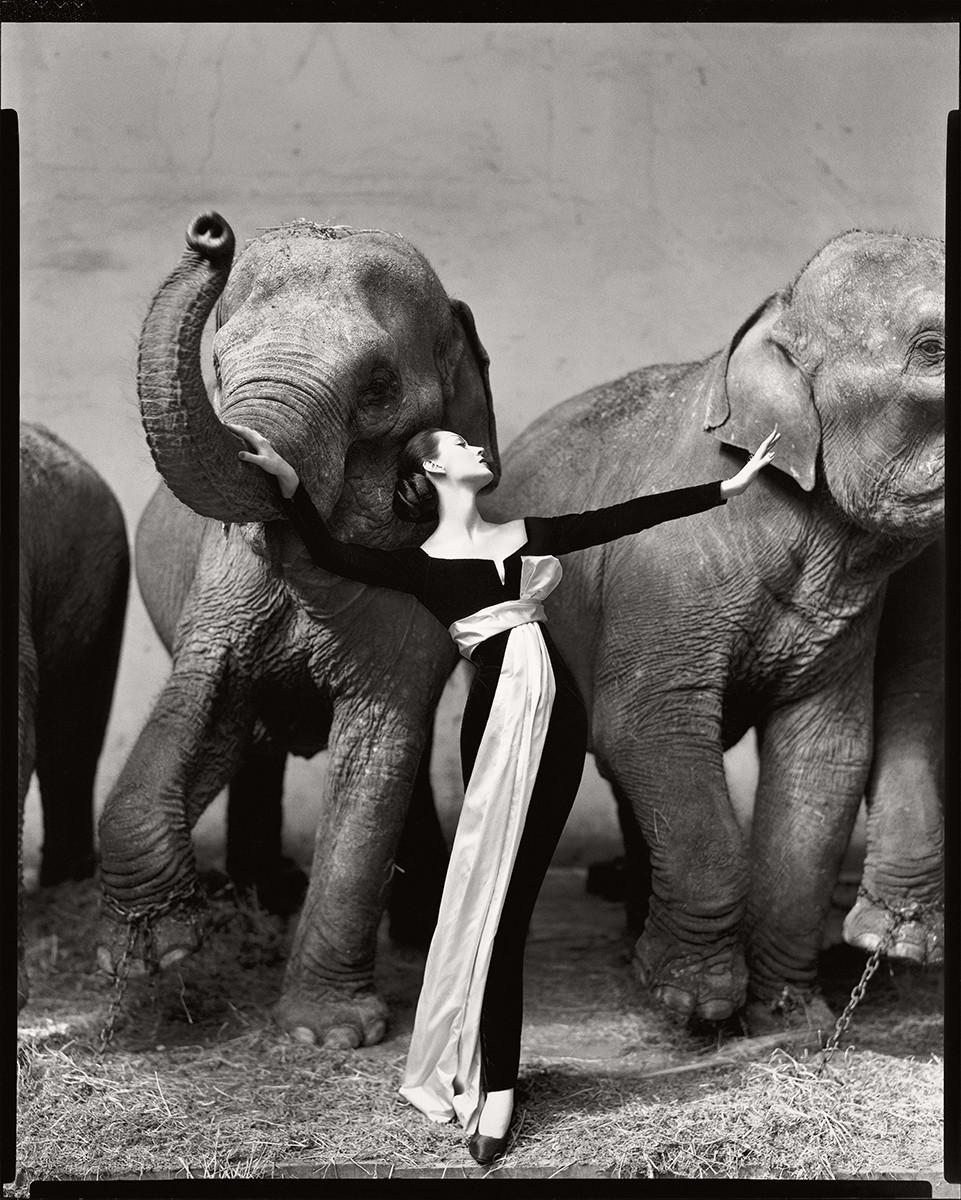
Richard Avedon, Dovima with Elephants, Evening Dress by Dior, Cirque d’Hiver, Paris, August 1955
[Matthew Rolston]
Oh, yeah, that one. Okay.
[Sandro Miller]
[laughs]
[Matthew Rolston]
I think we’ve covered that pretty well, so let’s move on. New question.
“How do you prepare for a sitting? What are you looking for, and do you or the sitter decide the nature of the portrait?”
[Sandro Miller]
[screen shows Sandro’s portrait of John Malkovich as John Paul II]
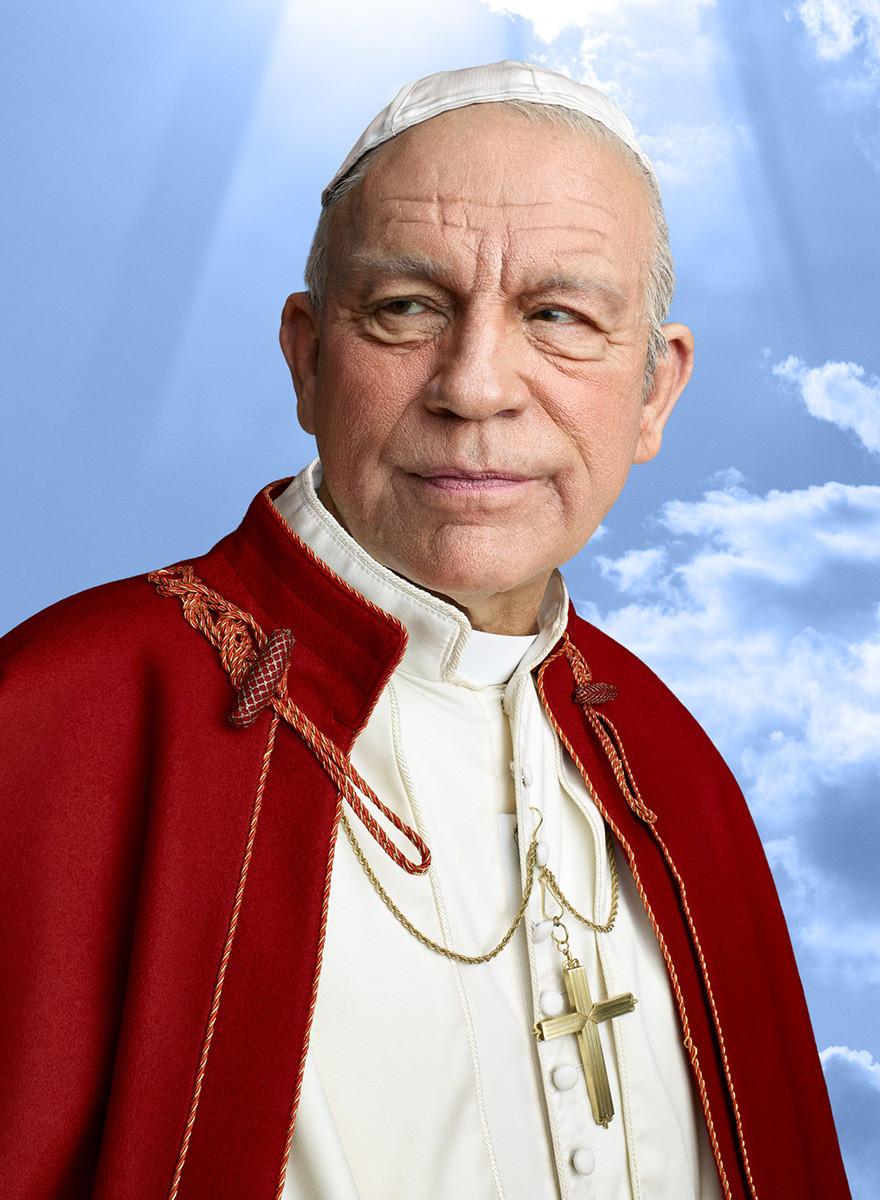
Sandro Miller, Malkovich as Pope John Paul II, Vivia Magazine, Polish Dignitaries, 2018
My portraits are not always planned out. This one here is definitely planned out. This was a project that came to me from Viva Magazine out of Poland, which is like Vanity Fair for Poland. They hired me to create John Paul with Malkovich. They had seen my series “Homage to the Photographic Masters”, and had the idea of wanting to celebrate Pope John Paul II, through this image. So what does it take to create an image like this?
Research. Research and development. A lot of time. A crew, a staff, stylist, people to find the right wardrobe for you. Hair and makeup people to give me the exact look underneath the eyes that I’m looking for that will evoke John Paul. You’ll see it’s on a background, a very heavenly background that my team created.
[screen shows Sandro’s portrait of Willem Dafoe]

Sandro Miller, Willem Dafoe, New York Magazine, 2018
Okay, Willem Dafoe. I was called by New York Magazine on a Thursday while I was on a photo shoot in LA, and they said they needed to have Willem Dafoe photographed that Saturday. And I’m in the middle of a job, and Dafoe has been one of the people that I’ve always wanted to photograph. This was an editorial for Gucci. It was for New York Magazine. I couldn’t say no! I finished my photo shoot on a Friday, jumped on the redeye, and got there on a Saturday.
Now, this is where you have a producer put together an equipment list, finding you a location to shoot, and this is all happening, like, right now. You know, very, very quickly. You walk into a situation like this; I don’t have any time to do any research or development. I don’t have any time to really work and super refine my light. But because of my experience, I can pull something like this off. I was given 30 minutes with Dafoe, and in that 30 minutes, we had four different Gucci wardrobe pieces that we needed to photograph him in. So this is all instinct. This is just something that we’ve learned, and we know how to, in seconds, create what we need to create. Something that’s gonna be powerful.
Again, there is zero room for not performing and not getting excellence. I mean, you have to produce. So you’re under a tremendous amount of pressure, and you don’t think about this stuff so much. It just happens.
The sitter, with me, never gets involved with what I’m going to do, or my idea, or how I’m going to shoot them. Never. I did have one, one moment in my life. It was Cindy Crawford, and Cindy Crawford walked into the studio. I had this one big, huge, 10 by 10 beautiful silk set up. It was the most gorgeous, soft light created.
But Cindy said, “Sandro, you are not gonna photograph me with that single light source.” She was so afraid of her mole, that it would have a little shadow coming off of her mole. So she made me put two more lights up in the oddest places. I had never used a light like this before. But normally, I don’t care who it is. You know, I’ve got the idea. I know what I want. We don’t discuss the shoot, usually, with the sitter.
[screen shows Sandro’s portrait of David Lynch]
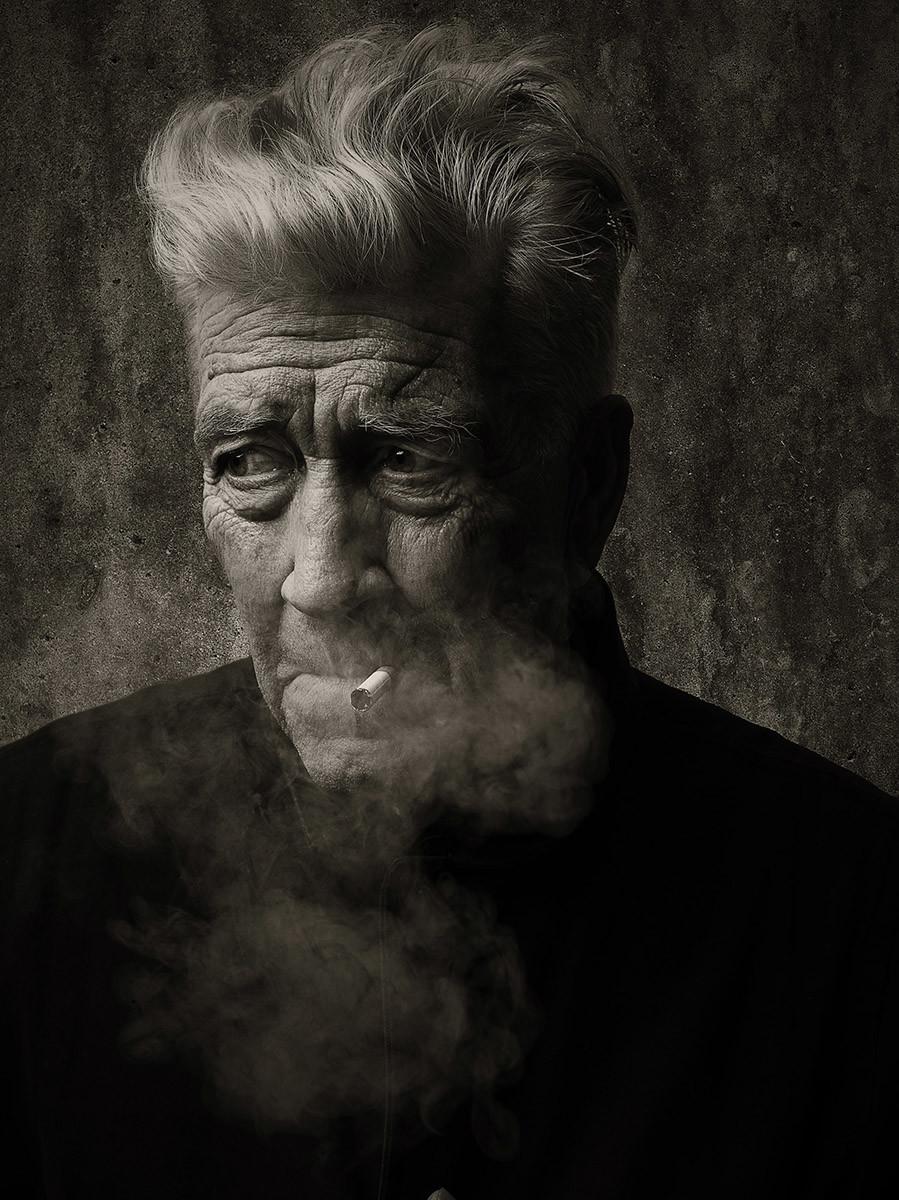
Sandro Miller, David Lynch 2016
And then there’s when you are given just very, very little time. I walk in there, my subject is a piece of white canvas to me. I’ve got this white canvas, and I’m going to create something that’s going to be interesting. Something that’s going to move my viewers. I let the flow happen, and things… magic happens. I don’t over-plan these kinds of shoots. I’ll think about what I’d like to capture, but I don’t know what I’m gonna walk into when I walk into David Lynch’s house. I don’t know where he’s going to put me, what my backgrounds are going to be. So you have to be open-minded and ‘let the paintbrush flow’. So you just let it happen.
What about you, Matthew, how do you prepare? What are you looking for?
[Matthew Rolston]
I have a very different approach. Of course, it is diverse in terms of the subject matter. But why don’t we talk about what a portrait is, first of all? The definition of a portrait, to me – it’s very simple – is a photograph of another person who is complicit in that process. It’s not a reportage. They’re there, they’re sitting, they’re posing. They are participating, and they’re putting on a performance on some level.
[Sandro Miller]
Absolutely.
[Matthew Rolston]
And I certainly see the actors in your portraits we just showed putting on wonderful portraits of attitude. Oh my gosh, the gaze from Dafoe’s face is powerful. Could cut through glass.
But back to the question – how do I prepare…
[screen shows Matthew’s portrait, Madonna as Marlene]

Matthew Rolston, Madonna as Marlene, Los Angeles, 1986
From the series Hollywood Royale: Out of the School of Los Angeles
This portrait of Madonna has a lot of ‘Easter eggs’ and commentary woven into it. Before I deconstruct it for you, I will say that this is not ‘backstage’. This is a set of backstage on my stage. And it was very carefully prepared. I will usually, for a big sitting, have maybe six or eight different scenarios that I have storyboarded, sketched, had prepared, sets, costumes, et cetera. And when that person arrives, Madonna or whoever it might be, I will sit with them and take them through all the ideas that I have. And some of them, they’ll like. Some of them, they won’t like. It depends on what that person’s ability to absorb is. It will be collaborative.
Sometimes, they don’t like anything and I throw it all away and just ‘let the paintbrush flow’, to use your expression.
But in this case, I wanted to make a comment about Madonna and old Hollywood. And it’s hard for us all to remember, but she was referred to at that time as “the queen of reinvention”. Every one of her singles, every one of her single covers, every one of her albums, every one of her videos was a new Madonna. A new hairstyle, a new pose, a new whatever. So at this point, she had never been imaged as old Hollywood. She’d never cross-dressed. My image is filled with references to Marlene Dietrich. I’d been haunting old bookstores and watching old movies, I mean, in my childhood, growing up obsessed with Hollywood.
By the way, back then there was no Blockbuster. There was certainly no internet. I would have to find repertory theaters in my neighborhood and cut class to go see Grand Hotel, or circle a listing in TV Guide at 3:00 AM and set my alarm clock to wake up and see those old films.
But I knew Dietrich’s film Morocco. And I remembered a scene in it, and I had a still from it that I bought from Larry Edmund’s Bookstore on Hollywood Boulevard. That place is still there, by the way. Back then, they had a bin of old stills that were like 10 cents each, and I’ll show you the picture right now.
[screen shows historic production still of Adolphe Menjou and Dietrich in character from Morocco]

Production still of Adolphe Menjou and Marlene Dietrich for the film Morocco, 1930
The inscription on the mirror, “I changed my mind. Good luck.” What does that mean? Well, in the film, she leaves Adolphe Menjou, the guy with all the money, and runs off into the desert to chase Gary Cooper. Not a bad choice!
[Audience]
[laughs]
[Matthew Rolston]
But this production still itself is a ‘set-up’. This is not an actual scene in the movie. In the movie, she writes, scrawls, in lipstick on the mirror… she’s supposed to meet Menjou after her show and go off with him. “I changed my mind. Good luck.”
But I think what I was saying, if we go back to Madonna, is, “You think you know me? Not so much. Here’s a new me.” And it’s significant that this is five years before Madonna’s “Vogue” video. So this was Madonna’s education, I think, the first education, into old Hollywood imagery, which led to David Fincher’s music video quite a few years later. So, I can claim to be the guy that gave her the idea of old Hollywood.
[screen again shows Matthew’s portrait, Madonna as Marlene]
Matthew Rolston, Madonna as Marlene, Los Angeles, 1986
From the series Hollywood Royale: Out of the School of Los Angeles
If you look in the background, there is a partially obscured ‘no smoking’ sign reflected in the mirror, but Madonna’s holding a lit cigarette in her hand – because she’s the rule breaker. This was shot with an 8 x 10 camera. In her cigarette, if you saw the print (the print of this is quite large), you can make out the cigarette brand. It’s perfectly turned to the lens, and it’s a Lucky Strike. One of her biggest hits at that moment and the reason for making this picture was the song “Lucky Star”. So there’s a lot of Easter eggs built into this little picture, and that’s a little bit of deconstruction.
I’ll show you one more thing about cigarettes. The glamour of cigarettes and the glamour of spotlights.
[screen shows Don English’s publicity still of Marlene Dietrich for Shanghai Express]

Don English, publicity photo of Marlene Dietrich for the film Shanghai Express, 1932
This is a Don English photograph made at Paramount. It was really set up by the director Josef von Sternberg for his movie, Shanghai Express, where Dietrich says the immortal line, “It took more than one man to change my name to Shanghai Lily.”
[Sandro Miller]
[laughs]
[Matthew Rolston]
I’ve said that myself, but that’s another story.
[Audience]
[laughs]
[Matthew Rolston]
But this image is in fact a ‘diagram’ of the Hollywood glamour of the ’30s. That spotlight, that ‘butterfly’ shadow, it’s called, under the nose, is actually referred to as ‘Paramount lighting’. This was an innovation by the director, Josef von Sternberg, and I think this is what Hurrell picked up on. Because the glamour photography of the ’20s, the silent era, did not have deep blacks, did not have cheekbones and inky, unfilled shadows.
[screen shows Ruth Harriet Louise’s double portrait of Greta Garbo & John Gilbert]
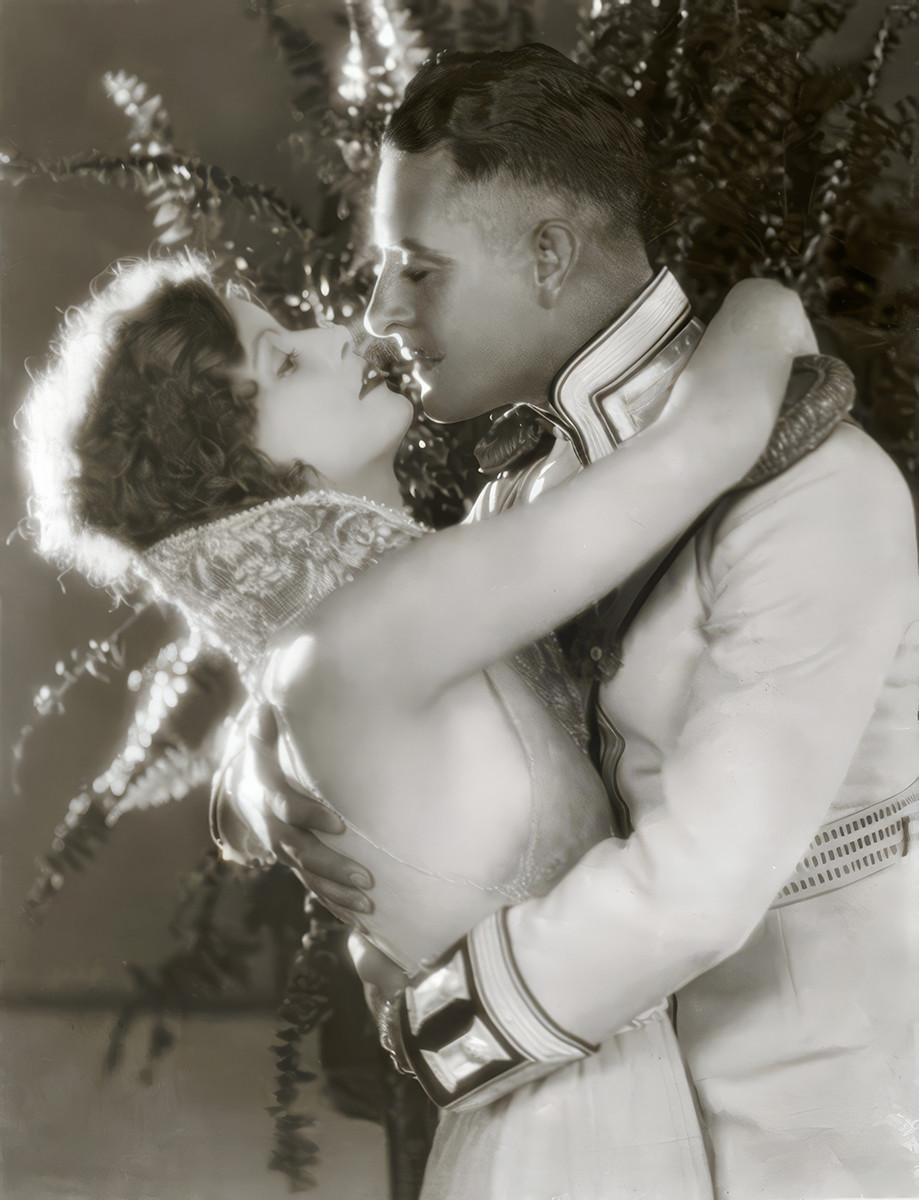
Ruth Harriet Louise, double portrait of Greta Garbo and John Gilbert, 1927
Ruth Harriet Louise, who was the MGM photographer before Hurrell, in the ’20s, the silent era, it was all, if you can remember, it was a pearly look with a kind of a nimbus of light behind the head – that frizzy hair with the glow around. No obvious shadows on the face at all.
The so-called ‘Paramount lighting’ was a major shift, and it came from the spotlights in the Berlin cabarets of Weimar, Germany. That’s where Marlene Dietrich was discovered by Josef von Sternberg. He brought her back to Hollywood and signed her to a contract. So this Paramount look, this new kind of photographic glamour in the ‘30s is all really inspired by pre-Nazi Germany entertainment in the cabarets. Paramount was the ‘artistic’ studio. MGM was the ‘commercial’ studio. And George Hurrell, MGM’s lead photographer, I guarantee was influenced by this moment. And so was I… many, many, many years later.
[Sandro Miller]
Beautiful. Beautiful. Thank you, Matthew.
[Matthew Rolston]
Next question, Sandro.
“Is there a photographic subject or moment that you still think about, decades later?”
[Sandro Miller]
Absolutely. There is a photograph that, for me, much like the automobile when I was six – this image that I made of Muhammad Ali in 2002.
[screen shows Sandro’s portrait of Muhammad Ali]
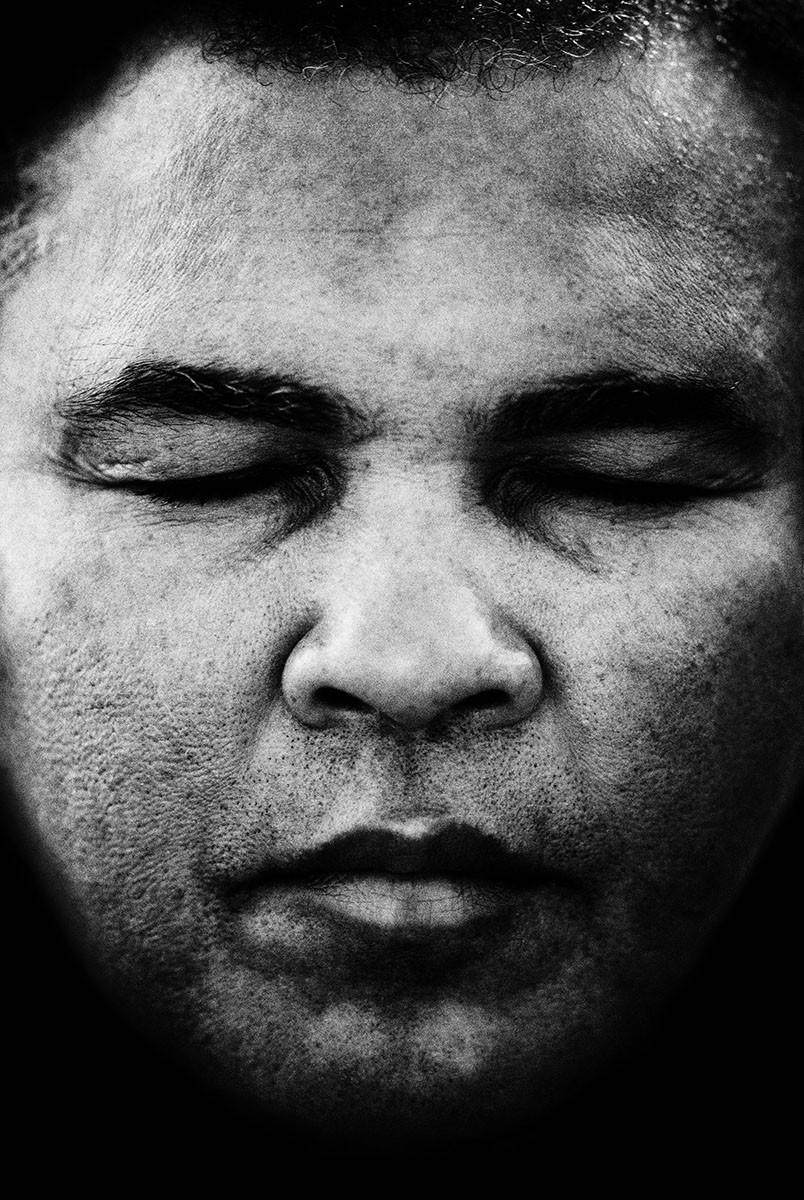
Sandro Miller, Ali at Rest, 2002
Now, I could have really been crowned the one-minute photographer or the two-minute photographer. I can’t tell you how often I’ve walked into a photo shoot and been told, “You’ve got two minutes.” So often when you’re shooting superstars, especially athletes, that’s what they’re gonna give you. CEOs are the same with time. “Don’t talk to him. He’s gotta be outta there in one minute.” And it happens to me all the time. I’m kind of the king of the one-minute photo shoot.
For Muhammad Ali, I basically had two minutes. We were at an event, and I was given the opportunity to photograph him. There were like 400 people at this event who all seemed to have eyes on me while I’m shooting Ali. I had spent a lot of time prepping my light in order to get exactly what I wanted out of Ali. I knew I was only gonna get probably a minute or two with him. I sat him down on the chair, put my 80 millimeter Hasselblad right in his face, and captured this portrait.
Within a minute, I was done. I walked up to Ali. And he was sitting down, I’m standing up, it’s the only time I was taller than Ali, [audience laughs] and I said, “Mr. Ali, I just want to thank you. I love you, I’ve watched all of your fights, but you have impressed me more with what you’ve done outside of the ring for our country, and for the people of this country, than what you did in the ring. Thank you.”
I got up, I turned around. I was walking away, and all of a sudden, this gigantic hand on my shoulder turns me around. It’s Ali. He puts both of his hands on my face, looks at me, and he thanks me for what I just said. And he kisses me.
And I started to cry. So this is an image, Matthew, that I’ll never forget taking. It was of my hero. Ali, to this day, Ali is still my hero, and I got to spend two minutes with him.
[Matthew Rolston]
[interrupting] How was it? How was it being photographed by Matthew Rolston? “It was horrible, but at least it was over with quickly!” Sometimes you do have to be fast, that’s true.
[Audience]
[laughs]
[Sandro Miller]
Matthew, tell me about a subject or a moment in your photographic life that has stayed with you.
[screen shows Matthew’s Michael Jackson, King]
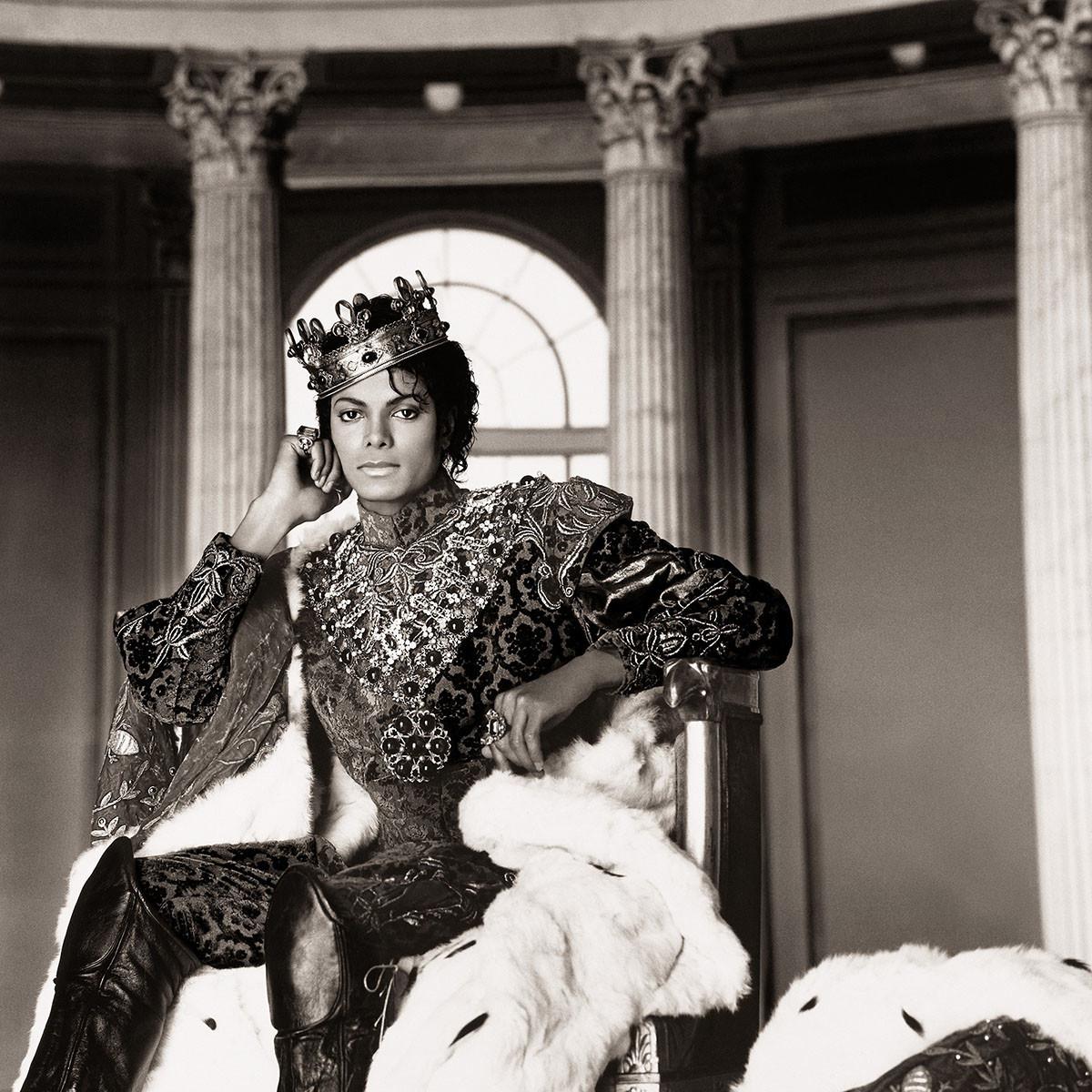
Matthew Rolston, Michael Jackson, King, Los Angeles, 1985
From the series Hollywood Royale: Out of the School of Los Angeles
[Matthew Rolston]
Michael Jackson as a king. Michael Jackson called me up and said, “I want you to photograph me as a king.” No explanation. For a magazine. This was for Interview, for Andy Warhol. I didn’t know it then, but Michael was already beginning the process of naming himself the ‘king of pop’. It wasn’t until six years later that Elizabeth Taylor introduced him at the Soul Train Awards as the ‘king of pop’, and I know for a fact that he asked her to say those words. He put those words in his best friend Elizabeth Taylor’s mouth. So this portrait was an early part of Michael’s own legend building.
But the reason it stays with me is… I photographed Michael a great deal in the beginning of my career. We were about the same age… and then there was a long period in which we did not see each other. We all know the tragic history of his life and the twist and turns that it took. I was the last photographer to photograph him formally. I am actually the person that did the last sitting of Michael Jackson. After my photographs, he was photographed by the paparazzi, and in newsreels and stuff, but he never sat again.
I think the reason it sticks in my mind is what I would call the tragedy of being famous. It’s toxic. We know this. We hold people up, we tear them down. People who need to be famous, they have a chip missing. There’s a Hollywood saying, “If you need to be loved by millions, you must have a problem being loved by one.”
So there’s a black hole of need that’s then reinforced by this sick, sycophantic, twisted worship that we perform as modern humans in this ritual of fame. And to me, it’s just tragic. At this time, Michael was the sweetest, most adorable, natural, just fun person, insatiable curiosity. He wanted to know the ‘why’ of everything. “Why do you put that light there? Why do you use that light? Why is there a ‘Fresnel’? What is a ‘Fresnel’? Why did you place it there?” He wanted to know everything. Really just ‘idiot savant’, I mean, kind of a genius. But again, conceptually this portrait was a part of his own legend building, even if I didn’t know it at the time.
So again, I can say, I remember the early Michael, I remember the late Michael, I mean later career Michael. And then truly the tragedy that was his life, and how tragic I now feel that ‘celebrity’, the elevation of people to celebrity status, is a social experiment and a ‘social disease’ that we all participate in. It isn’t us opposite them, we’re in it together. It’s us and them.
[Sandro Miller]
Such a beautiful image, Matthew.
[Matthew Rolston]
Thank you, Sandro. Here are some new questions.
“Is there a difference between your commercial self and your personal work self? Is there a difference which way you approach the work, and is there a difference between the way you wish your audience to receive the work that is personal rather than that which is commissioned?”
[Sandro Miller]
First of all, in my commercial work, I’m a craftsman. In my personal work, I’m a messenger.
[Matthew Rolston]
That’s a lovely distinction.
[Sandro Miller]
I’m a messenger and a teacher. I do the commercial work, much like Man Ray did, Diane Arbus, Irving Penn, Avedon. We all did the commercial work to pay for our personal work. In a way, I’m a prostitute. I do the work, I need the money so I could feed the family.
[Matthew Rolston]
Just leave the money on the dresser on your way out!
[Audience]
[laughs]
[Sandro Miller]
One of the reasons I found myself doing commercial work is because I came from a family… we lived on a government check for 10 years. It was just a little more than a $400 dollar government check.
As a young man, when I started looking through magazines, I started seeing Italian shoes. I want the Italian shoes.” This is why I began doing the commercial work. I was able to get into the commercial work to provide the funds that I needed to do the work that my heart and soul needed to do. When I’m doing commercial work, I’m doing it for somebody else. It’s somebody else’s idea; I am crafting an image for somebody else. When I’m doing my personal work, Matthew, I’m putting it all on the line. I’m putting my reputation on the line. I’m putting my heart and soul on the line.
It’s very vulnerable to put your ideas into a photograph and then show them. It can be very painful. I prep myself tremendously. I give no less to my commercial work than I give to my personal work. If somebody’s gonna come to me and pay me a good dollar for a photo session, they’re gonna get 200% of me. A client or corporation can come up to me for pro-bono or charity work that helps a cause, and they will still get 200% of me.
This is the same when it comes to my personal work. I study, I research, I test, I develop my idea and my narrative. I want my message to resonate and teach, and hopefully become historically important.
My audience for commercial and personal work are very different. My audience for commercial work is millions of people. It’s in magazines, it’s on social, it’s on billboards. Millions of people see the work: it’s designed to trigger specific emotional responses that make the message memorable and to influence people to buy things they don’t really need. It is to make somebody money. I have to succeed in making that corporation, as ugly as it seems to me sometimes, it’s my job to make that corporation or that company a lot of money. Because if I don’t, they’re not coming back to me.
My personal work, it’s a much smaller audience, but it means so much more to me. My audience sometimes at an exhibition might be 200, 250 people. It’s a much smaller audience. People may decide to pick up my book or come to my exhibition to be entertained. I feel like when I’m doing my personal work, my responsibility is to entertain, make sure that my viewer is walking away with something that has changed their day, something that made them happy to spend that time with me, or to just feel something emotional in their hearts.
[Matthew Rolston]
I would really agree with everything that you said for myself. Absolutely. I wouldn’t characterize myself necessarily as a prostitute, but on the other hand I have been known to say something to my agent like, “Okay, cut the crap. How much have they got?”
[Audience]
[laughs]
[Matthew Rolston]
But more seriously, I regard commercial clients as patrons, and it is through their patronage that I’m able to have the bandwidth, by which I mean time and money, to take on personal projects.
Who is the audience for my personal work versus my commercial work? Commercial work is the demographic of my advertiser, entertainment client, whoever wants to reach millions of people, absolutely, and I take it upon myself to be a ‘stand-in’ for that audience. When I’m standing there on the set, I am an audience member on a rarefied level. I’m getting to see the performance and shape it for the rest of the world. In contrast, the audience for my personal work is first and foremost myself. And the intent is to ask questions that I may not have answers to, through the lived experience of creating personal projects.
Secondarily, I want to share that experience with people, but that is not the primary focus. It’s very different. The primary focus of the commercial work is to share the idea with millions of people. The primary focus of the personal work is, for me, really, truly personal. But I put no less effort or time or craftsmanship into either side. Absolutely. I take it all very seriously.
How do I approach the work? Much the same, really. It’s just the questions are different. Look, art of any kind is a vessel for an idea. It’s not just a photograph, it’s a photograph that contains an idea or a set of ideas. So what are those ideas? I didn’t come to making personal work until much later in my life.
When we were young, photographing for ‘one minute,’ we’re busy. You don’t have time to reflect. You’re acting and reacting. It’s only with the passage of time that you can look back and analyze what was going on, what I was actually doing.
The new project, the mummy portraits, the dead people in Palermo are an absolute reflection on Hollywood glamour. Hollywood glamour imagery denies, completely negates death, aging and dying. And I’ve been part and parcel of that denial for decades.
I wanted to question that. And the ironic thing is that I discovered that the inhabitants of the crypt were every bit as vain as the Hollywood stars. They wanted to defeat death as well. That was a big surprise. Hence my title, Vanitas. All is vanity.
[Sandro Miller]
Matthew, I will end by saying that I’m extremely grateful for the commercial work that I’ve received, and the personal work that I have undertaken because here I am after 50 years, yourself, 50 years of shooting. We’ve been photographers. We’re doing something that we’ve loved to do. And not many people can say that for 50 years they did something that they absolutely loved to do.
[Matthew Rolston]
It’s good to be reminded of our privilege. There’s no doubt about it.
I will say that I have completely quit doing commercial work. I don’t want to do commissioned work anymore. What happened was, the more and more successful I became, the more was at stake for those clients, the more people were involved with making decisions, and the less creative it was, to the point where I just felt like an order taker. Like, “Okay, would you like fries with that? Can I super-size it for you?”
[Audience]
[laughs]
[Matthew Rolston]
So I just felt unsatisfied and hemmed in, and I’m not fabulously wealthy but I had enough money to say, “Okay, I’m just not gonna do that any more. I only have so many years left. I’m gonna use my skill and my resources to do things that I want to do.” I earned my freedom.
[Audience]
[applauds]
[Matthew Rolston]
Okay, next question:
“Is there an image, other than your own, that shifted the photographic world as a whole?”
That’s an interesting question. I think you came up with this one.
[Sandro Miller]
[screen shows Richard Drew’s The Falling Man]
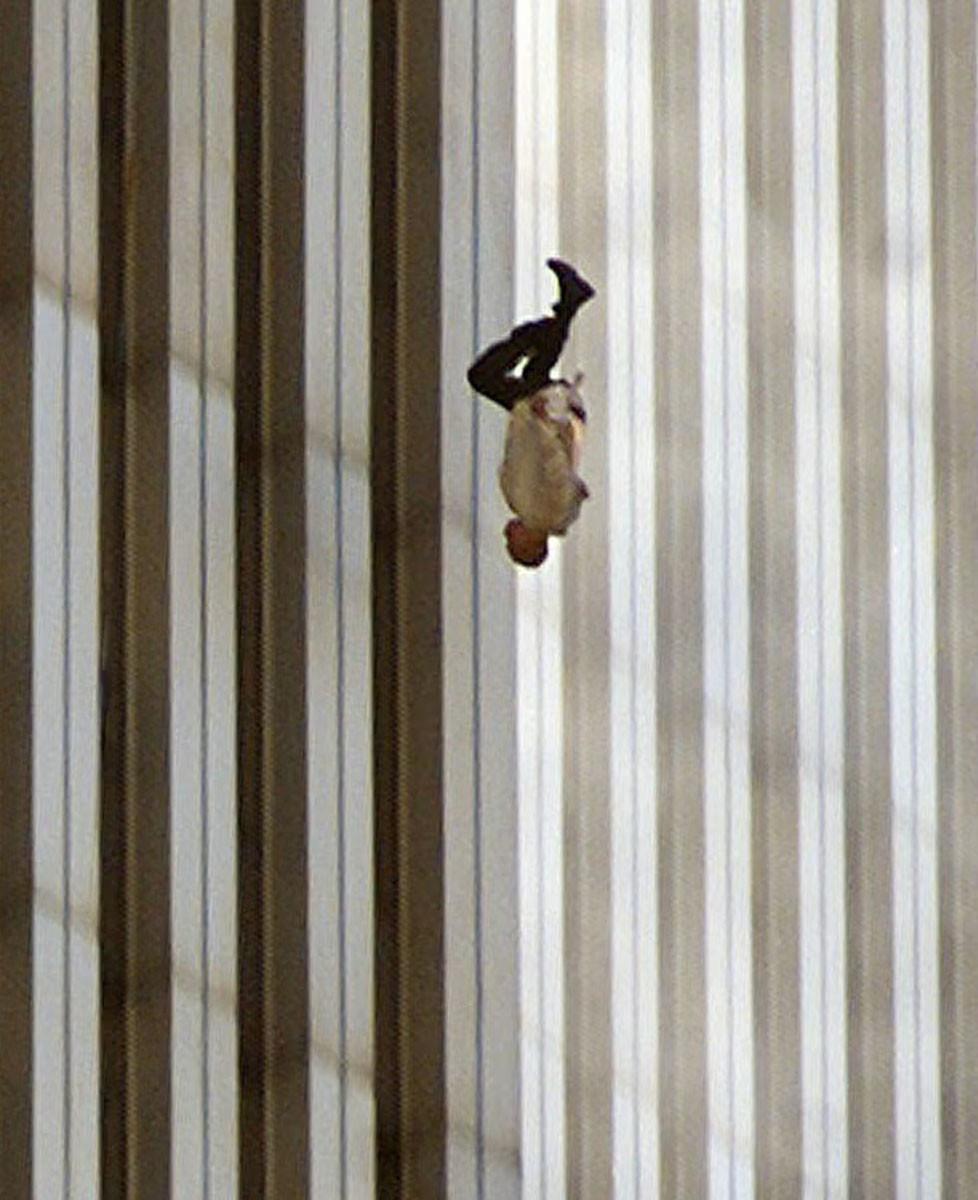
Richard Drew, The Falling Man, 2001
Matthew, for me, this image here, 2001, The Falling Man, at the collapse of the North Tower of the World Trade Center. The photographer was Richard Drew. He’s an Associated Press photojournalist. This image ran in the New York Times and in Esquire magazine. Photojournalism says we need to run these kinds of images here because we need to show what really happened. We needed to humanize this event.
My question here Matthew is this, It has been determined that the subject of this image was either Jonathan Briley or Norberto Hernandez. These names came up, This image was identified as one of those two people. My thoughts are as I look at this image and think to myself, “Is this ethical? Is it ethical to show an image of someone that’s about to die? What’s this going to do to their family members, to a child?”
Again, I go back to myself, my father’s death, the automobile and the trauma that that image created in me. What is this gonna continue to do for a lifetime to this family, the daughter, the son, the wife, the near relatives, knowing that this might be Jonathan or Norberto? And then they gave it the name The Falling Man. And what does that tell us? Was it suicide? You know, we have to ask this question.
I think this image shifted the nature of photojournalism. We went much deeper into shock. And today, you’ll see people running out of buildings, and their baby will have the arm that’s been removed or gashes and bleeding and dead. We’re showing images that are just truly gruesome. And it seems to me like the more gruesome they are, the more the public wants it. For me, this was the image that opened up that can of worms. I also believe, and I’ll talk to you later on a question coming up soon, that this might be one of the last images that we can truly believe is real.
[Matthew Rolston]
Mm-hmm, I disagree. [to the audience] Don’t believe any image at any time, ever. There is nothing in the human experience that is truly objective, let alone in photography. Not a scientific photograph, not a war photograph, not documentary, not a single thing. It’s impossible for us to be objective.
We’ve been back and forth on Zoom for quite a few days preparing this slideshow and these questions. And there are two things that struck me about this image. One, it’s extremely antiseptic as far as a vision of death. It’s immaculately clean. The second is how poised. He looks like he’s standing, posing, almost for a lifestyle or photographic magazine, but upside down. That’s such an odd contradiction given what we know is about to happen. So it has a lot of visual tension for me – conceptual tension.
Let me show you an image that I think changed the world. Ok, it didn’t change the world, it changed the photographic world. I don’t think I can address, as you have done, the whole world. But this image, which I think is a fascinating image – [to the audience] does everybody know what this image is? Anybody recognize it?
[screen shows Boris Eldgasen’s The Electrician]
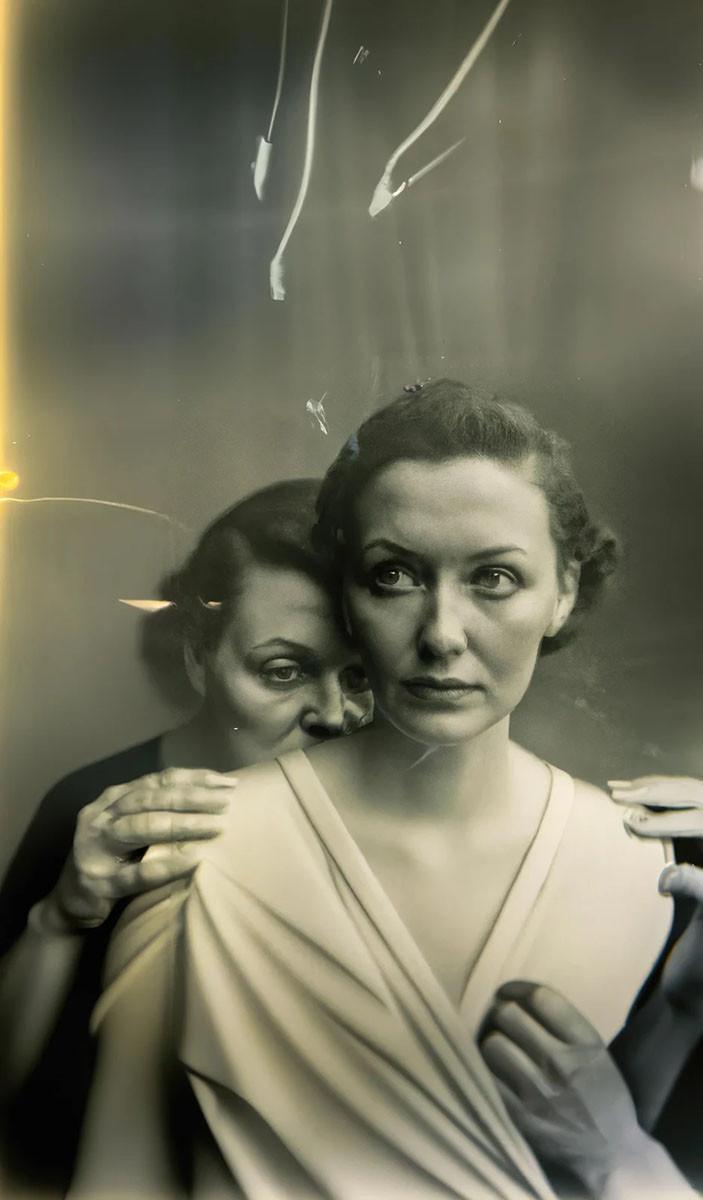
Boris Eldgasen, The Electrician, 2022
[Sandro Miller]
It’s AI. It’s one of the first AI images.
[Matthew Rolston]
Correct. This is the first important AI image. It’s from two years ago, Boris Eldgasen’s image called The Electrician. It was submitted to, and won, the Sony World Competition in the “Open Creative Category”. That’s a huge honor. Eldgasen went to the ceremony with the express purpose of refusing the award and making a statement to the world about the advent of AI.
I think this is a watershed moment. This is a moment in photo history. The image itself has echoes of Julia Margaret Cameron. It’s got echoes of Irving Penn. It’s a powerful and well-constructed image with many levels of mystery – because there’s not two people in this image. They happen to be three.
The third is indicated by the hands coming in at the bottom of the frame. It’s a very layered, fascinating, and very beautiful image. This is not people, and it is not a photograph. It is ‘lens-based art’. That’s a new classification, I think. By the way, I didn’t come up with that term. It’s something that’s out there right now. So I think this image changed the photographic world.
Let’s move on to the next question:
“Selfie culture – how has that affected the practice of a portrait photographer?”
Do you think selfie culture has had an impact on what you do?”
[Sandro Miller]
Well, first, everybody now is a photographer. Everyone wanted to be a photographer. Now everybody is a photographer. I feel like it’s cheapened photography in many ways. It’s easy to take a photograph of somebody, put a filter on it and make somebody look beautiful. Techniques that we’ve worked our whole careers on, getting these beautiful photographs. People are able to do it in a second. I find that our art directors and our creative directors want, because of the selfie culture, they want things instantly.
“I can get that on my phone right now. Why can’t I have these images right now? Why can’t we produce this right now? Why can’t we change this quickly right now?” So we’ve sped up. Everything’s been extremely sped up, cheapened and made disposable; the selfie culture has extremely cheapened our art and our craft.
[Matthew Rolston]
And throw it away just as quickly.
[Sandro Miller]
And throw it away.
[Matthew Rolston]
But the notion of memorializing yourself, that’s nothing new.
[screen shows da Vinci’s self-portrait]
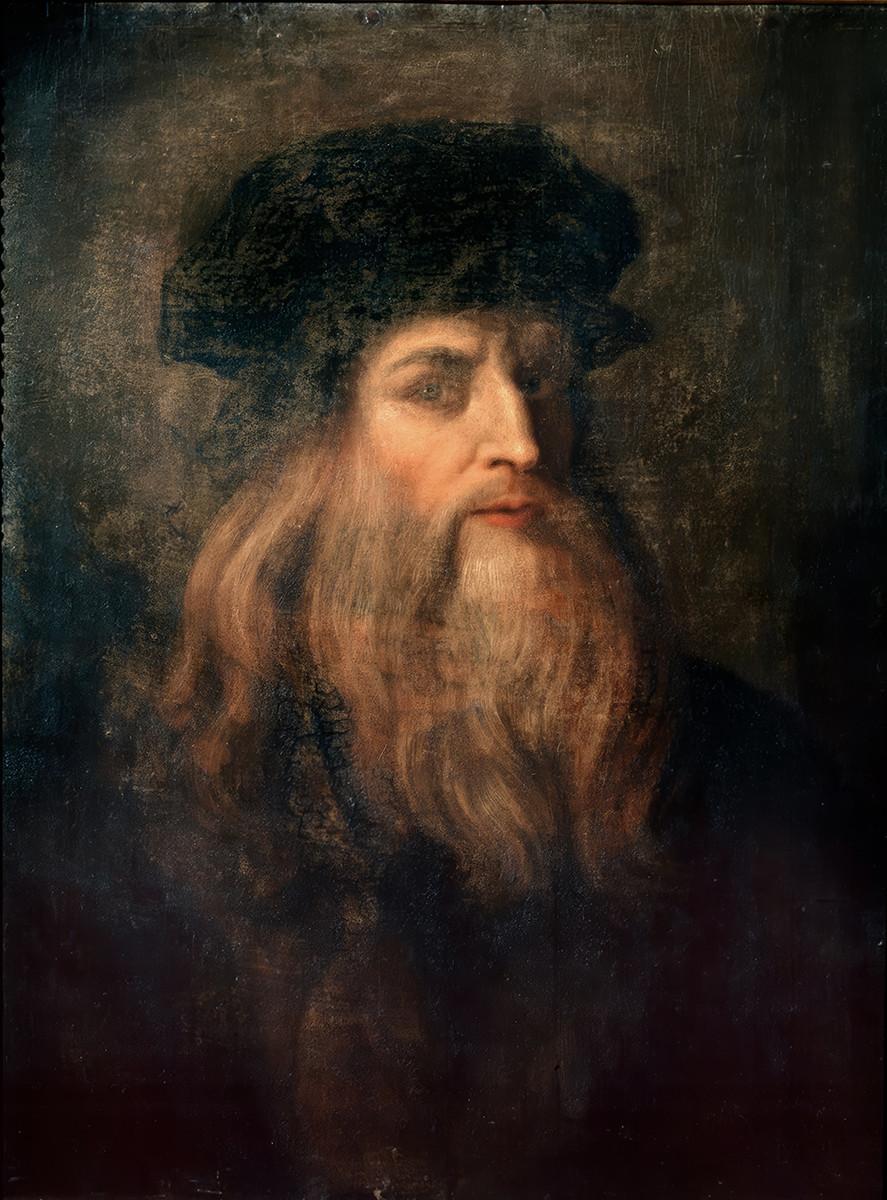
Self portrait of Leonardo da Vinci c.1505
[Sandro Miller]
You are right, Matthew. But if selfies were all this beautiful, I’d say, “Hey, let’s all take selfies.”
[Matthew Rolston]
If only we were all Leonardo da Vinci.
[Sandro Miller]
This is a ‘selfie’ of da Vinci – a self-portrait. But unfortunately, we’re bombarded with billions of images per day. Researchers estimate that about 5.3 billion photographs are taken each day, 61,400 images per second.
Then you have the Kim Kardashians, the Paris Hiltons who made the selfie a phenomenon. And I just really feel that it has completely cheapened who we are as photographers. You know, we have spent our lifetimes creating, or trying to create, something that’s very special, something that’s now being done on an Apple or a Samsung phone in seconds.
[screen shows cover of Kim Kardashian’s book, Selfish]

Selfish by Kim Kardashian, book cover.
[Matthew Rolston]
For me this is just emblematic. This is Kim Kardashian’s book for Rizzoli, Selfish – what a perfect title. It’s a collection of her selfies. The queen of selfie culture. And it asks a question for me. In my era, celebrities and editors came to me to make a comment on the nature of that celebrity – to show them in a new light, to interpret them.
Kim doesn’t need me or anybody to interpret her. She does it for herself with every bit as much mediation as I would. There is not a single image on Instagram put out by Kim Kardashian that is not retouched and staged. Not one. So talk about objectivity. There never was, and there certainly isn’t now. 30 years ago, or even 20 years ago, Rizzoli might have published one of my books, a compendium of portraits of a star. Now, stars do it for themselves. So there’s a major shift.
To be continued…