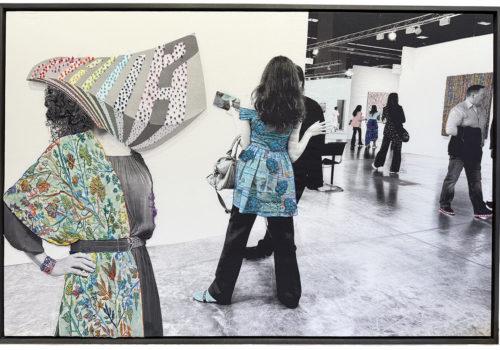
In between
‘Decontextualised portraits of African women from remote tribes in southern Angola, photographed from the back: an intentional choice dictated by the desire to depict the harsh condition of women whose dominant patriarchal culture, in their respective tribes to which they belong, forces them to suffer injustice, violence and abuse or obliges them to fight daily for their essential rights.
The women to whom I try to give a voice through my photographs live in a condition of marginalisation and exclusion that oppresses or negates any desire for freedom.
Women who are apparently trying to emancipate themselves through a creativity that is characterised by their clothing and hairstyles; the latter, in particular, are like veritable sculptures, in the form of weaving or horns, forged from mud, grasses, grease, cow dung, embellished with shells and hundreds of multicoloured beads and buttons. And yet, even in this aesthetic expression, they conform to the social, cultural and spiritual conditioning that determines and demands precise symbolic representations.
The spiritual aspect can be traced back to the animist religion which, through the forms and canons dictated by the ancestral rites of the tribe, transmits its beliefs through symbols. Since the hair is the most extreme part of the individual turned towards the sky, it is believed that communication with the Gods and the spirits of the ancestors passes through it to reach the soul: hence the importance of the hair.
The social and cultural implications of this are manifested in multifaceted characterisations: each type of female hair evokes belonging to an ethnic group; or, in the same social context, a different age, entry into adulthood with the first menstruation, or a particular civil and social status.