At LE BAL in Paris, French photographer Marie Quéau unveils Fury, a project developed over the past two years as part of the 5th edition of the LE BAL/ADAGP Award for Young Creation, of which she is the winner.
At the origin of Marie Quéau’s work, there are always notebooks. Research journals that seem barely able to contain themselves, overflowing with images: snapshots taken by the photographer during her scouting trips, and illustrations she obsessively gathers from second-hand books and magazines, especially those linked to history, art, or natural science. Assembled, glued, intertwined across the pages, they form a visual hum that accompanies her in shaping her narrative. A world constructed from fragments of reality, which she absorbs in order to craft works that hover between documentary and fiction.
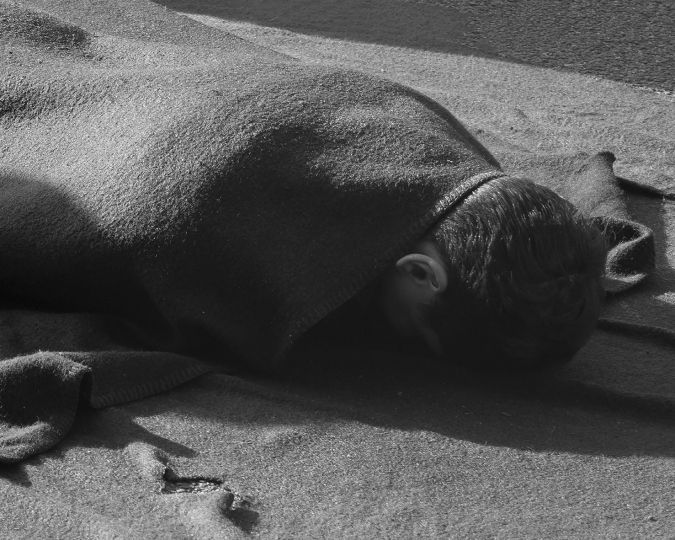
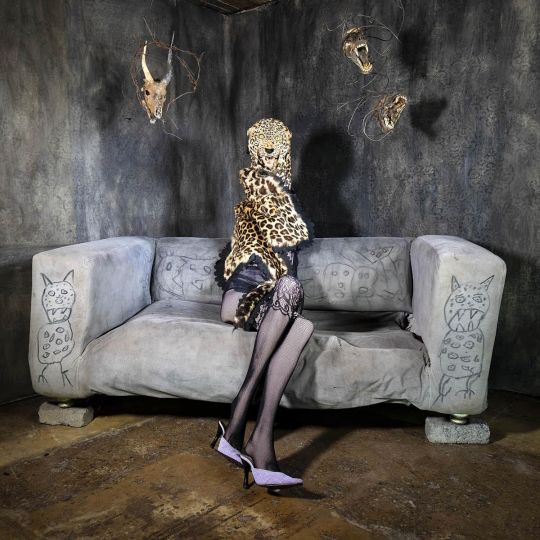
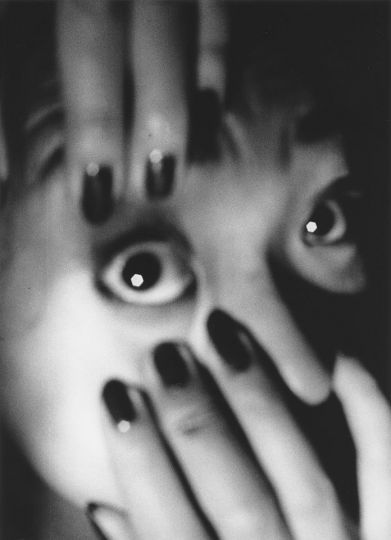
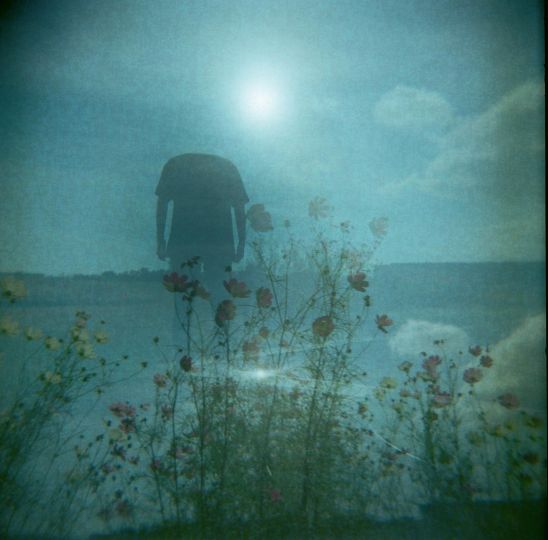
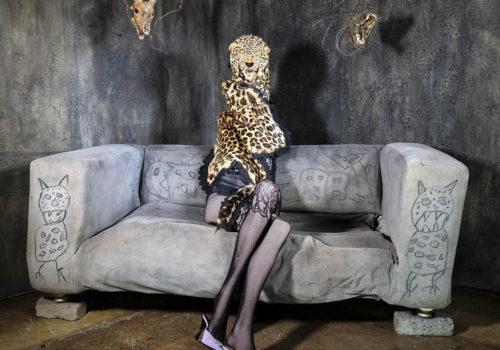
At Le Bal, the world she invites us into bears the name Fury. Like Ripley, whose ship crashes on the planet Fury-161 in the third Alien film, the visitor enters an unfamiliar realm, guided by a curiosity tinged with unease. Black-and-white prints, wallpapers, videograms, and projections form a mysterious constellation of masked faces, figures dressed in motion-capture suits, body parts coated in gel, and standing out as the only colour images flames arranged on the ground. Scattered without an apparent order and displayed in semi-darkness, these works of varied materialities form an organism of their own.
No wall labels disrupt this immersion, but a projection placed at the entrance offers a few clues. Fury also refers to “fury rooms,” spaces that anyone can rent to destroy objects in a cathartic gesture. Jittery surveillance footage from these rooms alternates with moments of weightlessness, where motionless bodies float in water, regulating their breath to the hypnotic cadence of a voice counting the minutes. Fury rooms, static apnoea, or stunt performers coated in fire-retardant gel walking through flames: Marie Quéau explores the extreme states to which the body submits itself. The body is central to her practice, a focus that originated in her assigned work for sports magazines while later shifting toward a resolutely artistic approach: “I wanted to highlight a philosophy of the body, something that touches on its limits, a fictional approach rather than a biological study of sport.”
A solarized image of a body at the edge of a window encapsulates this notion of thresholds running through her work: the tension of wavering, that moment when the body reaches its limit and only the mind remains, a refuge through which chaos, risk, and fear can be tamed. Echoing what she describes as a “state of absence from the world,” tight framings heighten this both suffocating and soothing sensation of retreat into oneself. Wandering through the twists of Fury, the visitor too seems to hold their breath. Or perhaps this is simply the experience of contemporary life itself.
Like a return to the notebooks, the exhibition is accompanied by a publication conceived with graphic designer Roger Willems from Roma Publications. The photographer’s taste for accumulation reappears here, in the shimmering effect of the paper, with the same precision with which she approaches the materiality of images. A text by historian Guillaume Blanc-Marianne offers a nuanced exploration of the “poetic enigma” that this body of work represents. For Fury is, above all, the world of Marie Quéau and that is precisely where its beauty lies.
More information