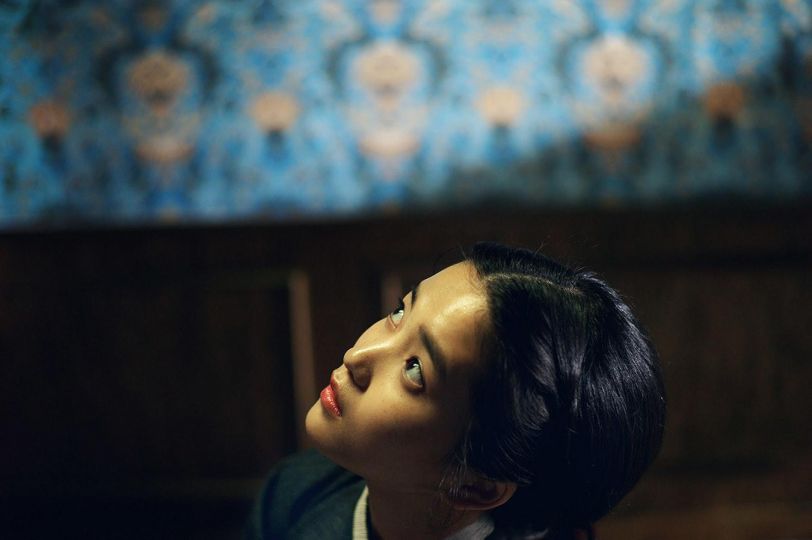
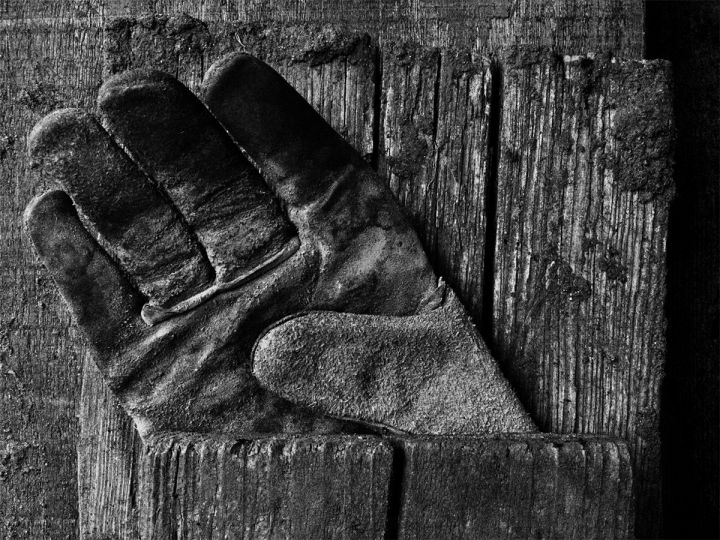
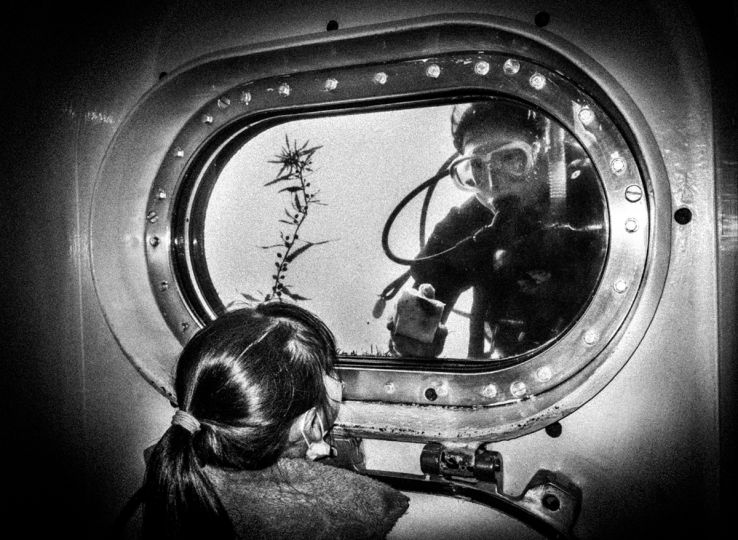
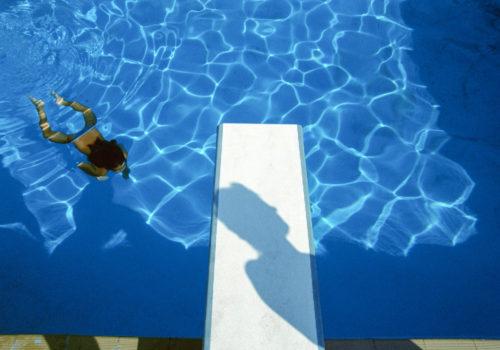
Nearly 200 yellow flags flutter through the streets of Kyoto. In black letters, the words ‘KG+’ can be seen. The Kyotographie satellite festival, launched in 2013 by Lucille Reyboz and Yusuke Nakanishi, showcases emerging photographers and curators.
It’s easy to get lost amidst the multitude of exhibitions on offer as part of Kyotographie’s satellite festival, KG+. Strolling through the former imperial capital is the best way to discover a succession of artistic surprises: round a street corner, works appear without warning.
Between politics and memory
It’s impossible to miss the Kurochiku Makura building, where the ten artists competing for the KG+ Select Award create an eclectic exhibition. Styles intersect, perspectives diverge. Among them, Wan Woafan exhibits *Yes, the River Knows*, the second chapter of his project dedicated to the rivers of Asia. Panoramas, contact sheets and rolls of film converge on the Huangpu, which flows through Shanghai. “Rather than exploring ‘memory’, I’m interested in the present and the relationship between photography and politics. I try to approach it indirectly, by observing the river’s transformations, to see if they reflect those of a city, or even an ideology,” he explains.
A few rooms further on, four openings in the white wall cast shifting sunlight onto Mila Rae Sarabhai’s textiles. On saris and silks, shapes in white ink are barely visible. “Depending on the time of day, you don’t see the same things,” she remarks. Her work is rooted in the memory of Ahmedabad, her hometown in India, marked by the struggles for independence. There, the artist gathers urban fragments and elements drawn from the collective memory to create collages, which she then transfers onto textiles or reveals on photopolymer prints. “For me, photography is like a sketchbook,” reveals the artist.
On the top floor, a mobile of geometric shapes and a fabric printed with the image of a cat forms a circus diffusing light onto photos with pop-art tones: a smartphone wedged between knees or a slice of white bread blending into the marble. Sohei Nakanishi presents Urban Paradise – neither inside nor outside, a world in between: “My focus is not on people but on the traces that remain after they have gone,” explains the artist. The city appears as a silent accumulation of gestures, the remnants of which persist “in the form of an absence”. Photography thus becomes a tool of perception, “a means of capturing these subtle shifts.”
City-wide experiments
KG+ extends far beyond this venue. Across Kyoto, an emerging scene is exploring formats and media. Above a laundrette, Yusuke Takano and the duo NAKICE present an immersive installation: a giant book to browse through, set on steel stilts and surrounded by objects, which are themselves depicted on the book’s pages. “Photography is an act of recording reality, but it is also a medium that reveals that reality is never fixed in a single form,” explains Yusuke Takano.
In a chic hotel, Yuka Takasu surprises with a profusion of installations and media: prints on fabric, engravings on aluminium and video projections. She blurs hierarchies and places “photography and waste on the same level”. Re-membering the Temporal Fragments is a “reorganisation of memory”. Each of her works is like a moving archive, traversed by the forces of nature and the human imprint. She poses an implicit question: “What has disappeared, and what is returning?”
Aoshima: Chronicle of a Disappearance
Finally, to the west of the Imperial Palace, No. 317 ANEWAL Gallery presents Katherine Longly. Her project, Cat Blues Island, takes us to Aoshima. “It all began when I came across a viral video on YouTube: one of an island populated by cats in southern Japan. Filmed by wildlife photographer Mitsuaki Iwago, it shows around fifteen residents living peacefully alongside 120 cats. It was an instant hit: from 2013 onwards, waves of tourists flocked to the island, feeding the animals, which accelerated their proliferation. “Within a few years, the cat population doubled, whilst the human population continued to decline,” says the artist. Faced with this situation, a local campaign was organised around Ms Naoko and Mr Takino. They decided to neuter the entire cat population. Intrigued by this story, Katherine Longly travelled to Aoshima for the first time in 2023 and embarked on a patient investigation. By exploring the island’s archives, photographing the landscapes and portraying the last remaining residents – now just three in number – and the cats, she has crafted a sensitive chronicle of a place where life is on the brink of extinction. Her work sketches a unique narrative, blending the challenges of overtourism, the looming spectre of death and the question of memory
KG+ is a dynamic festival, a showcase for visual stories—both big and small—told by artists who aren’t afraid to explore hybrid and alternative forms in a city steeped in tradition. There are plenty of discoveries to be made!
Marie Baranger
https://kgplus.kyotographie.jp/en/
Each exhibition has different dates; please check the KG+ website directly for details.