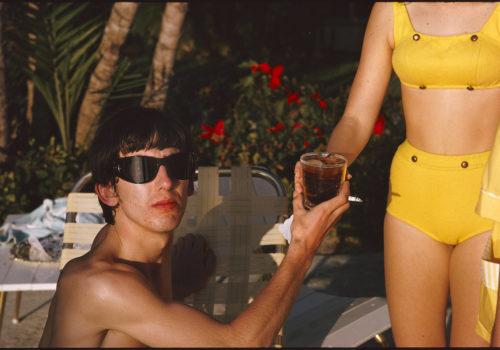
The Musée Granet in Aix-en-Provence presents, through January 3, 2027, a new exhibition devoted to the photographs of Paul McCartney (Liverpool, 1942). “Paul McCartney Photographer 1963-64 Eyes of the Storm” with more than 250 photographs taken by the musician between ’63 and ’64 offers a spontaneous look at a pivotal period, when Beatlemania spread beyond Liverpool and the United Kingdom to conquer the entire world, changing their lives forever.
Rediscovered in 2020 in the composer’s personal archives, nearly a thousand photographs offer a deeply personal record. Taken with a simple Pentax, these images capture the frenzy of touring, days of rehearsal, hotel rooms, journeys by car or train, and the ever-present media pressure. “At the time, we weren’t allowed to be lazy. You had to get the shot right, compose the image yourself within the frame, without telling yourself that, worst case, you could always crop it afterwards”, McCartney confides. Already, it is clear that he was passionate about the visual arts, through the imagery conveyed by the Nouvelle Vague, by documentary film and photojournalism; “It was after the war, things were getting better, and I was exposed to good art and good photography”.
Rosie Broadley, Chief Curator at the National Portrait Gallery in London, testifies: “Paul McCartney was personally involved in choosing the images. He also enriched the exhibition with precise and captivating memories of that period, so that, as much as possible, it is his own words that accompany the works. It was only once the prints had been made and enlarged for the exhibition that Paul McCartney discovered, for the first time, photographs he had taken more than sixty years earlier.”
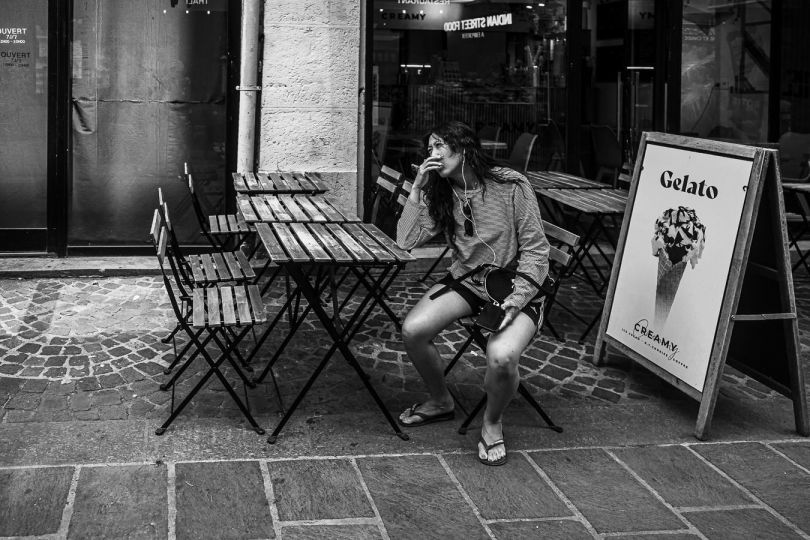
These photographs thus reveal atmospheres distinctive of the sixties, between the United Kingdom, Paris and America. Street corners outside the Olympia, where they shared the bill with Sylvie Vartan and Trini Lopez; a series of eighteen concerts was scheduled, sometimes with as many as three shows a day (!). Images snatched through a car window, blurred and improvised framing sit alongside more composed shots. McCartney, who had taken photographs since childhood with his brother and a family Kodak Brownie, captures these slices of life that speak as much to youth as to the sudden scale of fame. At the time, the way Europeans viewed America was distinctive — it was the country that had liberated Europe, and it fascinated them. Less than twenty years after the end of the Second World War, the United States also appeared, for many Europeans, as the cradle of musical and cultural modernity. “America was without question the jackpot, it was the birthplace of much, if not all, of the music we loved. I used to say: I don’t think we should go to the United States before we have a No. 1 hit”, notes one of the exhibition’s texts, which places the Beatles’ fascination with the country in its historical context. On January 15, ’64, the band received a telegram announcing that their song I Want to Hold Your Hand had just reached No. 1 in the USA.
The exhibition trail follows the band from city to city: Liverpool and London at the end of 1963, Paris, then the United States in February 1964, tracing the cultural transformation as it unfolded. The Beatles’ performance on The Ed Sullivan Show, watched at the time by some 73 million viewers, marks the moment the Fab Four achieved global stardom. More than a simple anthology of portraits, “Eyes of the Storm” captures the urgency and intensity of an era when everything changed. The famous singer himself acknowledges this: “Looking at these photos doesn’t give me so much a sense of loss as one of retrospective joy. Every picture brings back memories, and I can have fun trying to work out where a particular photo was taken, remembering what we were doing just out of frame at that moment”. The exhibition thus invites the public to rediscover, through one of its central figures standing right in the eye of the storm, the birth of Beatlemania and the first outline of a new concept of fame.
Jean-Jacques Ader
“Eyes of the Storm,” an exhibition by Paul McCartney (with Sarah Brown, for MPL Communications Ltd, and Rosie Broadley, National Portrait Gallery, London) at the Musée Granet, Aix-en-Provence, from July 4, 2026 to January 3, 2027. Part of the celebration program for the Bicentenary of Photography and the Rencontres d’Arles, “Grand Arles Express.”
Information: https://www.museegranet-aixenprovence.fr/accueil