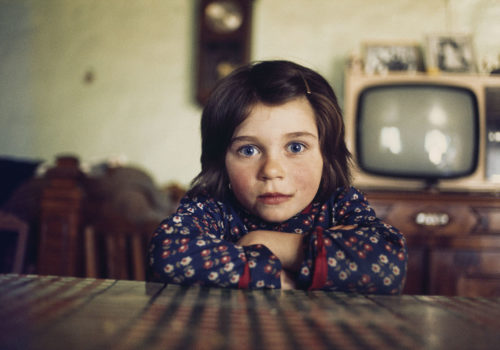
The Jeu de Paume presents Madeleine de Sinéty : Une vie.
The exhibition is the first retrospective devoted to Madeleine de Sinéty (1934–2011) – presented at the Château de Tours in 2025, then in Paris in 2026 – whose singular and still little-known photographic work, in colour and in black and white, spans four decades between France and the United States.
Born in a Loire Valley château destroyed by fire when she was fourteen, Madeleine de Sinéty began her artistic journey in Paris in the mid-1960s as a fashion illustrator for magazines. The urge to create seems to have always driven her; she could have written or painted, but it was photography that combined the greatest number of her aspirations and won out. After studying at the École des arts décoratifs in Paris, she began photographing self-taught, in colour as well as in black and white. Tentatively at first, in 1970, with images of her neighbourhood – the Gare Montparnasse area in full transformation – a few street scenes, already a few fleeting faces. Then in the streets of New York, where she travelled with her husband, Daniel Behrman, an American journalist she had met in Paris. Together, they nurtured a childhood passion for steam trains, which she photographed tirelessly. It was there that she found a different kind of closeness with her subjects: she befriended railway workers, made their portraits, shared their rest time and discovered the realities of working-class life. This proximity, a true hallmark of her work, would become even more pronounced when she decided, on a whim, to abandon her Parisian life and settle for ten years in the small village of Poilley, in Brittany. She befriended its inhabitants, helped them with their fieldwork, and gradually became part of this community, which welcomed her with curiosity and goodwill. She immediately sensed she would be there for a long time – it was where she wanted to live and create.
She photographed from the inside these twenty or so families, these farms, and those who had become her own people. The document is unique: more than 50,000 images trace the life of this village where men and women still combine their labour with that of the animals, and submit to the rhythm of the seasons.
She took this vast archive built up at Poilley with her when she followed her American husband to begin a new life in the United States – notably in the small town of Rangeley in Maine – once again photographing a community, and reinventing herself, to make a living after her husband’s death, as a wedding and events photographer.
Following the major stages of her life, the exhibition brings to light several series of photographs, largely entirely unpublished. Their common denominator is a desire to document ways of life, practices, trades, or places destined to disappear or in the process of disappearing.
In her early days in Paris, she became passionate about the old neighbourhood of Montparnasse and its artists’ studios, soon to be demolished to make way for the Tower and the new station.
It is under the title «Paris démoli» that she grouped these photographs of a Paris whose streets still bore the presence of its working classes, workers’ cafés, playing children, and whose memory she longed to preserve. At the same time, with her companion she set out to travel the stations and secondary railway lines, photographing engines and railway workers, driven by an enthusiasm for the last steam trains still in service, which embodied in her eyes a romantic dimension of travel.
In New York, it is in the Meatpacking District, the slaughterhouses south of Manhattan, that she chose to wander in the early morning, capturing small trades: animal carcasses being loaded, a hand cart laden with a merchant’s fruit, workers warming themselves around improvised fires near the railway tracks. In Poilley, a small village in Ille-et-
Vilaine, it is the rural world in full transformation whose gestures she set out to capture: the slaughter of the pig, work with the animals, the harvest. Accepted by all, she photographed in the intimacy of homes, village festivals, organising, from time to time, screenings of her images in the village hall. Finally, in Rangeley, on the other side of the Atlantic, from the 1980s onwards, it is another very close-knit rural community that she encounters and of which she becomes, over the years, the appointed photographer, immortalising rituals both private and public: weddings, graduation ceremonies, school outings.
In the early 1970s Madeleine de Sinéty wrote in the diary she kept for several decades: «Perhaps I should only do photography, not drawing? And yet I would like to be able to render life with a piece of paper and a pencil; photography is simply faster than my hands, what I see is the same and it is the same things that move me.» The body of photographic work does indeed describe a singular path and strongly anchored documentary and social concerns. The fragility of beings, of existences, of places and practices, appears as a leitmotif throughout, magnified by a poetic use of colour and light.
Her photographic attention goes towards the ordinary life of ordinary people, the invisible ones, those whose story is not told or who do not have the capacity to write it themselves: workers, peasants, women alone or dependent on social welfare… During her lifetime, few images were shown to the public: Madeleine de Sinéty photographed throughout her life in a solitary manner, without responding to commissions, without publishing in magazines, and exhibiting only twice – at the Bibliothèque nationale de France in 1996 and at the Museum of Art in Portland (Maine, United States) in 2010, in both cases only her black-and-white work.
It was not until 2020 that the GwinZegal art centre devoted an exhibition and a publication (Un village) to her, centred on a group of colour photographs donated to the Musée Niépce in Chalon-sur-Saône, initiating a discovery of the work. Today, the donation of the archive collection, comprising several hundred thousand images, to the Médiathèque de la photographie et du patrimoine is under way.
Catalogue
Madeleine de Sinéty. Une vie is the first monograph devoted to the photographer, whose work spans four decades, between France and the United States.
Epigraph by Annie Ernaux
Texts by Nancy Huston, Nina Ferreire-Gleize, Marion Grébert and Jérôme Sother Excerpts from the diary of Madeleine de Sinéty
Co-edition Jeu de Paume – Delpire French-English
Hardback, 20 × 25 cm, 248 pages Retail price: €45
Album
Through 60 images, largely unpublished, this album offers an immersion in the photographer’s work, intertwined with her remarkable life journey.
Text by Jérôme Sother Edition Jeu de Paume French-English
Paperback, 22 x 31 cm 52 pages Retail price: €12.50
Madeleine de Sinéty : Une vie
12 June – 27 September 2026
Jeu de Paume
1, place de la Concorde, Jardin des Tuileries
Paris 1er • Mo Concorde (lines 1, 8, 12)
+33 (0) 1 47 03 12 50
www.jeudepaume.org