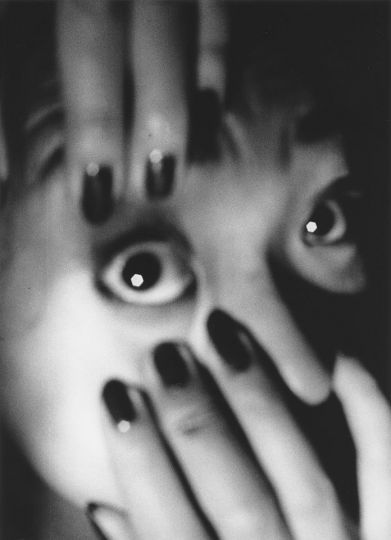
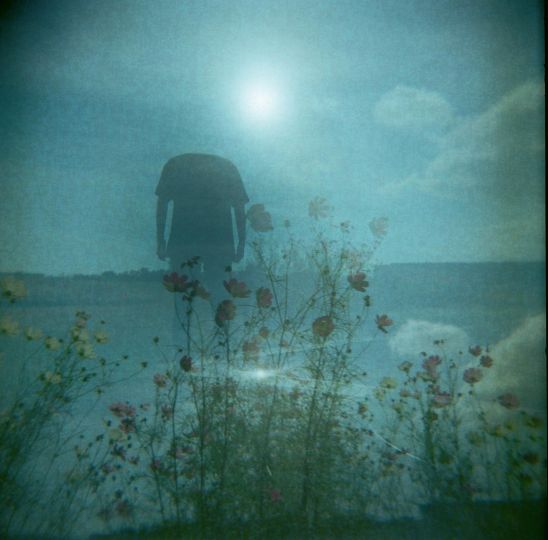
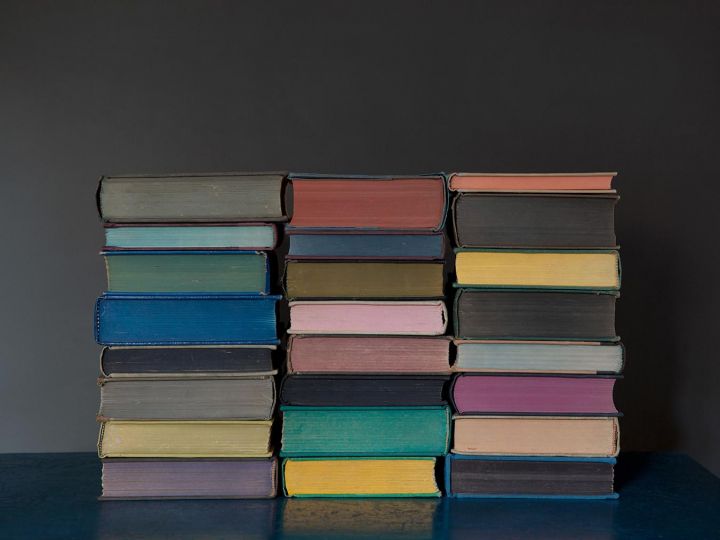
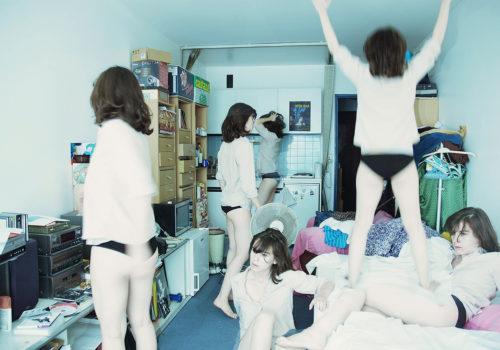
In its Projektraum, the exhibition space in Berlin’s Schöneberg district, Haus am Kleistpark presents the work of Cihan Çakmak, an artist of Kurdish origin. Photographs, drawings, moving images, and sound explore the traces that inherited stories leave within us.
A woman seen from behind. Hair wrapped in a grey-blue cloth stained brown from the dyeing in progress, an everyday gesture captured in its intimacy. Yet something holds our attention in that entirely concealed face and in the drape of this sky-colored garment. The image suspends the gaze, somewhere between the gentle and the burdened. This is precisely where Cihan Çakmak’s work begins: in what the body holds back rather than reveals.
Born in 1993 into a Kurdish family settled in Germany, Çakmak builds a body of work that refuses both documentary testimony and intimate confession. The series em fraktal provides the key to it. The title combines “em,” the Kurdish word for “we,” and “fractal”—the principle by which each part resembles the whole. Weaving together photographs, video, and sound, Çakmak photographs other Kurdish women in search of a reflection of herself and of the traces, inscribed in bodies, of wounds transmitted from one generation to the next.
The hanging in the main room says as much as the works themselves: small and large formats intermingled, framed or placed directly on the wall, drawings and photographs side by side. Amid the color, a black-and-white photograph—two women facing one another in a field—takes up this recurring motif of the turned-away face.
In this same room, the vividly colored drawings open up a parallel register and draw the eye, neither illustrative nor decorative. Executed in colored pencil through a repetitive, emphatic gesture, they have an almost tactile texture. Their subjects are fragmented or overflowing. Vegetation is more present than human figures—a large fuchsia-pink inflorescence, a white jar from which mint leaves spill, sinuous branches crossing the composition, almond-shaped leaves flanking a blue comma, between the eye and the moon.
Where I Left You and My Sister and I form two sides of the same inquiry. The video reduces the narrative to gestures and vignettes: two protagonists move through phases of turmoil and mourning while a voice, at times whispered and at times breaking, recounts autofictional experiences of war, fear, and anger. Set against this emotional abstraction, My Sister and I serves as the political counterpoint: Çakmak depicts herself with her sister in the mode of the classical portrait, yet the clothing and poses allude to the state violence inflicted on the Kurds without collapsing into illustration. The series functions like an indictment that nonetheless retains the form of a family portrait.
When we leave and not me not you extend this exploration of the body and its constraints. Nothing about the poses is accidental. Kneeling in a red swimsuit with arms wrapped like a boxer’s, crouching atop a rock facing the sea, clinging to a rocky wall, or buried face down in the sand: each image is a negotiation between the body and what is imposed upon it. The artist does not seem to seek to resolve the tensions she summons between tradition and emancipation, assimilation and redefinition. It is in this unstable space that her works take root.
Noémie de Belllaigue
Cihan Çakmak’s exhibition is on view at Haus am Kleistpark through April 12, 2026.
Haus am Kleistpark
Grunewaldstraße 6-7,
10823 Berlin
https://hausamkleistpark.de