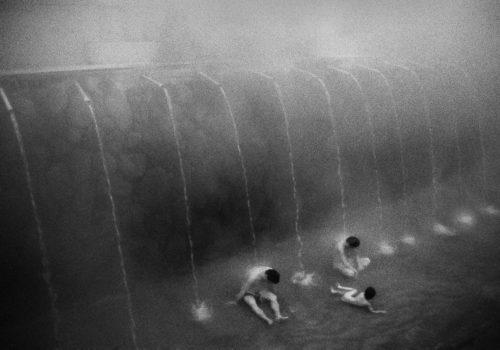
His photographic images, as he likes to present his works, are everywhere, even in the most unexpected or unusual places. If Hans Silvester is the man who has certainly sold the most photography books on our planet, he is most certainly also the one who is most involved in the exhibitions of his work.
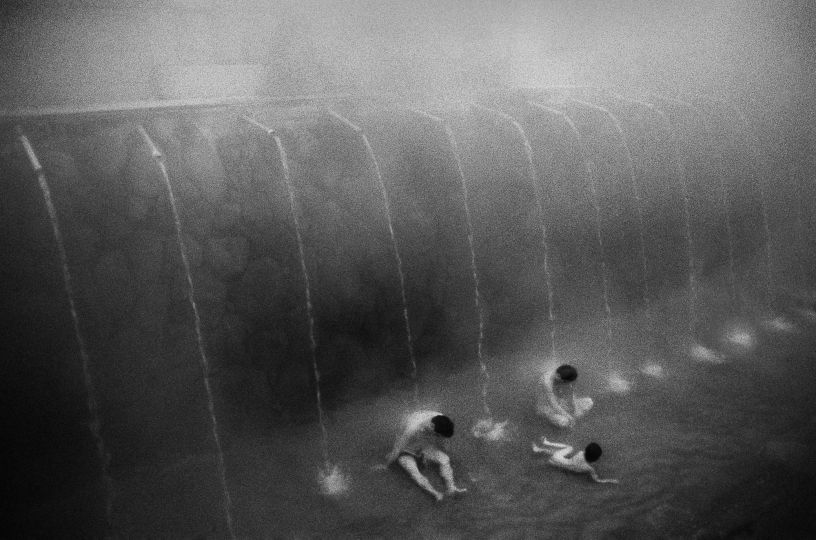
Two weeks ago, he presented, in the famous Puyricard Agar museum in Cavaillon, the latest masterful masterpiece designed by the Renard Pâle editions. Some thought it was yet another book from the Master Silvester. This is not the case, we discovered, with some creators of – all knowledge – of very high reputation also invited, a marvelous original Work of Art, produced in a limited edition of only 30 copies. Hans’s emblematic images created in 1968 in Japan, alongside eternal Haikus, all in a montage as sumptuous as it is ingenious. Before your eyes, an original photograph in a perfectly finished black shadow box. Behind this frame, unhooked from its picture rail, a very discreet trapdoor gives access to a magically bound book that opens on one side to the Japanese version and on the other side to the French version. All this seems banal and already seen! But no, because the two versions are nested on the same images, creating magical tabs. If you add the authentic seals made by Japanese masters and texts calligraphed by another great master, you plunge into the exceptional universe of instinctive poetry, without further discourse.
By all accounts, the Arlaten Museum’s pétanque exhibition, associated with the Rencontres d’Arles 2024, was the finest showcase of this vintage. In 2025, it spawned offspring when it wasn’t also traveling. This is how it ended up at the Municipal Museum of the City of Marseille. But also in Pertuis, where it was installed this summer, and again in Paris since last Friday, at the “Les Amies Rouges” bookstore.
Meanwhile, graphic constructions, fences, and wooden houses from the Omo Valley frolicked in the Nasbinals square for Phot’Aubrac. While his chickens were exhibited in the botanical gardens of Aubrac.
The extensive series of scarecrows, in various configurations, can be found in numerous outdoor spaces, from Peter Fischer’s vineyards in Jouque to the gardens of Villa Simone de Six Fours, and Rimoulès.
Japan is in Brittany, in Daoulas.
His flower children, highly appreciated at this year’s Japanese Kyotography, are installed at the Librairie Le Bleuet in Banon.
The list becomes endless with these overlaps, these mythical places, these municipal gardens or these natural spaces that Hans particularly appreciates. When you meet Hans Silvester, he is always expected somewhere, the next day, for the opening of an exhibition or the signing of a book, both built around his works.
Why and how is this possible? It’s quite simple: Hans’s photographs are good, with quality in every aspect. And they are images that tell a story, that interest, that question, and even move. So the public never tires of it and delves into this author’s diverse work, on the lookout for any new series to discover.
Good photography imposes its seduction.
Thierry Maindrault