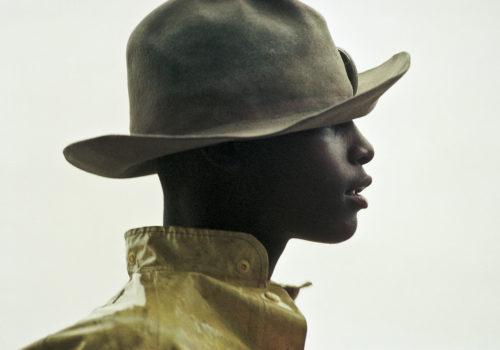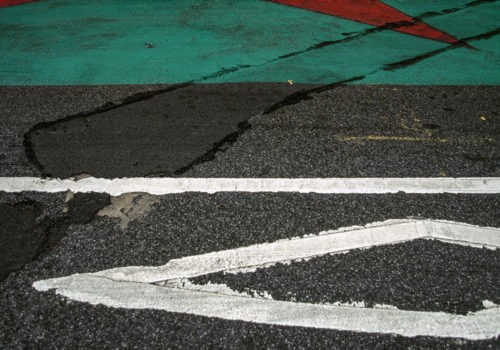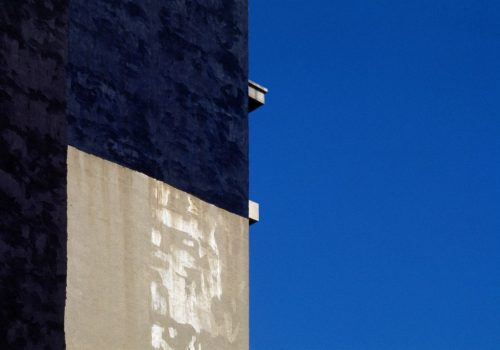
The setting is Venice and the venues are two historic buildings, which are worth a visit in their own right. These two exhibitions highlight two significant moments in the history of photography. At the Museo Fortuny, the work by Antonio Beato (as well as by Felice Beato and James Robertson), among the pioneers of travel and war photography, is on show. Meanwhile, at the Fondazione Querini Stampalia, John Baldessari, one of the most influential figures in conceptual art, is on display.
At the Museo Fortuny, you can explore the work by Antonio Beato (c. 1835–1905/1906), one of the leading figures in nineteenth-century photography. The exhibition itinerary of Antonio Beato. Ritorno a Venezia follows the Venetian photographer’s travels to the Mediterranean and the East. Antonio Beato, the brother of Felice, was one of the first European photographers to settle permanently in the Middle East.
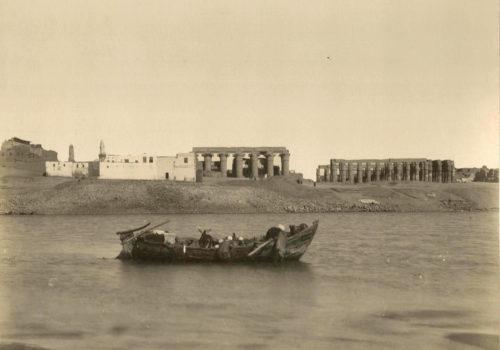
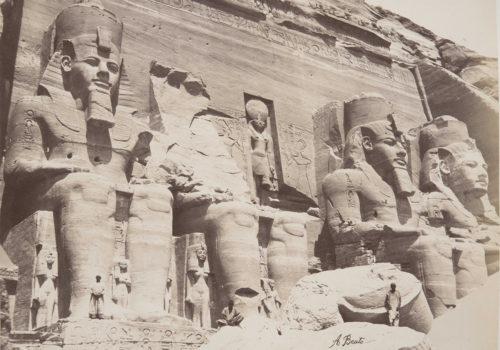
Between 1860 and 1880, he documented Egypt, capturing landscapes, architecture and archaeological sites of a world at that time almost unknown to the West. Photographic albums and prints were being acquired by the nobility and bourgeoisie of Europe, who were captivated by the Near and Far East. This was almost a prelude to documentary photography. The palace housing the exhibition was once owned by Mariano Fortuny y Madrazo, an eclectic artist devoted to painting, engraving, scenography, fashion design and creating exquisite fabrics. Fortuny, who was captivated by the charm of the Orient, also experimented with photography, and his equipment is on display in the museum.
The first section, The Mediterranean, corresponds to the Beato brothers’ formative years and is dedicated to the travels they made with their brother-in-law, James Robertson, between 1854 and 1857. They based themselves in Constantinople and travelled to Athens, Malta, Jerusalem and Cairo.
The second section, The Wars, showcases images taken by them between 1855 and 1859 in war zones such as Crimea and India. These regions were largely unknown at the time. These sometimes disturbing images bear witness to the beginnings of war reporting.
The Egyptian Years: documents Antonio Beato’s time in Egypt between 1860 and 1905. The photographs are organised by location and accompanied by drawings of the main archaeological sites. They take the viewer on a journey from Cairo up the Nile to Nubia, revealing the monuments as an intrinsic part of the surrounding landscape and cultural context. Images of Luxor, Abu Simbel, Cairo and Giza are juxtaposed with photographs taken by other 19th-century authors, such as Pascal Sébah and Félix Bonfils, and 20th-century photographers (such as Lee Miller’s Great Pyramid of Cheops, 1938.
Finally, the Dopo Beato (After Beato) section brings together works by contemporary authors documenting Cairo’s ongoing transformation. One room is dedicated to Mariano Fortuny and Henriette Nigrin’s 1938 trip to Egypt, offering glimpses of lesser-known places such as the El-Fayyum oasis, Abu Simbel and Wadi Halfa. Fortuny later reinterpreted these images in his printed fabrics and velvets.
The exhibition concludes with a video interview with photography historian Italo Zannier. A selection of original prints and reproductions from prestigious international institutions is on show. The prints have been reproduced using techniques and media consistent with the originals, ranging from salted paper to albumen prints.
Curated by João Magalhães Rocha and Marco Ferrari, with Cristina Da Roit, and organised in collaboration with Università IUAV di Venice and the Università di Évora, with the patronage of the Portuguese Embassy in Italy, the exhibition is accompanied by a catalogue published by b-r-u-n-o.it.
Just a few calli and canals away, the Querini Stampalia Foundation welcomes visitors. The former historic residence of Count Giovanni Querini, it is the second museum on this Venetian exhibition trail and is currently hosting the retrospective John Baldessari. No Stone Unturned – Conceptual Photography.
John Baldessari (1931–2020) was one of the most influential figures in conceptual art. His work, which spanned more than seventy years, redefined the concept of art. Drawing inspiration from everyday life and visual culture, he explored the tension between image and language, and between object and meaning, through his use of various media, including painting, sculpture, drawing, video and photography. The retrospective focuses on a key period in the late 1960s when Baldessari began to use photography as the centrepiece of his conceptual practice. Baldessari’s subjects were the objects that surrounded him in Los Angeles, in his studio, and during his teaching work. However, he was able to achieve very complex things with them, playing on the estrangement and continuous search for meaning by observers.
In his 1969 series Commissioned Paintings, Baldessari photographed a finger pointing at ordinary objects. He then commissioned a hyperrealist painter to reproduce the image and a sign painter to add a caption featuring the painter’s name. In this way, he complicated the concept of authorship and reflected on the capacity of the painting to determine what deserves to be looked at.
After the Cremation Project (1970), in which he set fire to many of his canvases (a project documented almost exclusively through photographs), Baldessari experimented with various ways of using photography in many series during the 1970s and 1980s.
In Police Drawing (1971), he explored the use of photography as circumstantial evidence, while other works from the early 1970s include videos, such as Teaching a Plant the Alphabet (1972), which present absurd situations; and photographic series in which images, arranged in grids or other visual patterns, explore the relationship between photography and cinema.
In the Kissing Series, he highlighted the significance of spaces between things, and in the Embed Series, he explored the concept of the subliminal image by inserting words and images into each photograph.
Blasted Allegories consists of photographs of a television screen with superimposed words. They were taken with a timer to remove the artist’s “hand”. Using arrows and other symbols, Baldessari combined the images into complex sequences that expose our need to find meaning in what we see.
The exhibition is accompanied by a catalogue, curated by Cristiana Collu and published by Allemandi.
Postscript: Among the artworks and atmospheres of the house museum, don’t miss Giovanni Bellini’s Renaissance masterpiece, Presentation of Jesus in the Temple (c. 1475), displayed in an installation that emphasises its value.
ANTONIO BEATO. Ritorno a Venezia. Fotografie tra viaggio, architettura e paesaggio
From October 15, 2025, to January 12, 2026
Museo Fortuny
San Marco 3958, Fondamenta Narisi, 3958
30124 Venezia
Italy
https://fortuny.visitmuve.it/en/
https://fortuny.visitmuve.it/fr/
JOHN BALDESSARI. No Stone Unturned – Conceptual Photography
From May 5 to November 23, 2025
Fondazione Querini Stampalia
Santa Maria Formosa, Castello 5252
30122 Venezia
Italy
https://www.querinistampalia.org/en/