Photographers Félix Cholet and Olga du Saillant publish their first joint book, Fallen from the Sky, with Équator Editions.
The story could begin like this: a character lands somewhere and starts wandering through that somewhere.
But the character is in fact made up of two photographers, very different yet so complementary that, in the end, it would be impossible to say who took which picture. This doubled gaze becomes larger. Strictly speaking there isn’t really a story. They choose poetry instead whispered from the cracks, carried by the wind and the foam.
One could keep subtracting, to reach the same bareness that emerges in this body of photographs. Subtract, first of all, the superfluous: intentions, transposable narratives. This is not a journey, nor a drifting, nor an escape, but a bare presence, with no imposed direction. The landscape is not thought-out, it is not a question or a memory; it simply is. This is not about collecting debris, not an archaeology, but the timelessness of a minimal fiction.
Nor is this a search for what cannot be found. There is no quest, only a sharp attentiveness. No hurry since duration is everywhere, and there is nowhere to go. There is no edge to reach, no limit, no meeting point or arrival. It is a great walk through suspended vastness. The gaze offers itself and the world springs out of nothingness, while at the same time what is already-there shapes a new gaze, in an endless loop. It is an exchange between what is seen and the one who sees, silent yet full of presence.
This place has no name, no defined boundaries, but it calls out to be traversed.. It is an imaginary place where the weather is always beautiful. This is not the postcard of a place it is about aesthetics. Perhaps it is an island. It is uncharted, appearing on no map. It exists only through these images. As if by magic, this island exists, born from the process of photographic sedimentation.
Particles in suspension settle, and the deposit forms the image? Yes, one must imagine a photograph formed by the accumulation of elements from disintegration, from the dissolution of rocks, carried and deposited by waters, by winds. This omnipresent white noise is the sound of waters, winds in motion, while the concrete material of the photograph constitutes the rest of this given territory. Are these geoglyphs, or the imprint of trembling twigs, an aerial view or a microscopic one?
Sand made from all those particles of shell, rock, glass, plastic, magma, oxides is a matter in perpetual recomposition. It shapes itself into circles, mounds, folds into damp drapery, becomes a reclining woman, the back of a massive beast—and functions like language. At times the image is so dry and stratified that it feels as though one could detach fragments and crumble them, or scatter the fine surface dust by blowing, or alter the drawing by adding the movement of one’s own hand. At times the image is fed with water, and begins to glisten.
One might believe it changes its state according to atmospheric conditions. Something has fallen from the sky, without breaking, descending softly, because if time is silence then nothing sudden can occur. It could be the character arriving as if parachuted onto the island, or it could be a rain of signs covering everything like fine ash.
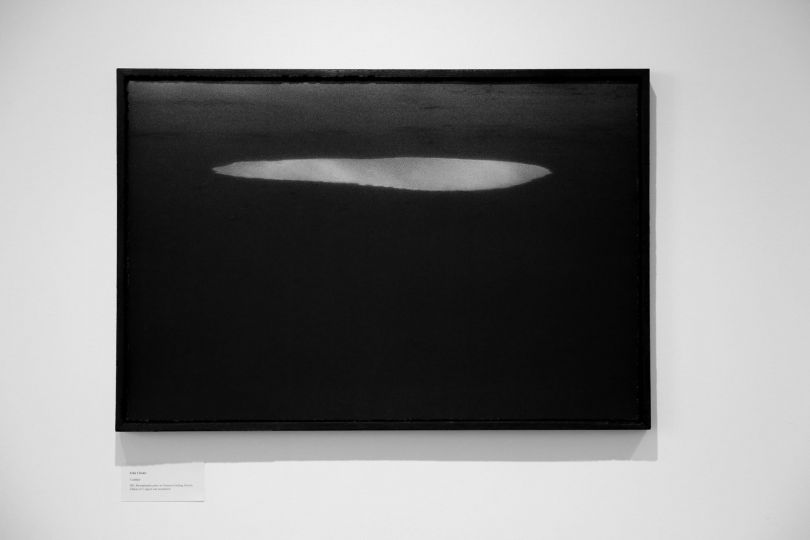
A shift occurs and, once inverted, it is no longer a fall but a levitation or a slow evaporation—not a collapse, but an inverted apparition. The sky finds itself below and the ground above. Elements exchange their properties, merge, and respond to one another. Air crystallizes salted surfaces. Flames, or roots, or furrows? All at once.
Light is water, but shadows are rocks, each hollow a stone.
— Jeanne Borensztajn
This work began with our meeting, three years ago. FALLEN FROM THE SKY is an ode to the works created by the dance between the Atlantic Ocean and the shoreline that borders it. It is a spontaneous work, which came to life during the first exhibition: THE WIND IS THE DOUBLE OF THE HORIZON. The gaze of each viewer gradually allowed us to grasp its scope.
We then understood that this series might be exploring the encounter between Mandelbrot’s mathematics and pure abstraction: two extremes, a double gaze. With all that differentiates us, we set off to opposite ends of vast stretches of sand, without consulting one another, and always came back amazed at the correspondence between our film rolls. These photographs are born from patient, humble observation. Our approach is that of witnesses and interpreters. We let ourselves be guided by these fragile compositions, which we seek to reveal with accuracy and respect.
We try to capture the paintings that the ocean lays down on the sand, in rhythm with the tides, the winds, and the seasons. These shifting, ephemeral forms are like canvases offered and then instantly erased by the waves. The grains of sand, like pigments carried from the mountains, the oceans, the sky, settle to compose a unique work.
The book FALLEN FROM THE SKY gathers their traces, so that these art works, which nature invents and tirelessly erases, may be contemplated, transmitted, shared. Excerpts of modern and surrealist poetry accompany the photographs, as if to breathe our thoughts—without fully revealing them. These texts, like our images, have an abstract and organic character. Thus, three years of work and love are brought together in this book, published alongside the second part of the exhibition: FALLEN FROM THE SKY. The eye and the heart at work.
More information
Félix Chollet & Olga du Saillant – Tombé du ciel
Limited first edition
112 pages
245 x 300 x 12 mm
Available online.