The Centre régional de la photographie Hauts-de-France presents Isabelle Wenzel‘s exhibition entitled Corps Épreuve.
For two decades, Isabelle Wenzel has been building a photographic oeuvre in which her own body is the sole subject.
In search of forms, she explores the immediacy of the medium in her poses, capturing imbalance, movement, and figures. In this exhibition, a first in France for the German artist, the CRP/ presents a body of work spanning the photographer’s career.
Between monomania and statement, what does Isabelle Wenzel seek to express through this recurrence in her photographic writing?
It’s no coincidence. Isabelle Wenzel was born in 1982 in Wuppertal, a Rhineland city inextricably linked to Pina Baush. The world-renowned German choreographer established her Tanztheater troupe there in 1973, and this institution, directed until recently by Boris Charmatz, embodies one of the leading centers of contemporary dance internationally.
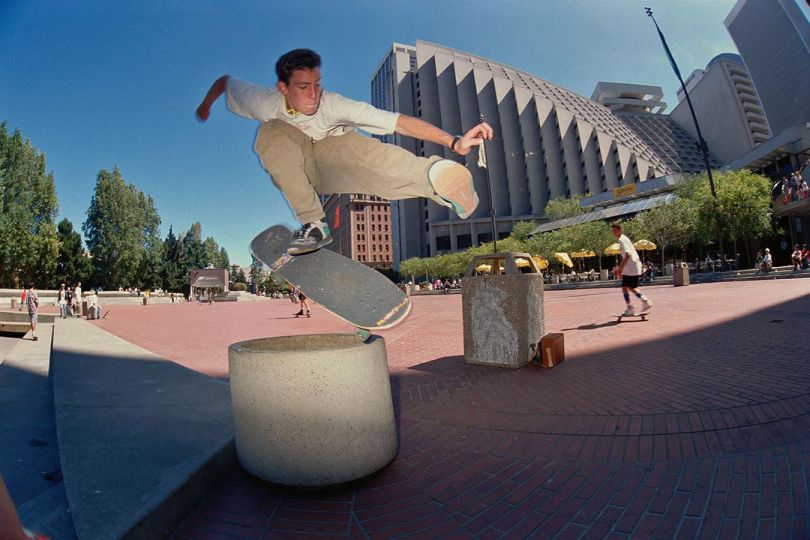
Early on, her physical abilities and innate mastery of her own body led her to the practice of acrobatics. She perfected her balance, flexibility, and technique at a circus school. Highly physical, she pursued a career as a professional skateboarder until a knee injury interrupted her starting career at the age of twenty.
Considering a career change, she enrolled in a design program at Bielefeld University. The quality of the images in her application was noted, and she was referred to the photography department. It was then that she fully embraced the medium and never abandoned it.
In 2007, she enrolled at the Gerrit Rietveld Academie in Amsterdam, where she studied under neo-surrealist photographer Paul Kooiker, who would influence her conceptual and experimental approach.
After completing her studies, she remained based in Amsterdam.
The capital’s energy allowed her to develop her artistic work, particularly alongside Galerie Bart, which stands out for its original approach and commitment to emerging artists.
When she discovered photography, she turned to portraiture before finally focusing on a single model. This model gave her the greatest freedom of action and freed her from the tedious organization of shots. She found that producing alone from her own body provided optimal working conditions and great creative latitude. Autonomous in her production, the photographer asserted her independence, and her works exuded this spirit of freedom and overflowing spontaneity.
It’s hard not to see the notion of play and challenge in her photographs. Reinforcing the theatrical dimension of the work, improvisation is a driving force. Isabelle Wenzel isn’t afraid to give the impression that something happened by mistake or chance; she embraces the uncontrolled element of the accident, a guarantee of a certain truth often generated by her working method, which is essentially based on self-timer.
While the fashion industry has recognized this singularity and increasingly solicits her for commissions, Isabelle Wenzel, who sometimes describes herself as a stuntwoman, asserts herself as an artist and focuses her approach on the fundamental question of the physicality of the body. How do we inhabit this envelope, how do we represent the physical being?
This demonstration takes place through photographic and videographic mediums, through performance, the exploration of bodily limits, and the experimentation of gravity.
In the catalogue of forms produced by Isabelle Wenzel, we note her taste for the figure of the simulated fall. Photography allows her to freeze this state which translates a form of abandonment in movement, a wavering which is not unrelated to the troubles of the world, to current events which sometimes influence her gestures, her poses, however spontaneous they may be. A measuring instrument, her body is similar to a filter through which she receives, integrates and expresses the information emitted by the outside world.
However, it would be inappropriate to focus her work on political intentions or to transcribe her images into a feminist manifesto. Isabelle Wenzel’s bias is clear: this is not an allegorical self-portrait, but above all, a purely representation of the body as an object, a tool. She says: “I see myself both as raw material and as a sculptor of this material.”
Under the controlled lighting of the studio, atop slag heaps, in dunes, or on paved roads, she unfolds environments and settings that define an entire universe. Her huddled figure, head to tail or suspended, suddenly transforms into these spaces, as varied as they are evocative.
Beyond gesture, her performances are experiences connected to these spaces: “I got lost. I stumbled. I failed. I started over. I am a space in the landscape. A geological formation. A botanical form. An island of isolation. A thinking body.”
At times constrained by still images, Isabelle Wenzel regularly resorts to video, which allows her to access a more complete form of expression, more broadly embracing the breadth of her movements. The sequences and seriality of her photographs also accompany her as she extends her gestures, transcending the instantaneous.
In the microcosm of the office, the moving image seems more suited to conveying the absurdity of repeated gestures, the mechanics of numb, tired bodies.
“I’ve never worked in an office, and I found it fascinating to see how functional and minimal people’s movements are in such a space. I wondered how long I could sit still.”
Intrigued by this environment, so far removed from her own and at odds with the rigidity and rules imposed by office life, Isabelle Wenzel develops a body language that breaks with the norms of this rigid world. A static, computerized universe, where constrained bodies are forced to remain silent for too many hours.
For this first exhibition in France, Isabelle Wenzel and the CRP/ have chosen to highlight the image, merging with the space. In a display reminiscent of a mood board, the photographs pasted directly onto the wall become, like the artist, one with the space.
If the photographic medium is desecrated here, it is to better celebrate the intelligence of the body, emotion, and physical sensation. What we remember from this ode to the body is a photographer’s commitment to sublimating it, from its prowess to its flaws, with playfulness and audacity, in a body of work that she deserves to have accomplished with consistency and coherence, certainly at the cost of a few bruises.
Audrey Hoareau, exhibition curator
Isabelle Wenzel : Corps Épreuve
Until October 5, 2025
Centre régional de la photographie Hauts-de-France
Place des Nations
59282 Douchy-les-Mines – France
www.crp.photo