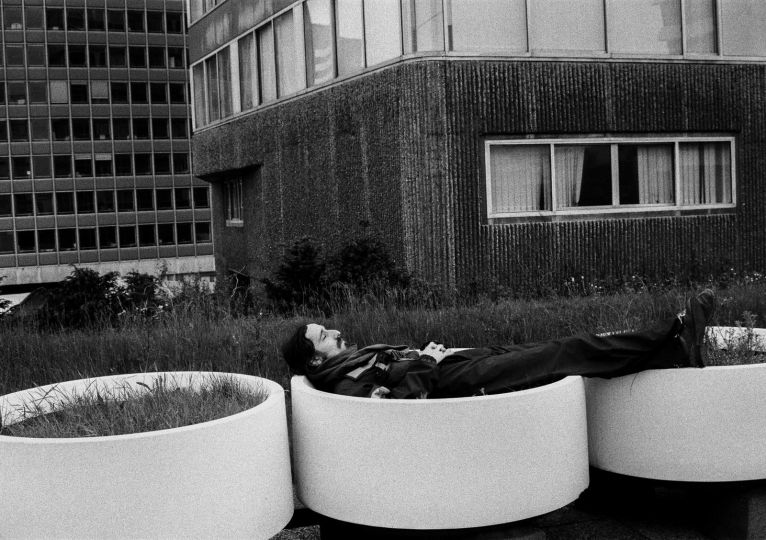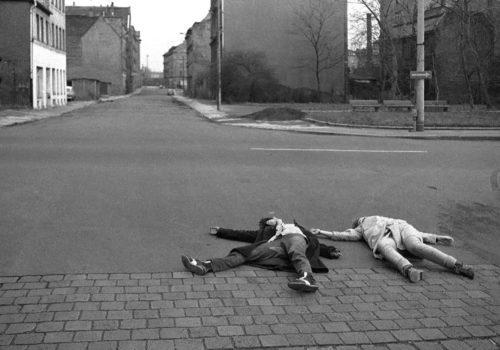
Christiane Eisler was 24 when she first encountered the Leipzig punks. Originally from East Berlin, she was then studying at the Hochschule für Grafik und Buchkunst (HGB) in Leipzig, a renowned institution which, at the time, was the only art school in the GDR to teach photography. Seeing them pass by her home time and again, she became curious about these exuberant rebels who, with their outfits and mohawks, stood out starkly against a grey urban landscape. The GDR regime was particularly harsh, and these young people, beneath their carefree demeanour, were taking serious risks by stepping out of line and defying authority. The crackdown on the punk scene was brutal, and the punishments whether psychological or physical were systematic.
A lasting relationship developed between the young photography student and the Leipzig punks, resulting in an impressive body of portraits and group shots. Whilst the shared moments concerts, trips to the amusement park provided an opportunity to mingle with the groups and observe their energy unfolding in public spaces, it was above all indoors and through her art of portraiture that Christiane Eisler captured the profound melancholy of this youth who rejected the system’s expectations. Their despair at the lack of prospects, their rage at being confined within the country’s borders, were transcended by the fantasy and euphoria characteristic of their age. Eisler captured with accuracy and sensitivity the tension between nihilism and innocence that defined their ambiguity and their strength.
Chaos, Skiny, Stefan, Imad, Ratte, Mita, Jana… are among the ‘protagonists’ of this scene, comprising bands such as Wutanfall and L’Attentat, and their followers. They passed around under the counter sounds from Britain, in defiance of the bans imposed on Western music. Unlike their British contemporaries, however, they could neither record albums nor perform freely in public. They also stood out for the highly political nature of their lyrics, sometimes penned by young poets in their circle. Their popularity remained confined to a circle of insiders, who learned of their semi-illegal gigs through word of mouth. The Stasi did everything in its power to dismantle the scene and wipe the punks off the map and it would almost have succeeded, had it not been for Christiane Eisler’s photographs.
In 1983, Christiane Eisler graduated the HBG looked after its students and shielded them from the coercive measures taken by the authorities but her work was subsequently censored: several exhibitions were cancelled. She extended her studies by two years and continued her work with the punks, through the ups and downs of their gatherings and break-ups bands forming and disbanding, departures to the West, and imprisonments. It was not until 2016 that her photographs were recognised as an essential record of an era and a generation that stood up against it. The courage of these young people foreshadowed the peaceful demonstrations that would fill the streets of Leipzig a few years later and ultimately lead to the fall of the Berlin Wall on 9 November 1989.
Alongside her work on the punks, and through one of their representatives who had been subjected to disciplinary measures, Christiane Eisler also turned her attention to a correctional centre for teenage girls in Crimmitschau, an industrial town in Saxony. In the GDR, young people who stepped out of line had to be brought back into line at all costs, willingly or by force, and the state did not hesitate to place them in institutions to shatter their dreams, silence their voices and attempt to turn them into good socialist citizens. These institutions were known as Jugendwerkhöfe literally: youth work centres. The one Eisler went to in 1982 and 1983 was reserved for young girls. There, they had minimal privacy, shared a dormitory and worked in shifts at the adjacent state-run textile factory. The days were gruelling, made worse by constant punishments and cleaning duties. This treatment, characterised by humiliation and quasi-military discipline, would leave a lasting mark on some of the women.
Born in East Berlin in 1958, Christiane Eisler studied photography at the Hochschule für Grafik und Buchkunst (HGB) in Leipzig from 1978 to 1985, under Harald Kirchner and Evelyn Richter. There she produced acclaimed work on the punk scenes in Leipzig and Berlin, as well as on a correctional centre for teenage girls and, in collaboration with the GDR’s Institute for Youth Research, on young people living on the outskirts of Leipzig. Establishing herself as a freelance photographer, she continued to explore the documentary and social aspects of her work after completing her studies. Study trips to Algeria and Russia in 1988 also shaped her interest in foreign countries, which she would explore extensively after the fall of the Berlin Wall. In 1990, she founded the Transit agency and documented the upheavals experienced by her fellow citizens, particularly female workers, following the collapse of the GDR. Portraiture remains at the heart of her practice and her series, which she often develops over the long term, reconnecting with the subjects of her youth decades later. In 2016, her work on punks, which had been censored at the time, was finally published and exhibited at the Stasi archives in Leipzig. Since then, Christiane Eisler has taken part in numerous solo and group exhibitions, both in Germany and internationally.
Christiane Eisler – La jeunesse des autres
March 7th – Mai 31st 2026
CRP/ Centre régional de la photographie Hauts-de-France
Place des Nations
59282 Douchy-les-Mines France
www.crp.photo