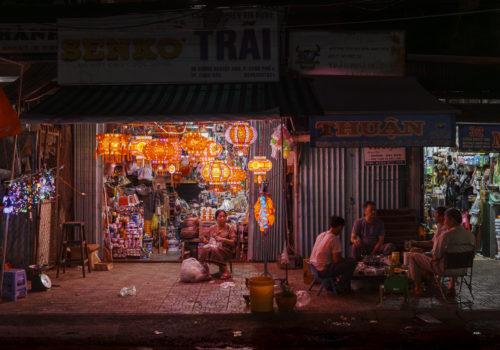
The Centre d’Art Gwinzegal presents the exhibition Bertien van Manen : Les échos de l’ordinaire (Echoes of the Ordinary).
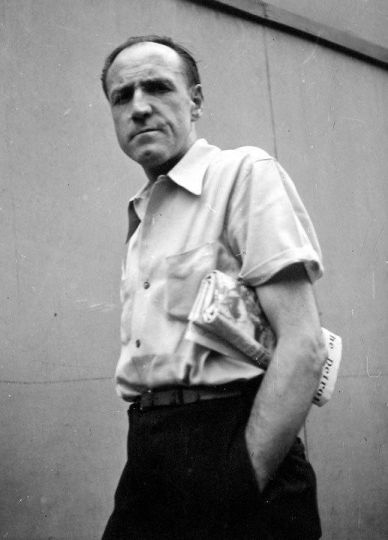
The photographs of Bertien van Manen (1935−2024) are neither a personal diary nor a family album. While certain visual codes may suggest this, they do not meet any of the prerequisites. They are not about her, nor about rituals, events, or planned staging. Nor do they correspond to the canons of the spectacular or the commonplaces of photojournalism; historical or political events are quite absent from the center of the image. Her work could be defined as an intimate and subjective chronicle of the lives of ordinary people, who, tossed by the winds of a history that is written without them and sometimes overwhelms or crushes them, try to get by as best they can—and this is often much more heroic than one might think. A chance self-portrait reveals the photographer as a bold woman, with disheveled hair and rolled-up sleeves: we imagine her as free, strong, rebellious, and tenacious. A short-lived career as a model led Bertien van Manen to move to the other side of the lens and begin a life as a magazine photographer. However, she quickly demonstrated social acuity and commitment by producing several reportages on migrant women—Turks, Moroccans, Yugoslavs—who came to the Netherlands to work and escaped the determinism of their condition. It was while leafing through Robert Frank’s book The Americans (1958) that Bertien van Manen had a spark for photography she truly wanted to create and show the world she wished to tell. It was in this distance and proximity that she now wished to inscribe herself. She no longer sought to illustrate the world, but to experience it by being as close as possible to the people and things, the communities that fascinated her. The daughter of a Dutch coal mining engineer, she left for the United States, in 1985, to the Appalachians, in search of women working in the mines. These coal workers lived in small houses, or sometimes crammed into caravans, mobile homes, or improvised constructions in the woods. The photographer abandoned her professional photographic equipment in favor of a small, amateur 35mm camera. Farewell to fashion or magazine commissions, it was in another temporality that she accessed an intense and unpretentious intimacy, which allowed her to share the life of this community for more than thirty years, during numerous visits. Never cynical, her images oscillate between beauty and chaos; we can follow the daily lives of these families over several generations, with their difficulties and their laughter. She crafted a documentary and subjective style that she would fully express through books more than through exhibitions. She also retained from Robert Frank’s work the insatiable thirst for travel and encounters, which would never cease to fuel her existence. “I never sleep as soundly as when I’m traveling, in an anonymous bed, in a strange place, waking up without knowing where I am, thinking that no one else does either,” one can read in the pages of her journal. It is probably no coincidence that the bed, as a piece of furniture, appears repeatedly in her work. It is the most private place, where intimacy unfolds in sleep, dreams, or embraces. Bertien van Manen was one of the first to slip behind the Iron Curtain to document post-Soviet life in Russia, Moldova, Kazakhstan, Uzbekistan, and Ukraine, during dozens of trips between 1991 and 2009. She was not a street photographer; the relationships she created are more intimate: it is inside apartments, in kitchens, living rooms, and bedrooms, that she took us, late at night or early in the morning.
“I have to love the people I photograph. I have to feel an attraction, a fascination,” the photographer confessed. It was with this same appetite for others that she attempted, at the turn of the millennium, to portray an even more opaque society: in China, where the private sphere and the individual had been made suspect by the Cultural Revolution and seventy years of communism.
This exhibition introduces us for the first time in France to a deeply feminist and committed artist. It brings together four major photographic series: from the Netherlands, the United States, the former USSR, and China. This work evokes a sensitive reflection, beyond political realities, on what connects individuals and societies rather than what separates them. A spectacle of ordinary and humble lives, Bertien van Manen’s photography, far from sensationalism and dominant narratives, is a singular documentary body of work, driven by constant empathy.
Bertien van Manen : Les échos de l’ordinaire
Until October 12, 2025
Centre d’Art GwinZegal
4 Rue Auguste Pavie
22200 Guingamp, France
https://gwinzegal.com/
Wednesday to Sunday, 2 p.m. to 6:30 p.m.