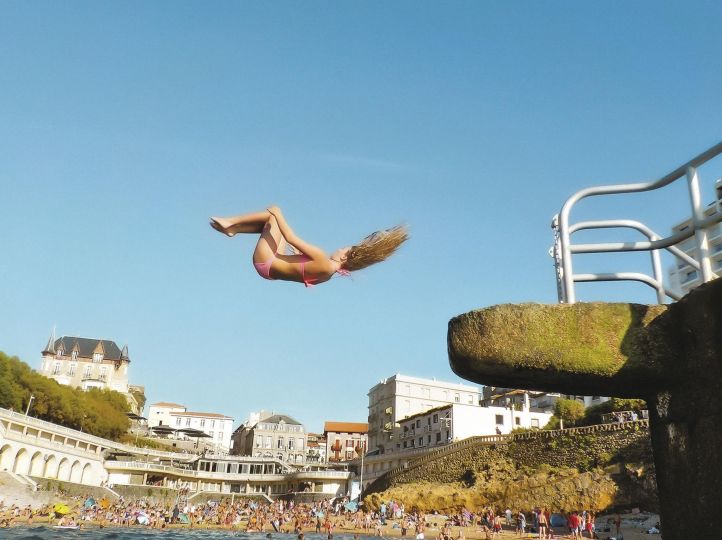
Cédric Calandraud is a documentary photographer and a lecturer in visual sociology at Université Paris Cité. He published his first photography book, Le reste du monde n’existe pas (Éditions Loco), devoted to the rural youth of La Rochefoucauld, a town of 2,932 inhabitants in the Charente department in southwestern France.
Originally from this town, Cédric Calandraud left his hometown to pursue his studies. For the past few years, he has regularly returned to Charente to document the lives of young people there. His black and white photographs offer an accurate and sensitive portrayal of rural youth.
Why is this segment of youth, which still represents about a third of young people in France, so rarely represented in the media?
When this youth is represented, it is often portrayed from an urban perspective. When people talk about youth, they mostly refer to urban youth or young people from working-class neighborhoods. Rural youth is often forgotten, or only discussed from a distance. When it is mentioned, it is often through either miserabilist or folkloric stereotypes. As a result, when it is discussed, it is often misrepresented. At the beginning of this project, I realized there were very few photographic representations of rural youth. My goal was to produce images that would be as accurate as possible. When these young people looked at the photographs, I wanted them to feel that the images reflected who they are. I worked with sociologists because I see sociology as a complementary discipline within the social sciences, including Benoît Coquard, Yaëlle Amsellem-Mainguy, and Clément Reversé. Their work helped me better understand the living conditions of rural youth, what I was seeing in the field and also what I was not seeing. I am thinking in particular of the work Les filles du coin by Yaëlle Amsellem-Mainguy. Being surrounded by researchers helped me remain as accurate as possible, avoiding both miserabilist and folkloric approaches. My objective was always to create photographs that felt true to the people represented. When they looked at the images, I wanted them to recognize themselves.
What led you to work on this project?
This project is part of a long personal process of returning home. I left this place when I was 18, after finishing high school, like about a third of each generation does when growing up in rural areas. I left because I no longer felt I belonged there. I wanted to see something else, to discover what I thought of as the rest of the world. I went on to study sociology and for several years I rarely returned. At first I came back every weekend, then less and less, until there was a real break between me and this territory and my social background. Over time, and thanks to sociology, I began to better understand where I came from and to become aware of social, geographical, and cultural determinisms. That was the beginning of a reconciliation with this place. I started coming back more regularly after completing my master’s degree, often with my camera. At first, I worked on a very personal and intimate project called France 98, which revisited my family history through found photographs. I also produced a documentary with Arte Radio about my grandmother and regional dialects. All of these projects were, in a way, reasons to come back and reconnect with this place. The real reconnection happened with this project, Le reste du monde n’existe pas. It is part of a long process of reconnecting with this territory and more broadly of seeking visibility for a rural youth that has little or none.
How did the photo shoots take place?
About a year after I started the project, young people knew that a photographer was working in the area to photograph local youth. I began receiving requests, often through social media, directly from them. That was a great opportunity for me. Before taking the photographs, we would often plan them together, choosing locations and clothing. Sometimes we had exactly the same ideas, which worked very well. Other times we had different expectations. There were occasions when we took one photograph for them, which they would immediately share after the shoot, and another for my project. Even though the images were different, they still represented them and were created collaboratively. In one they might be smiling, in another more serious. One might be in color and the other in black and white. This dimension of exchange and the horizontal relationship between the photographer and the photographed subjects was very important to me.
Your cousin, who lives in La Rochefoucauld, helped you a lot by introducing you to young people. Would your project have been completely different without him?
Reconnecting with this cousin, whom I had not seen for years, was a real turning point. When we met again, he opened the doors to his world. He allowed me to reconnect with that environment. For me, the project cannot be separated from him. He told me he was proud to show me his hometown. This sense of pride is very important in rural areas, being proud of where you come from. Many young people spoke to me about this pride. He also talked about self-confidence. He too told me he had a difficult relationship with his own image. Seeing himself in photographs and regularly having new portraits taken helped him. One of his favorite photographs from the project, out of the hundreds or even thousands we took together, is a picture of him shirtless in a lake. It appears at the end of the book.
You also led photography workshops in your village. What did this bring to you and to the young people involved?
The workshops were a way for me to connect with these young people. Organized with social centers and local youth employment organizations, they allowed me to meet more disadvantaged and often socially isolated groups. These were young people I would not necessarily meet in the village square or on the football field. They are often isolated and not involved in clubs. I needed to find a way to enter these spaces. Offering photography workshops interested both the organizations and the young people. The idea was also to create an exchange. I had something to offer them, some technical knowledge about photography and the opportunity to be part of an artistic project. Over five years of work, I received almost no refusals. In rural areas, when artistic and cultural projects are proposed, young people tend to embrace them. These workshops also focused on self-esteem. I tried to help rebuild a bit of confidence in the young people I met. Many told me they were not photogenic, that they did not like how they looked in pictures, that they felt unattractive. We worked on how they perceived themselves. When we reviewed the photographs, some would say that they did not look so bad after all. For someone with very low self-esteem, that is already a small victory and a step toward accepting their own image.
Do you think this lack of self-confidence is specific to rural youth or more generally linked to youth as a whole?
It would require a comparative study to answer that question properly. My impression is that it is not specific to rural youth. If you visit youth employment centers in urban areas, you will also find young people facing different kinds of challenges but who may also be socially isolated, who may also have low self-esteem because they left school early or experienced bullying. I do not think this is specific to rural environments.
How did you make people feel comfortable during the photo sessions?
There are two types of photographs in the book. There are spontaneous images where I act more as an observer of a situation. At times I even acted as the official photographer for the local football club or for school end-of-year events. Then there are more formal portraits where we think together about how to construct the image. Spending time with them, talking, and involving them in the process is what helped make them feel comfortable.
Why did you choose to present all your photographs in black and white?
That is always a good question. I like the aesthetic of black and white and its timeless quality. Young audiences often tell me that black and white makes things look dated. I always find that remark interesting. What I tell them is that they will always find a small detail in each photograph that anchors it in the present, a clothing brand, a mobile phone left on a table, a type of car or motorcycle.
How do the young people you met see their future?
I try to avoid generalizations, so I would say it depends. I met very different young people. Those I met through youth employment programs were different from those I met at the football club or in high schools. Even within high schools, there were significant differences. Students in agricultural programs had very different perspectives from those studying personal services, for example. What I can say about the future is that many seemed to share a common goal, which they often described as wanting to settle down. This idea of settling down came up frequently. It meant achieving financial stability, having a home, often becoming a homeowner, which is more realistic in rural areas than in cities. It does not necessarily mean being wealthy. Ultimately, settling down means having stability, a circle of friends, and a partner. These ways of life are valued and I do not think that will change.
At what point did you feel that your project was complete?
I had set myself the goal of meeting young people in their different environments and across various social spaces. Around 2024, I felt I had explored many contexts, vocational training programs, workplaces. I also visited them at home and attended parties with them. In the end, I had built a very large body of work, several tens of thousands of images. My greatest pride was organizing an exhibition in La Rochefoucauld where all the young people attended the opening. That was the culmination of the project.
If you had to describe La Rochefoucauld in three words, what would come to mind?
The town is largely defined by its castle. At the beginning of my research, I found it quite amusing that La Rochefoucauld, the town where I grew up, had been listed among the one hundred most beautiful detours in France. That label made me smile because it suggests your town is just a detour, a place where people stop for two hours before moving on. There is also the local Charentaise slipper factory.
Do you still go back often?
During the project, I spent about one week per month there, making frequent trips back and forth. Today I go a little less often because I am also working on other photography projects, still focused on rural youth.
Interview by Laurine Varnier
Cédric Calandraud – Le reste du monde n’existe pas
2025, Éditions Loco
150 pages
Available in bookstores and online