We received these images and this text from the photographer Carlos Muñoz Yagüe.
This photographic project covers a period from 2000 to 2010. My intention was to reveal, in the urban landscape of contemporary Spain, the traces of the Civil War (1936–1939) and the dictatorship (1939–1975). At that time this historical past was still very easy to see. The implementation, from November 2025 onward, of the second law on memory, known as loi de Mémoire Démocratique, calls through legal action for the removal of street names, monuments and statues that pay tribute to the Francoist and fascist victors of the Civil War and to the dead and “heroes” of General Franco’s dictatorship. These photographs bear witness to Spain’s difficulty in acknowledging Francoism as a criminal regime and the refusal, for forty years, to eradicate these traces from public space.
In 2000, when I began this work, Spanish civil society was pretending to have forgotten its past. And yet, since 1975, the year of General Franco’s death, one could still encounter, in many Spanish towns and villages, the same Francoist statues and monuments, the same street names honouring the founders of the Falange or of the Nationalist movement that would become Francoist, avenues named after generals responsible for massacres, monuments to fascist dead, military museums celebrating Francoist victors, and a few remaining statues of Franco.
I therefore began photographing these places and objects. I also went to archive centres and museums. Then, from city to city, from one village to another, and even out in the countryside, I photographed some of the last remaining witnesses. I was then invited to take part in commemorations, accompanying veterans from both sides. I always photographed under the same premise: in 6×6 format, on black‑and‑white film.
On November 20th 2025 we reach the fiftieth anniversary of Franco’s death. In 1978 an Amnesty Law was passed that came at a price: oblivion, and it had a consequence: denial. When I began this work, without realising it I became part of the generation that called this past to account. This generation was and is made up primarily of Spaniards, grandchildren of the victims of repression, who in some cases only discovered long after Franco’s death that their grandparents or relatives had been victims of repression, or worse, had been executed between 1936 and 1959, then thrown into one of the pits and left in oblivion. This movement of renewed awareness was accompanied by English, French and Spanish historians and journalists who had had enough of this denial and wanted to open all the archives.
The figures are still debated: the fighting during the war is thought to have caused at least half a million deaths. Post‑war repression, between 1939 and 1959, is estimated to have killed between 150,000 and 200,000 people, all thrown into anonymous pits. The overall figure of one million dead in forty years has often been put forward, but remains unverifiable.
In 2007 this groundswell resurfaced in Spanish society and led to the adoption of a law known as Historical Memory Law, despite opposition from conservative circles. The debates that preceded it gave rise to verbal violence in all public arenas. Fifteen years later, in 2022, a second law was passed to complement it, with a more pronounced political and social intention, and named loi de Mémoire Démocratique.
This latter law is now coming into effect through the implementation of measures such as a comprehensive national inventory of objects, symbols and monuments present in public space, and of street and road names that celebrate Francoism. This list is intended to ensure their definitive removal. It will be followed, at national level and with the involvement of the public administration something that had never happened during the previous twenty years with the search for people who died and were buried in mass graves, so that they can be returned to their families. There is also a call to declare the memorial association Fondation Francisco Franco illegal. Spain’s public radio and television are currently putting online a website with an interactive map entitled « The Land of 6,000 Pits», indicating the mass graves already identified and opened, or those that are to be opened, so that, thanks to DNA identification, the remains can gradually be returned to descendants who request them. These are major political acts that, back in the 2010s, I would never have imagined seeing come to fruition.
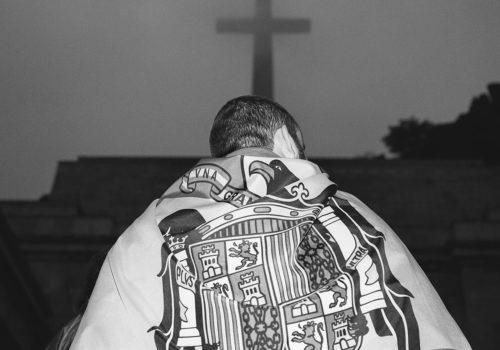
I accompanied the early stages of this movement, notably alongside the founder of the first of these historical‑memory associations, Emilio Silva. From the initial body of nearly 200 photographs I made over that decade (2000–2010), entitled The Memory of Bones, here is a selection. This edit focuses on Francoist nostalgics gathered at the famous Valle de los Caídos, including Franco’s daughter together with veterans of the División Azul; on the appearance of Franco’s face and busts that were, at the time, still visible in public spaces; and on photographs of one of the first exhumations and digs in the village of Uclès near Madrid, in 2001.
This debate has been present in the Spanish media for twenty years. For the older generations, particularly in conservative circles, the changes now taking place are an upheaval. These changes, awaited for eighty years by the descendants of republican victims, are confronted by attacks from the descendants and heirs of the right and the far right, who refuse to see the many crimes of the Franco regime condemned one day.
This work does not claim in any way to be exhaustive, just as I am far from having criss‑crossed the peninsula in every direction. It is more of a roadbook, in which I have tried to carry out an investigative project, referring to numerous serious, well‑established historical sources, both in Spain and abroad. Gradually, the history of my own family became entwined with this approach, as I explored my grandfather’s past through the revelations of my grandmother, once she became a widow in 2013. It is also the chronicle of my own awakening: this country bears a heavy past that it has not managed to come to terms with. For a long time including during the recent democratic period the forty years of dictatorship were excluded from history lessons in primary and secondary schools. To the hundreds of thousands of deaths during the war must be added the twenty years of terror and repression that followed the war from 1939 to 1959, slavery in the form of camps for political prisoners reduced to forced labour, and close to 450,000 exiles (perhaps almost twice that number). One last crime: orphanages filled with children stolen from left‑wing women to be brought up by nuns.
I am currently rewriting, expanding and updating a very long text that brings together my notes taken in the field, brief interviews, first‑hand testimonies from people who are still alive and, in particular, the invaluable account left by my grandmother. This book, due to be published in 2026, also recounts my experience as a child during the dictatorship, since I too grew up in Spain.
Carlos Muñoz Yagüe, December 2022–2025