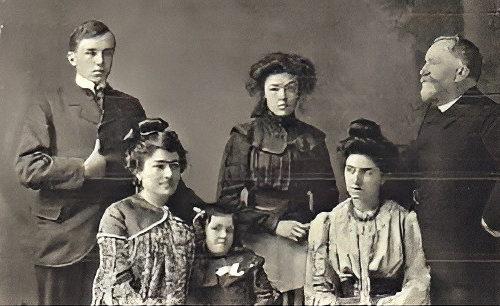
Several years ago, Mr. Roderic Martin put online a biography of Maurice Meys, Marcel’s father, himself a passionate photographer and the first official correspondent of the magazine L’Illustration, to whom we owe a great many views of the Pyrenees. As the result of his genealogical research, R. Martin also published the only certain portrait of Marcel, posed at the age of 19 with his sisters and parents in a family photograph that I take the liberty of reproducing (Ill. 26). One does not in any case have to look very far to understand that the combined influences of his father (outdoor photographs) and his uncle (artistic practice) opened up for the young man a path toward the creation of strong and harmonious, seductive images, produced in a darkroom that was still equipped with gelatin glass plates.
The work of Marcel Meys offers dazzling proof of this precious lineage as much and of his own personal standards, his high level of culture, and his perfect technical knowledge (let us recall that he adopted the Lumière autochrome as soon as it came onto the market). His undeniable gifts as an image-maker and photographer blossom in photographs that testify to his demanding care in selecting natural settings, whether it be the sea (possibly near Boulogne-sur-Mer, where his family lived), the mountains – the Alps and/or quite plausibly the Pyrenees, following in his father’s footsteps – and finally the countryside and forests gently traversed by delightful little streams conducive to Virgilian evocations so fashionable at the time of Pierre Louÿs and Le Sacre du printemps. His rigorous selection of well-proportioned models, with delicate bodies capable of holding the most elaborate poses while nevertheless giving the illusion of natural, balanced postures, their heads sometimes wreathed in headbands or floral crowns, fingering on their double pipes or Pan flutes a few pastoral melodies, is not the least of his assets. But this suave inspiration should not eclipse the almost wild, in any case picturesque aspect of his stagings, where, as we have already noted in the case of de Clugny, the female anatomy comes to constitute a just and sensual counterpoint to the ruggedness of nature, celebrated in his creations by this undeniable pantheist, heir to J.-J. Rousseau.
Marcel Meys is in fact far from being isolated in his approach, even if it is unmistakably personal; he forms a link in a tendency that predated him (and would outlive him), put into practice notably by the whole current of German naturist photography (1900–1910), through which the most renowned French practitioners of nude photography, particularly René Le Bègue (1856–1914) and A[chille] Lemoine (1857–1910), abundantly reproduced in German publications, found themselves annexed (Ill. 27–29). At the other end of the world, in California, at the same time as Meys in France, Arthur Albert Allen gained recognition, with great difficulty in an America still deeply puritanical, thanks to his Alo studies (1920, 1922), remarkable publications of outdoor nude photographs that display a close kinship of inspiration with those of Meys (Ill. 30–31), with which they can easily be confused. Finally, in his own country, the similarity of inspiration with his elder G. Louis Arlaud (1869–1944), a lifelong specialist of landscape, is striking, in the syncretism between nudes and landscapes (to the point that in his 20 Études de nus en plein air, s.d. (1920–25; pas de dépôt légal), his major published work, Arlaud takes particular care to localize his images) (Ill. 32 & 33). This naturist vein that runs through European photography in the first years of the twentieth century certainly has descendants. It would flourish in Germany within the FKK movement thanks among others to the work of committed photographers such as Lotte Herrlich, or indeed too committed to National Socialism such as Kurt Reichert; and in France, it was largely taken up by the libertarian movement of Dr Fouqué, friend and preface-writer of the Album de la femme (1936) by Arlaud, then by the naturist group of Kienné de Mongeot, Vivre d’abord with its publications À la gloire du corps humain. But in their photographic practice the landscape became only a simple accessory, a pure backdrop and not the principal protagonist in dialogue with the female nude that it is in their predecessors, Meys in particular. However, the most orthodox heir to the “Nus et paysages” trend of the 1920s would without doubt be the cosmopolitan photographer André de Diénès – who moreover had spent a long time in France before emigrating to California, where his love of landscapes and overly glamorous models could fully blossom. It is above all in his American publications, including Natural nudes (Amphoto, 1966), that this tendency would manifest itself most spectacularly (Ill. 34–35), with shooting sessions on the wild beaches and coves of the Pacific, amid the jagged silhouettes of the Rockies, lost in the endless sand dunes of Yuma. Epigone of Meys and Arlaud, Diénès is, like them, a great lover of nature and of the landscapes it shapes, to such an extent that this book includes around twenty photographs devoid of any human presence.
To conclude, I cannot remain silent – even if, clearly, we are not dealing here with printed works – about the fact that I also own slides by Meys, 24 × 36 mm in format, mounted in lettered cardboard frames bearing titles [Ill. 37] and stored in numbered boxes “Série 1, 2, 3” written in ink, each containing ten slides. These sometimes reprise earlier autochromes by Meys, or are inspired by them [Ill. 39, 42], to the point that many commentators confuse them and date some thirty years too early. These images were self-published toward the end of the 1930s, very likely using Kodachrome films that had just appeared on the market which have nothing technically in common with the Lumière autochromes. Most often, these images, of striking presence and pleasing chromatic balance, prove to be fully in line with his highly sensual production of the 1920s (Ill. 38–42); but they also appreciably complete our knowledge of his biography notably by attesting to a trip to the Maghreb [Ill. 43] as well as of his personality, with the affirmation of his taste for ancient Roman culture (which his initial bucolic inspirations hardly allowed one to overlook), a culture admittedly heavily idealized in the manner of the Chansons de Bilitis or the Villa Kerylos of the Reinach brothers [Ill. 45 & 46], and they ultimately confirm, together with the adoration of the magnified female body, the existence of the powerful and fertile pantheist inspiration [Ill. 44] that animates his creativity.
Alain-René Hardy
L’ivre de nus
[email protected]