Brigitte Bardot belongs to that rare category of figures who outgrow their own time. More than an actress, she represented a rupture: embodied freedom, an emancipated body, a new way of inhabiting the world and the gaze of others. An absolute icon, she was also very early on a woman in retreat, fleeing the noise of her own image in order to preserve what truly mattered.
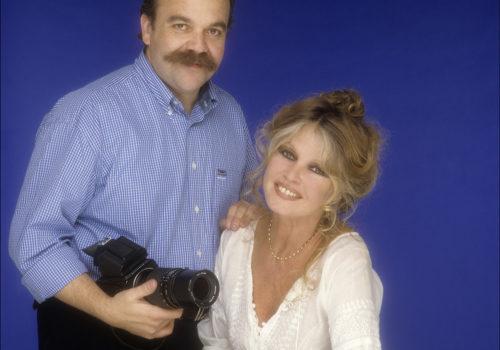
A photographer of reality and its margins, Gérard Schachmes has, for several decades, developed a demanding body of work deeply rooted in the human condition. His gaze, shaped by reportage and social photography, rejects effect and immediate seduction. In his work, the image does not impose itself: it questions, it resists, it takes time.
Photographing Brigitte Bardot was never a neutral act. She had been looked at to the point of exhaustion, desired to the point of saturation, frozen into an icon the world seemed to appropriate without ever fully understanding her. Faced with this myth overloaded with images and projections, some photographers chose not to add yet another image, but instead to suspend the noise.
Gérard Schachmes’ gaze belongs to this rare category. Neither spectacular nor complacent, it unfolds in a slow temporality, attentive to what escapes, to what resists. Where cinema constructed a moving legend, photography through his lens attempts something else: to approach a presence, to brush against a silent truth.
In this conversation, Gérard Schachmes reflects on his encounter with Brigitte Bardot, questioning the fragile boundary between the woman, the icon, and the collective projection. He speaks of memory, waiting, withdrawal, but also of what photography can still reveal of a face too often seen perhaps never truly looked at.
A dialogue on a human and visual scale, far from clichés, where the myth fractures and, at times, the essential appears.
When did you photograph Brigitte Bardot for the first time?
Gérard Schachmes: The very first time was in 1986. I had set up an improvised studio to shoot a cover for Paris Match. At the time, I was working for a major agency. But in truth, my real “first time” came much later, in 1991, at La Madrague. It was for a reportage produced by Jean-Louis Remilleux, dedicated entirely to her. The shoot ran for so long that by the end of the day the light had almost completely disappeared. I suggested postponing the session until the following day something Brigitte accepted, to everyone’s great surprise. Jean-Louis smiled and said to me, “You’re the only photographer I know who refused to photograph Bardot.” The next day, I spent nearly five hours alone with her. We produced a magnificent reportage. That is the moment I consider my true first photographic encounter with Brigitte Bardot.
What image did you have of her before meeting her, and what shattered when faced with reality?
Gérard Schachmes: Like everyone else, I saw her as a great actress, an absolute icon beauty incarnate. She embodied a myth, and of course I dreamed of photographing her. The encounter swept away the clichés. I discovered a deeply kind, loyal woman, of remarkable gentleness. She was also extremely perfectionist. And above all, she possessed an extraordinary charisma—a smile capable of sending shivers down your spine in an instant.
Do you have a particular anecdote you’d like to share with us?
Gérard Schachmes: Yes, from a studio session. To avoid paparazzi, Brigitte liked to work very late, often around midnight or half past. She always arrived with a large bundle filled with outfits. That night, she wore a headscarf hiding her curlers. She took them out, ran her hand through her hair, stepped into the light… and I was left speechless. She was breathtakingly beautiful. Those images went on to appear on many covers, including ELLE. Without doubt, one of my most beautiful sessions with Brigitte.
So, photographing Bardot—was it photographing a woman, an icon, or a collective projection? And how do you find the right distance?
Gérard Schachmes: At that time, I was already regularly photographing many well-known figures, so I wasn’t intimidated by her fame. What matters above all no matter who you photograph is the human connection. You can be the greatest photographer in the world: if the person in front of you gives you nothing, the images will be empty. With Brigitte, that connection was immediate. She quickly became a friend, and it was that relationship of trust that made the work honest and true.
Bardot was often looked at, scrutinized, desired. Did you feel she truly allowed herself to be seen through your lens?
Gérard Schachmes: Yes. Brigitte was a whole, committed, and deeply professional woman. When she accepted a session, she gave herself entirely. She offered herself as she was, without pretense.
In your view, what can photography reveal about Brigitte Bardot that cinema or the media never managed to capture?
Gérard Schachmes: She was filmed and photographed endlessly. But what cinema never truly revealed was the woman in her intimacy. I had that privilege: photographing her at home, in her different houses, with her husband Bernard d’Ormale, whose kindness and devotion to her were remarkable until the very end. I witnessed a deep, sincere love between them.
Is there a specific, almost intimate memory that immediately comes back to you when you think of her?
Gérard Schachmes: When I was preparing my book, I wanted her to write the captions. I called her to ask if she would agree. When I told her there were nearly 400 photographs to caption, she simply replied, “Come down to Saint-Tropez and we’ll do it together.” I arrived at her place in the early afternoon. By 10 p.m., we were still far from finished. I suggested continuing the next morning, but instead she prepared a small dinner for us and preferred to carry on afterward. That evening, she baked an apple tart just for me you can imagine. A moment of incredible simplicity and tenderness.
Is there an image of her that you consider “definitive” not perfect, but true?
Gérard Schachmes: Above all, I carry her extraordinary smile with me. And the image that will remain forever engraved is that moment when she removed her curlers, ran her hand through her hair, and simply stood there, in the light.
How did she handle silence, waiting, that suspended moment specific to photography? Was she in control or in surrender?
Gérard Schachmes: Every session was fluid, natural. She was at ease. Her only requirement: champagne, and several glasses so everyone could share. Once that was settled, we could work freely. She was a real woman deeply alive.
With hindsight, do you think Brigitte Bardot was aware of what she embodied for her era?
Gérard Schachmes: Absolutely. She had a very strong personality and knew exactly what she represented. She always made her choices consciously, without compromise.
Has your perception of her evolved over time, particularly in light of her withdrawal from cinema and her personal commitments?
Gérard Schachmes: Yes, inevitably. At first, I photographed the artist. Over the years, I photographed a friend. I admired her deeply not only for what she embodied, but also for her commitment to animal rights, a cause that was profoundly close to her heart.
If you had to sum up Brigitte Bardot in a single human quality, far from the myth, which would you choose—and why?
Gérard Schachmes: Without hesitation: kindness. And I would add humanity.
I remember a story we did in Romania, where she was meeting the Prime Minister about stray dogs, which at the time were being executed with flamethrowers. She insisted on going to a square where more than 500 dogs were gathered, some likely with rabies. I tried to dissuade her, fearing for her safety. She replied, “Don’t worry, they know me.” She walked into the middle of them and began feeding them. It was unreal. But it was Brigitte.
What do you think of the controversy surrounding Bardot at the time of her death?
Gérard Schachmes: Very honestly, I did not share her political views, and she knew that. But she was very tolerant. As for the rest one cannot please everyone.
Do you think history will one day be able to separate the icon, the woman, and the controversy or are these dimensions inseparable?
Gérard Schachmes: I believe that separation is already underway. Some media outlets, at the time of her death, knew how to retain only the icon she was, she is, and she will remain.