The Eye of Photography inaugurates a brand-new column: visits to artists in their studios, their workspaces, surrounded by works in progress, waiting to be exhibited. Artists at rest, in turmoil, in deep research, or overwhelmed by questions. The first episode takes place in Gennevilliers with Marie Clerel.
Is it possible to photograph the wind? Probably. It has already been done. Everything has already been done, and yet one must continue to create. “Try again. Fail again. Fail better,” wrote Beckett. To freeze the wind could simply be capturing a breath in wispy hair. Wheat waiting to be harvested, ruffled by a breeze. But to show the dance of the wind, its perpetual motion, the swaying of the breeze — that is something else entirely.
In one of her ongoing series, currently untitled, Marie Clerel plays with the randomness of the swaying of ash-leaved maple trees that form the horizon outside her studio. The branches or rather the shadows cast by the twigs caress a paper soaked in ferric ammonium citrate and potassium ferricyanide to create cyanotypes, revealing stains, accidents, circles, and orbs. It’s the movement of the wind. An abstraction searching for the essence of things.
Her studio is a little world tucked away in Gennevilliers in the suburbs of Paris. Since 2024, the Soukmachines association has opened Gros Lot, a set of three utilitarian-style buildings along the A86 highway, previously occupied by Orange. It is now entirely devoted to artists and artisans. Many studios are still available, and rare occurance, Gros Lot is set up for the long term, with a ten-year lease granted by the Gennevilliers city council a municipality engaged to contemporary art, as evidenced by the municipal fine arts school and the Édouard-Manet Gallery.
An artist’s studio defies tautology. Asking about it is as futile as asking writers: Where do you write? Everywhere for some, only in one place for others. Photography today is often digital, so a studio can be as minimal as a screen, a mouse, a hard drive. Yet the idea of a studio implies a space where creation happens. A computer may suffice, but a place bears witness to a life and its tentative experiments. In Marie Clerel’s case who works (most of the time) without film or contact she needs a space to experiment with photography’s relationship to time and motion. A space with many windows.
Leaning against the studio’s entrance wall is her series “Skies” (2016–2019). These large fabric canvases are photographs “made without a machine.” The cloth is first crumpled, beaten, twisted, then coated in the darkness with cyanotype solution, before being laid flat and exposed the next day. “Depending on the hour, the weather, or the exposure time, the shade varies, shadows are more or less pronounced, it can darken or remain pale if a cloud passes,” writes the artist. Time both the passing of it and the weather — soaks into the fabric, marking its surface like skin etched with texture.
In a corner of the studio stands a piece from the “Midi” series. A simple tableau of thirty-one rectangles, in varying shades of blue — some pale, others deep and Mediterranean. In 2017, Marie Clerel exposed a sheet of sensitized paper to the air each day. Each panel again speaks of time — the time that passes, the time told by the sky — during a given month of the year.
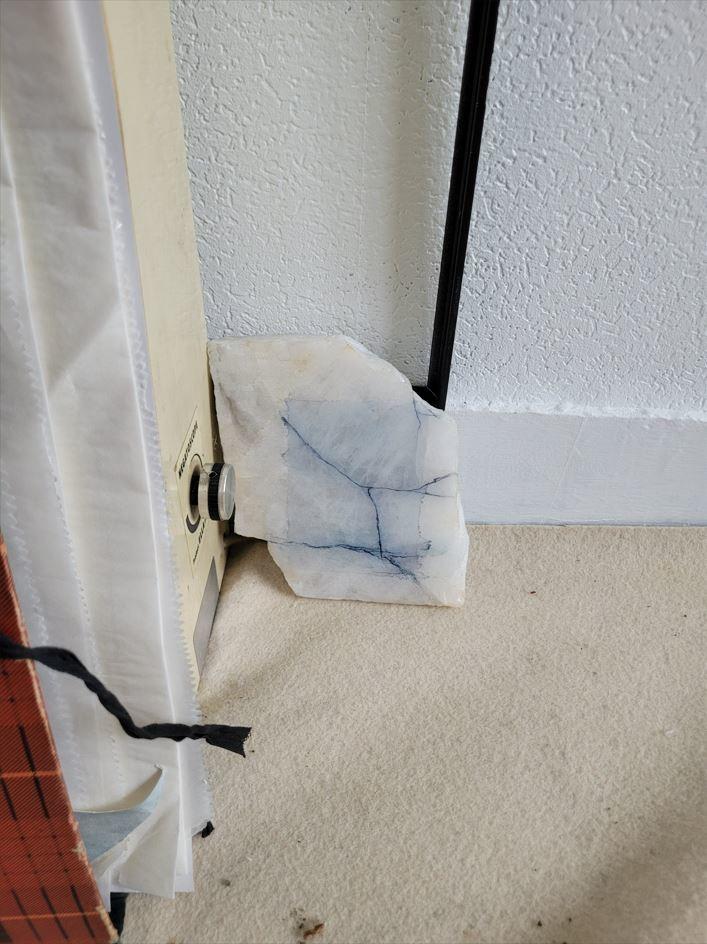
But most of all, there are the works still in an embryonic state. Those not yet born, still gestating. Works in progress. Like a piece of marble lying on a patch of carpet, whose veins have been etched — or perhaps revealed — by the cyanotype process. The underground world of the stone rises to the surface. A simple concept with promising beauty.
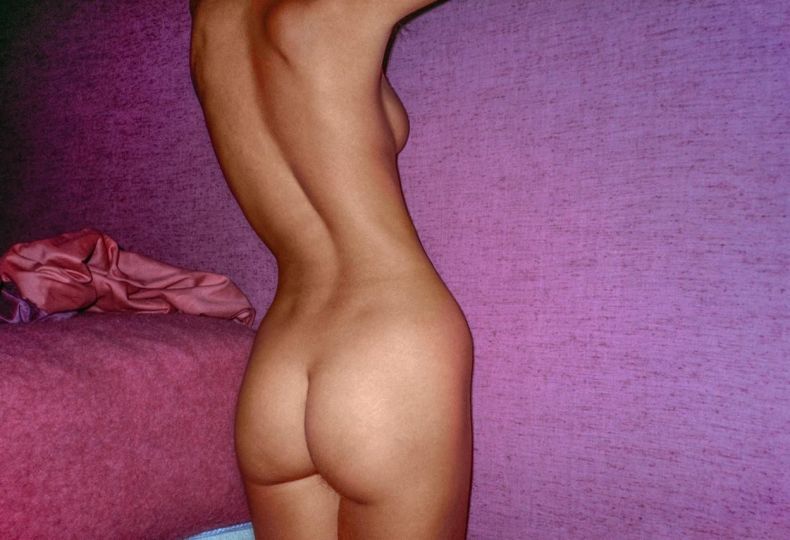
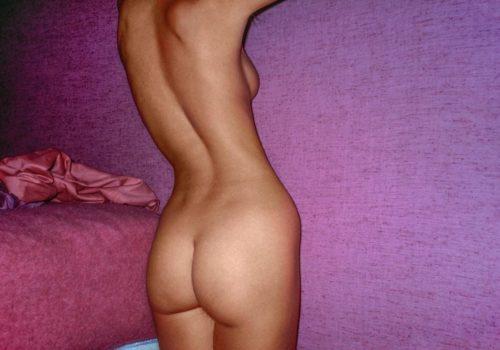
Also on the table are three frames, almost like three notes from the same movement. Each contains a rose-tinted, almost ethereal border, with at the center the curve, the fold of skin, and the roundness of a woman’s body. Her chest pressed to her knees. A nude, but deceptive — not a woman, but a sculpture, frozen in pose, found somewhere in the collections of the Musée d’Orsay.
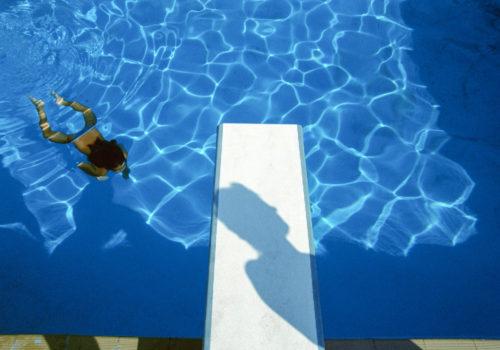
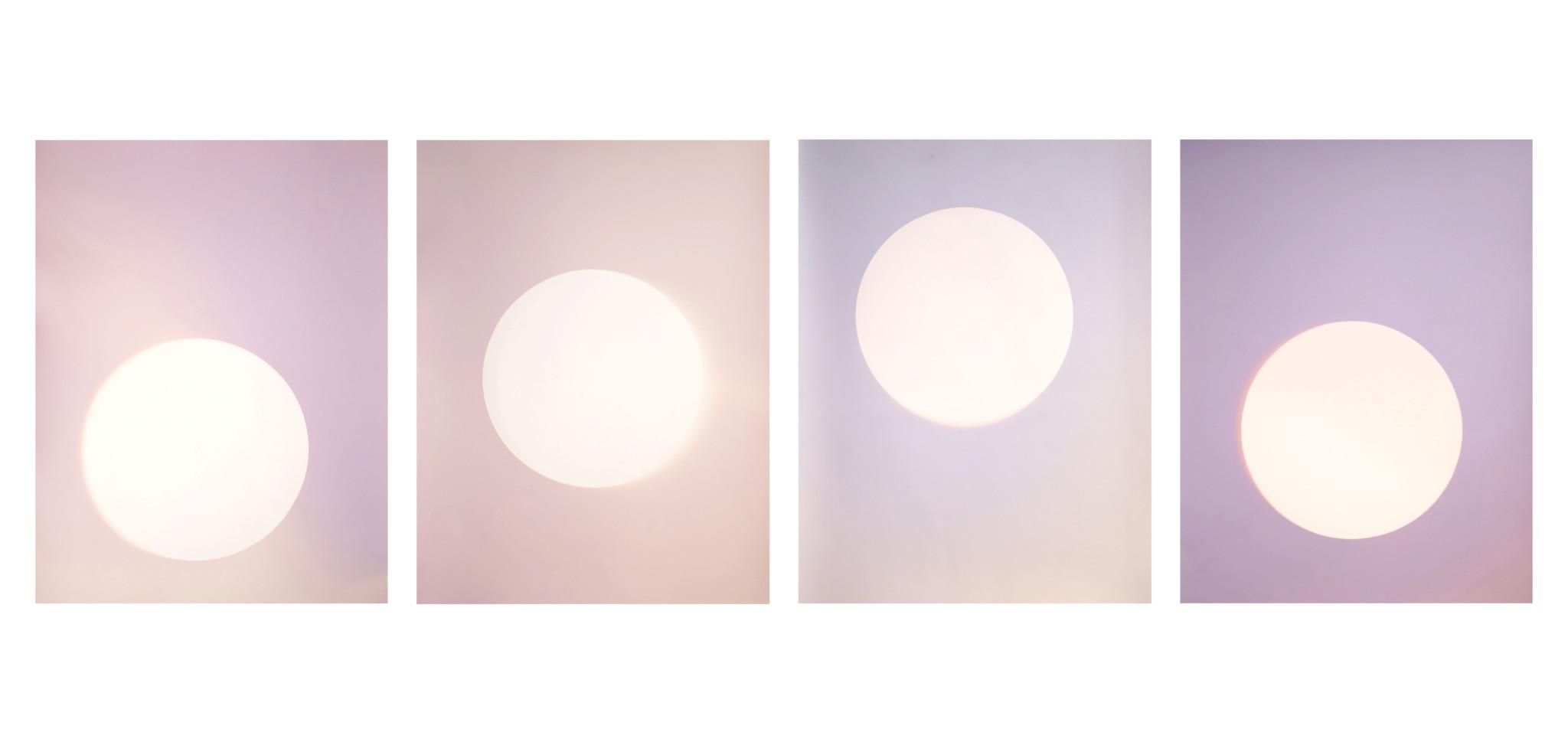
Marie Clerel’s photography is joyfully deceptive. What’s depicted might be foliage, or a masquerade of motion. A nude woman, or her classical representation. To the question “What is it?” one must answer as a child would: it’s time. Time and its suddenly darkened sky, in the series “Riviera”. Time and its hidden face, in “Lunaisons”.
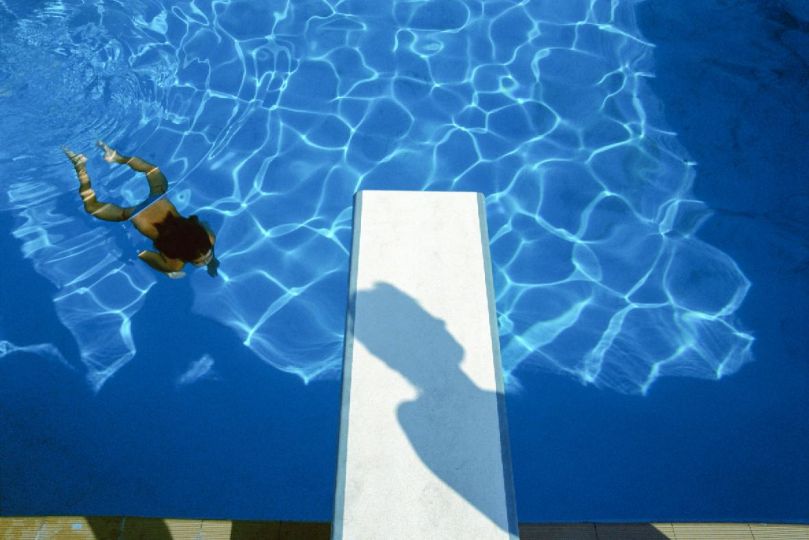
Time, which demands slow exposures, fixing, revelations, and which resists any definitive outcome. The uncertain time of creation, of failing better, again, not quite enough, and then finally, just right. Marie Clerel’s studio is a drawer of time. Do we remember the weather on June 8, 2017? And on March 30? Will we remember tomorrow’s weather? Can one freeze the whispering wind? Marie Clerel’s photography can. Without images, without representation. With imagination and a big blue.
More information