Surface Code
Žilvinas Kropas should be considered an exceptional creator of experimental photography. There is probably no photographic technique that the artist would not want to try. Not only he experiments with the medium of photography, but he also develops a methodical and unique artistic language. By combining techniques and searching for compositional harmony, Kropas creates a world we have never seen before. In his visual narrative, we only partially recognise the objects of our reality. They become new, different, unbelievable, distorted – an unmasked, different side of reality.
Moreover, through his experiments, Kropas shows us that the static or motion-suggesting photography remains a privileged means of visualising the reality. In other words, photography is a source of inspiration that determines the strategies of image creation and popularisation.
Returning to the use of earlier technologies, Žilvinas Kropas seems to be revising the progress and changes in visual creation. Following Frances Guerin one may note that this gesture of revision developed by the artist is linked to the plane of digital culture, where acknowledged and amateur methods of photography are no longer distinguished as separate . However, let us not be mistaken, the main difference lies in the philosophical content of the work, as pointed out by Guerin:
[…] photography has taken on a central role in everyday life as well as in art, academia and communication. […] Photography is becoming a means of community building among those who interact with it. […] Meaning no longer depends solely on the photographer’s intention […] photography enables civic partnership. […] we still see photography as a document or a window to the world. […] Through repeated representations or the defamiliarization of the image, we notice the absence of those who have no voice or image; photography creates an other side of reality.
The latest series of works by Žilvinas Kropas, created in 2024–2025, entitled Paviršiaus kodas (Surface Code), is astonishing and definitely discussion-worthy. The series questions the connections between photography and graphic representation. A circular body is highlighted as the central element of the visual narrative. In some photographs, it clearly resembles the Moon, while in others it appears as a nameless, voluminous sphere.
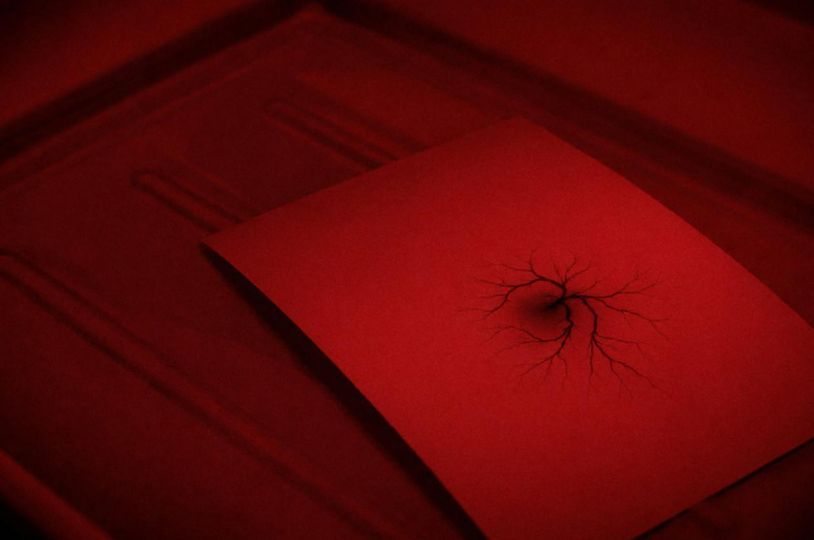
In the photographs, we see marks seemingly left by chemical reactions, cracks and uncontrollable, chaotic processes that occur when liquid substances collide. All this creates the alchemical charm of analogue photography.
Here, chemical materiality transforms the spherical body into an element of a dreamlike landscape, creating the impression of unexplored astronomical space. Moreover, the impression of a chemically decaying surface makes one think about the impermanence of technological media, atmospheric reactions; it also encourages to re-evaluate the problem of memory loss, the sinking of archive records into the zone of oblivion.
Corroded photographs, or imitations of corroded images, inspire the visual metaphor of history, which Rosalind E. Krauss calls a testimony to the fragility of memory. Instead of preserving, the archive becomes a place of memory loss. This creates the impression that the medium is erasing itself . Thus, the environment created by Kropas may be perceived as an optically unconscious aesthetic, where the function of photographic representation is rejected and a return to the origins of the medium (chemical, light effects, unexpected results, etc.) is made. Commenting on similar types of images, R. E. Krauss states:
Photography is presented here as a material shaped by light, time, and chemical accidents – not as a means of representation, but as the body of the medium. […] The surface of the photograph reveals a whole spectrum of scratches, stains and uncontrollable marks, as if it were the field of an alchemical reaction. […] The forms created by chemical reactions force the viewer to lose themselves between landscape and abstraction. […] Chemical layers not only recreate the image, but also cover it with their own marks, making it difficult to read. The act of representation is rejected here – only the surface remains, whose marks speak for themselves .
In this case, it can firmly be stated that the medium of photography in Kropas’ work is no longer just a tool. It becomes a visual object, a sign of an interdisciplinary approach, where fragments of memory about the world flicker like ghosts, where the reality of the photograph no longer represents, but is born from within the material like a fragment of a dream. Kropas’ photography is proof of the connection between visibility and its deformation.
Žilvinas Kropas’s series of photographs, Surface Code, exists as an intermediate space. The author gives us the opportunity to simultaneously approach and distance ourselves from the recognisable; that is, he gives us the opportunity to see the transformation of realism into abstraction and vice versa…
While looking at the photographs, as if in the heat of a creative game, the viewer encounters the question where the abstraction comes from. It seems that different forms of matter – physical and visual – are constantly transforming into one another. It is like a movement between the real and the abstract. And traces of materiality become evidence of what was and may never be again.
In this case, it can be said that the viewer’s gaze is forced to wander between the surface and the depths, between the figurative and the abstract. Photographs not only reflect reality but also embody it. Through photography, it is possible to think about materiality and deepen one’s understanding of how to see . In this case, it is worth remembering Vilém Flusser’s thoughts on the phenomenon of photography:
A way of looking that requires decoding the surface forces the viewer to think. […] To think about photography is to think about how we see and interpret. […] photographs can transcend the boundaries of representation and enter the realm of aesthetics and thought .
Through conscious experimentation, Žilvinas Kropas transcends the boundaries of photography and enters the realm of graphic drawing or experimental painting. It is here that the opportunity for new artistic meanings emerges. The structured surface of the photograph is discerned as a meaning, even though the photographs do not offer an unquestionable image of reality. Instead, the viewer is given only a certain perspective, directed towards a potential structure of the world.
The series of photographs created by Kropas may be regarded as an intentional opportunity to rethink the relationship between the object and its image. We are forced to confront the deconstruction of the apparatus/representation system that immortalises images, showing that images often have no counterpart in reality. According to Flusser, an image is neither true nor false – it represents a field of symbols. Thus, photographs (even those of Kropas) transcend the boundaries of representation and, finding themselves in the realm of aesthetics and thought, show that the author is creating a new visual language through the deconstruction of the apparatus/representation system .
Žilvinas Kropas is concerned with the tension between image and matter. Here, according to Georges Didi-Huberman, there is a gap in the image, a loss or a collapse of memory . As a result, photography refuses to be a document of reality. It boldly moves into the poetic-experimental field. The artist no longer explores reality but reveals visual archetypes to us and aestheticizes certain premonitions.
We are not dealing with the objective truth, but with a creative decision and a certain form of meditation. In this case, Susan Sontag would say that what we see in a photograph is not the world, but the world of images; that is, photographs transform our real world into an abstract one. By transcending the limits of reality representation, the photograph becomes an expression of personal vision. It creates a mirage of reality and is a laboratory for the author’s activity .
Following Joanna Zylinska it may be observed that Žilvinas Kropas’ works speak of the viewer’s lost control of their gaze. Here, the medium of photography acts as an independent agent. The photographs represent a filter that allows us to experience a deep perspective of time, actualising the imprints on the surface. Experimental photography suggests us a possibility to discuss images not only as results of data production, but also as an alternative form of relationship with the world .
In creating this series of photographs, Kropas uses chemograms and digital negatives. The author confesses:
All of these photographs were created using an experimental photographic technique called chemogram. There is no camera, no lens, no even traditional light. There is only photographic paper, chemicals, and the movements of my hands. These movements are sometimes precise and sometimes random. […] The main subject of these images is the Moon. It is a familiar, static, almost always identical and boring celestial body. It seems calm, cold and completely unchanging. But as soon as I transfer it to a chemogram, the celestial body loses its boredom and constancy. The form combines with unexpected patterns, symbols, spots and shades appear… everything is born without my control .
The artist’s detailed account of the application of technology suggests the concept of media research as the explanation of his creative method. In other words, it is not the theme itself that calls for the application of technology, but rather the deep research into the technology that determines the form of artistic language, the pursued theme and its connections with the broader culture of photographic art. In other words, the technology of the medium dictates what needs to be created and around what philosophical axis the creative narrative should be developed.
Thus, Kropas elaborates his artistic research that is based on technological experimentation. The author attempts to explore the potential for the integration and transformation of analogue and digital images. This creative approach is determined by the unique nature of the artistic experience that is being explored. According to Hanan Muneer Al Sheikh, experimental creation marks an exceptional artistic strategy:
[…] in experimentation, we see a departure from the controlled and predictable processes that are characteristic of conventional photography. […] when artists attempt to combine chemical processes with digital technologies and environmental factors, the flexibility and versatility of the photographic medium is revealed .
This quote explains how the intersection between the cultural and technical heritage of photography arises in the present day. Here, we see photography’s ability to create the impression of surprise.
If we look at the photographs in Kropas’ series not one by one, but all at once, we see a repetition, a clear visual rhythm of form. The result of a prolonged viewing is the realisation that the images show us something concrete and even individualised. In this case, Noam Gal’s remark is relevant:
[…] no matter how quickly or mechanically a photograph is taken, the longer we look at it, the greater its potential meaning becomes apparent” .
On the other hand, one can agree with the idea that formal photographs allow us to understand that
in order to simply see, we must employ a creative, highly active and conscious way of looking. […] Disagreements about what is seen in a photograph are often related to the difficulty of putting the visible into words. Certain details in a photograph that cannot be described in words occupy a special place — in one way or another, they correspond to what is consciously left out of the frame .
One thing is clear: Žilvinas Kropas shows us that photography itself has no identity. Its status as a technology changes depending on the power relations with the viewer that influence the image in question.
Through artistic, experimental research Kropas invites us to rethink the connections and dependencies between the nature of seeing and photography. Here, photographs become a practical tool that enables viewing as an activity not previously experienced. In other words, photography gives us a “new way of seeing” where our visual perception of an object changes. It seems that photographs rewrite our experiences, and the object of the photograph becomes a mediated interpretation.
Thus, it can be said that Kropas openly explains to us that a photograph can easily fabricate and misrepresent an object, and we uncritically perceive the resulting manipulation as a representation of reality. Irene Naudé observes:
Photographs recreate what we see, turning the world into captured moments and providing an opportunity to create other narratives of events in their absence. […] And when aesthetics become embodied experience, we engage not only our minds but also our senses .
In other words, even Kropas’ photography, which is particularly oriented towards experimentation with form, creates new memories that are determined by the current context and traces of the past. When confronted with abstract photographs, we seem to search for and grasp any new meanings. We do not lose the belief that they are able to outline clear perspectives for interpretation. Therefore, when faced with Kropas’ experimental photography, we are forced to be in a constant process of reinterpretation. What is more, the photographic image begins to create new memories for the viewer (and not necessarily realistic ones). Here we are dealing with the artist’s desire to stimulate the viewer’s pure and unrestrained imagination.
Since photographs often provoke memories that are not visible in the image itself, we encounter countless layers of memories, recollections and cultural planes while looking at them, even with such abstract creations as Kropas’ works. Through photographs, we find ourselves in the memory of memory and in the constant (re)creation of that memory. This means that when we look at photographs dominated by formal experimentation, we are dealing not only with the image as an abstraction, but also with the photograph as an artefact that demands new meaning. It turns out that abstract photographs are far removed from the definitions of primary reality.
By way of summary, it is possible to claim, that experimental photography, within the limits of this text, reveals itself as an artistic practice capable of radically transcending the usual documentary function of photography. Žilvinas Kropas’ works do not aim at capturing reality. The author is more interested in its transformation, interpretation and visual re-consideration. The artist is no longer an observer and recorder of reality. He is an alchemist, “meddling” with chemical processes, surface structures and optical deformations. He constructs new forms of reality, characteristic of dreams and mirages.
8 July 2025
Prof. Dr. Remigijus Venckus – (VILNIUS TECH) Vilnius Gediminas Technical University
VISUAL ALCHEMIST ŽILVINAS KROPAS
On the photographic series “Surface Code” (2024–2025)