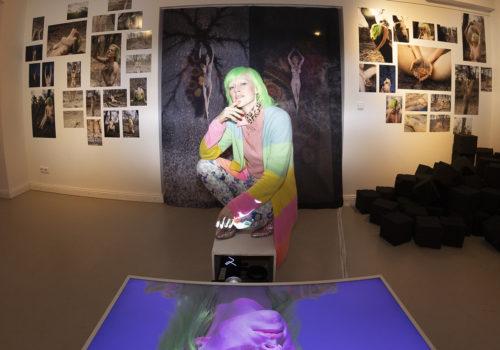
I first crossed paths with Johanna years back at an art event. With her distinctive energy and look, she’s impossible to miss – and the same goes for her work. So when her current show opened, we sat down to talk about the forces driving her practice, her creative process, and more. Dive in!
Nadine Dinter: Your current exhibition is called LEAVE YOUR BODY LIKE A SHELL / Bare Elements – Ice & Fire. Could you tell us a bit more about the origin of this unusual title?
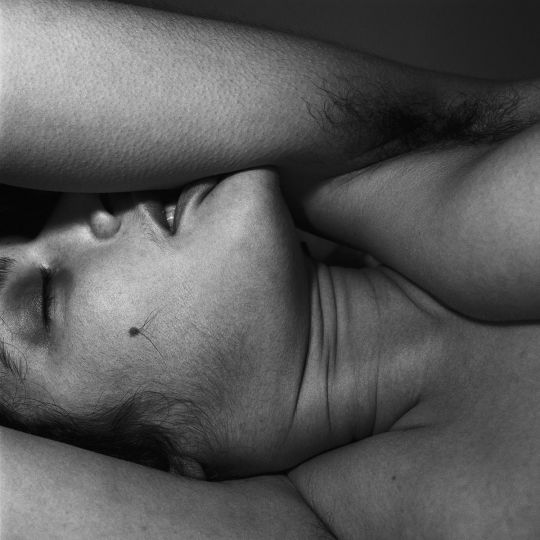
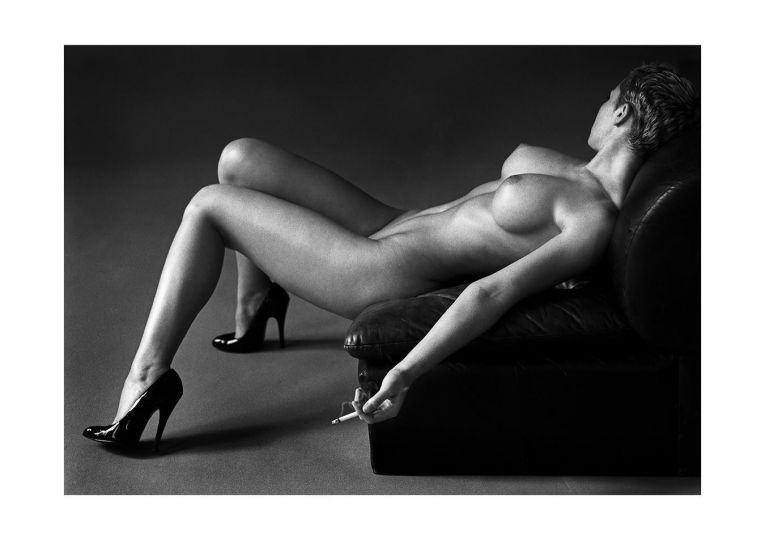
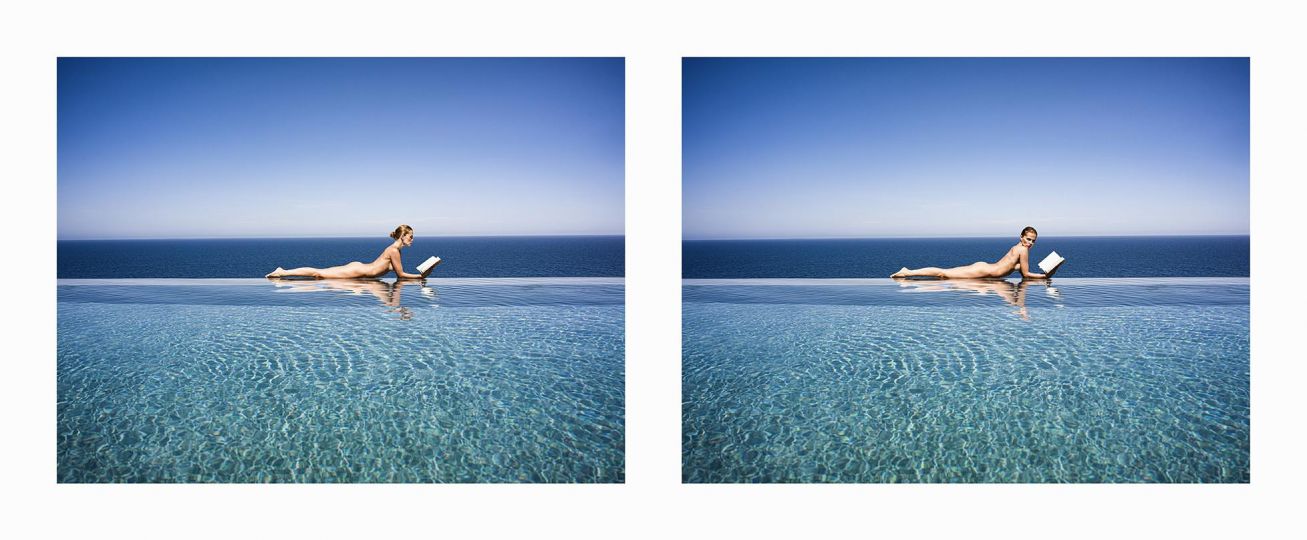
Johanna Keimeyer: My work investigates the body as a shell that never fully expresses our inner world. The title refers to the body as a vessel rather than an identity. In LEAVE YOUR BODY LIKE A SHELL, water becomes a space where I can explore freedom of thought and spirit, even while being bound by breath and gravity.
I explore the raw, unadorned human state within pure nature. In BARE ELEMENTS – Ice & Fire, this becomes a confrontation with what remains hidden beneath perception. At the core of both series lies the question: Who am I really?
In this show, we see two main series, Fire and Ice. What does it mean to work with such elemental forces?
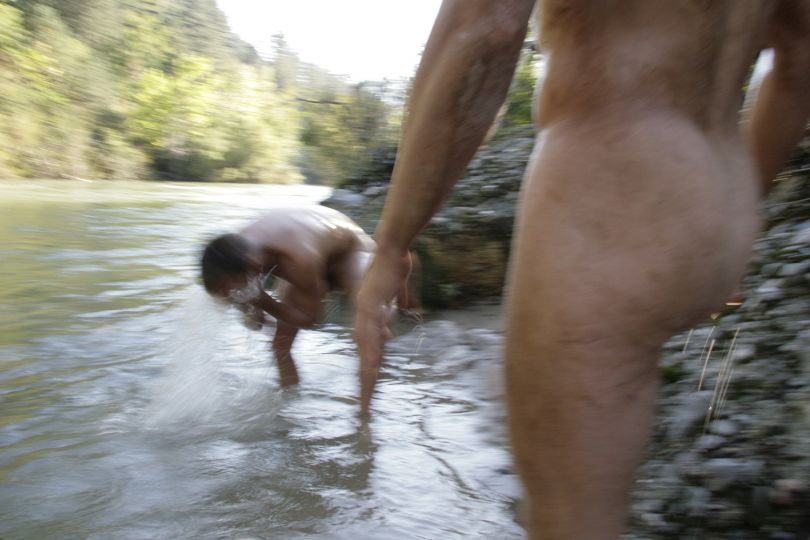
JK: In BARE ELEMENTS – Ice & Fire, I immerse myself in the elements au naturel and make the act of performance in front of the camera the artwork itself.
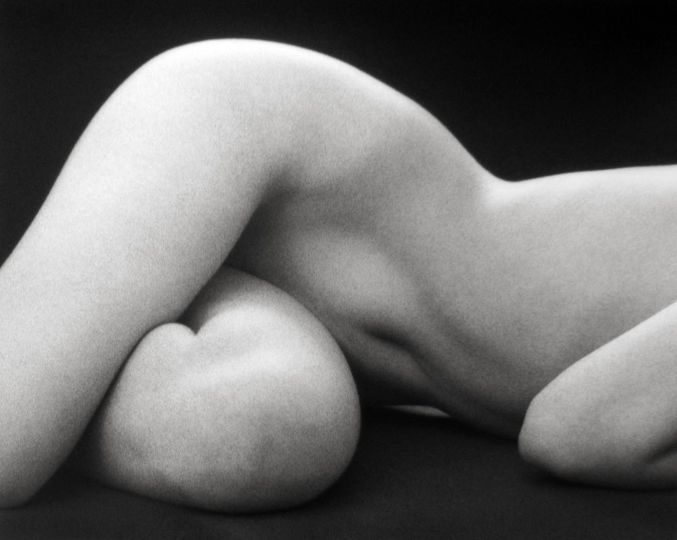
I seek to draw attention inward – toward that which is hidden, our most private and sacred space. My body may be exposed, judged, admired, or rejected; it may be seen as beautiful or not. Still, I remain separate from it. My body is a vehicle, but not my essence. We are far more than our outer beauty or the fragile architecture of flesh. What lies beneath must be preserved, protected, and explored. It is in this exploration that clarity may arise, guiding us deeper into the eternal questions: Who are we? What is our true expression in life?
On the photographs, we see you in a very pure form. Is this vulnerability intentional?
JK: In this work I expose myself, vulnerable, radically open, and therefore also provocative. I make myself transparent and honest in front of the camera. This openness is integral to my practice. My body is present, but it is not the essence. It is my shell, a vehicle that never fully expresses what moves within me. What remains hidden cannot be shown, only approached.
Your photographs feel closely tied to performance and presence. How do you understand the relationship between the performative act and the resulting image?
JK: The performative act is the work itself. The photographs are traces of lived experience.
What role does nature play in your work?
JK: My intention is to reveal the beauty of pure nature – and to present us as human beings as we first arrive in this world: as pure awareness.
Nature itself becomes the space in which the work unfolds, opening an encounter with an inner landscape.
You speak about inner and outer shells. How do you depict concepts like freedom and transformation?
JK: Freedom begins internally. Through awareness, perception shifts and we transform. Even within physical limits, the spirit remains free.
The body is a shell, a vehicle, while the mind remains free.
You also work with the moving image. Is film an extension of photography for you?
JK: Within the exhibition, film deepens the photographic works by introducing time, movement, and lived presence into the images.
Photography was the first medium I grew up with. My mother, an artist herself, documented our lives extensively with her camera, which was quite special at that time, creating photo books for each of us. We were six children, and these albums became early records of memory, presence, and identity. It remains the medium in which I feel most secure expressing myself.
Film came later. During my studies, especially through video projections and my graduation work, I fell in love with the moving image. Film allows lived time and presence to unfold. In my practice, I often work from video and use stills as outcomes, many performances exist only through video recording. Sometimes a live video performance resolves into a photograph; sometimes a still image continues as moving image. This fluid movement between media also shaped my long-term engagement with underwater photography.
You underwent intense training for your underwater work. Did that process change you personally?
JK: Yes, very much so. I have been working with underwater photography for almost 20 years, and in a way, the work itself became my training. Trying to stay underwater longer, driven by the desire to capture a certain image, was the most intense preparation. I trained for many years before realizing how long I could actually hold my breath.
Over time, this led me to take part in a German freediving competition, where I reached a valid breath-hold time of almost five minutes.
Freediving introduced a very specific experience of letting go. The free fall during descent is deeply calming. At depths of around 40 meters, the body enters a different state – the lungs are compressed, the mind becomes quiet, and awareness sharpens. Through breath control and meditation, the heart rate slows, tension dissolves, and a sense of freedom follows. Freediving is a precise balance between control and surrender. It becomes a practice where training and inner alignment make mind over matter tangible.
In your underwater film, you wear a haute couture dress by Wolfgang Joop. Why?
JK: The dress functions as a second shell – a visible extension of the body as vessel. Underwater, it becomes a presence I dance with, almost like a counterpart, entering into a silent dialogue. In the end, the dress stands in for my body itself – a body the spirit has left, no longer inhabited. Leaving it behind transforms it into a relic of the experience, a trace of what has been lived and released. The spirit itself remains unseen; it moves on and transforms into something new.
At the same time, wearing a Wunderkind outfit by Wolfgang Joop gave me strength. I deeply love his clothing – the care, the attention to detail, the playfulness, and the uncompromising creativity it carries, along with the quality of the materials. Entering the water with it supported the performative state I needed to inhabit.
What’s next for you?
JK: I am currently working on two new films emerging from the BARE ELEMENTS series – Ice and Fire – extending the photographic works into moving images. At the same time, I am developing a behind-the-scenes film for LEAVE YOUR BODY LIKE A SHELL. Further screenings and exhibitions will follow, including presentations around Gallery Weekend in Berlin. And of course, there are visions and ideas I am committed to bringing into form. The work continues to show me how much more is possible than we initially assume – for all of us, following our own paths.
For more information, check out the artist’s IG account @johannakeimeyer
Johanna Keimeyer’s show LEAVE YOUR BODY LIKE A SHELL / Bare Elements – Ice & Fire is on view at rk-Gallery, Möllendorfstrasse 6, 10367 Berlin through 4 March 2026