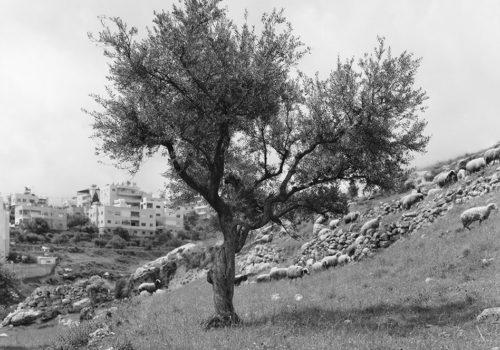
In a sober format—20x25cm black-and-white prints—artists Adam Broomberg and Rafael Gonzalez propose a set of images of symbolic intensity in Anchor in the Landscape. A series of century-old olive trees, photographed in the occupied territories of Palestine. These trees, some of which are thousands of years old, are historical and political witness.
The olive tree, a central figure in Palestinian identity, is much more than a tree; it is a symbol of continuity and resistance. More than 100,000 families still depend on its cultivation today. It marks the seasons, shapes the landscape, and supports an entire rural economy. But since 1967, some 800,000 olive trees have been uprooted or burned by Israeli authorities and settlers—an act that many Palestinians see as an attempt at cultural as well as physical erasure. It is in this context that Broomberg and Gonzalez undertook an 18-month journey through the Occupied Territories. Their approach is more about visual memory than photojournalism. Each image seems suspended in time, taken at a distance from the local political turmoil. The olive tree is not documented as a subject of reportage, but observed as a character; each trunk, each scar, each knot in the wood tells a story of endurance. The chosen format reinforces this contemplative approach—a slow, demanding process that requires both patience and rigor.
The images are striking in their silence. There are no silhouettes or human figures, no borders or soldiers, but everything speaks of presence and absence. In this landscape marked by occupation and destruction, the trees become fixed points, anchors of continuity amid change. Broomberg and Gonzalez treat them as natural monuments, standing tall despite everything, rooted in a disputed land. The black and white accentuates the timeless dimension of the subject, transforming these olive trees into veritable vegetal archives.
This project marks the meeting of two generations and two sensibilities. Adam Broomberg—born in Johannesburg in 1970—is an artist, activist, and educator who made his name as one half of the duo Broomberg & Chanarin, whose work questions images of power and war. Winner of the Deutsche Börse Photography Prize (2013) and the ICP Infinity Award (2014), he continues to be strongly committed to the NGO Artists + Allies x Hebron, which defends freedom of expression in the Palestinian territories. Alongside him, Rafael Gonzalez—born in Saint-Cloud in 1997—a young Franco-Spanish photographer trained in Berlin, London, and New York, presents his first major project here. His more intimate gaze complements Broomberg’s in a sensitive approach to the landscape.
Together, they offer a poetic but lucid interpretation of the territory, a collective portrait through these trees, a way of evoking Palestine without ever showing it directly. These photographed olive trees, both wounded and standing tall, remind us that the landscape can be a form of memory. That it retains, in its lines and scars, the memory of human gestures, losses, and rebirths. By capturing them on film, Broomberg and Gonzalez have created a visual manifesto in which photography becomes a witness and the olive tree a universal symbol of perseverance.
Jean-Jacques Ader
Exhibition at Villa Medici in Rome, currently and until January 19, 2026. Publication of the book “Anchor in the Landscape” by Mack Books, produced on the occasion of the exhibition during the 60th Venice Biennale.
Villa Medici
Viale della Trinità dei Monti, 1
00187 Roma RM, Italy
https://villamedici.it/en/