From the winding road along the Corniche d’Or, it appears suddenly, almost unreal: a cluster of pink and ochre spheres, like bubbles escaped from a dream, frozen on the cliffs of Théoule-sur-Mer. The Palais Bulles is there, seemingly set between sky and sea, defying both gravity and reason.
It was in 1975 that Antti Lovag, a nonconformist architect, began this organic construction, freed from right angles, which he considered “aggressive” to humans. For him, a dwelling should follow the natural curves of the body and of nature, like an extension of the skin. Each bubble is a cocoon, each porthole a window onto infinity. For nearly ten years, the structure grew, unfolded, and nestled into the red rock until Pierre Cardin, in 1992, recognized in it his own vision, transposed into architecture. He did not buy it to live there — he adopted it as one adopts a muse.
The man who revolutionized fashion with futuristic cuts and sculptural silhouettes saw in this palace the embodiment of his own intuitions. Here, nothing yields to banality: floors extend into tiered platforms, pools spill into shimmering cascades, and circular rooms open onto the Mediterranean like eyes gazing out to sea.
The curves invite fluidity. No rigid hallways: one drifts from one space to another as if carried by a wave. The walls, impossible to adorn with frames, lend themselves to murals, to plays of light that, depending on the hour, transform the material. In the morning, the sun pierces through the portholes, creating golden halos; in the afternoon, grazing light emphasizes the volumes; at night, Cardin’s spotlights turn the palace into a spacecraft poised to break away from Earth.
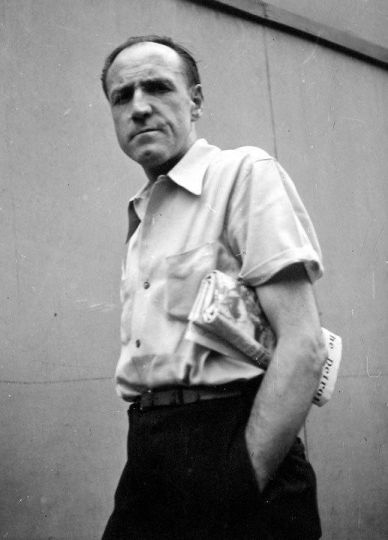
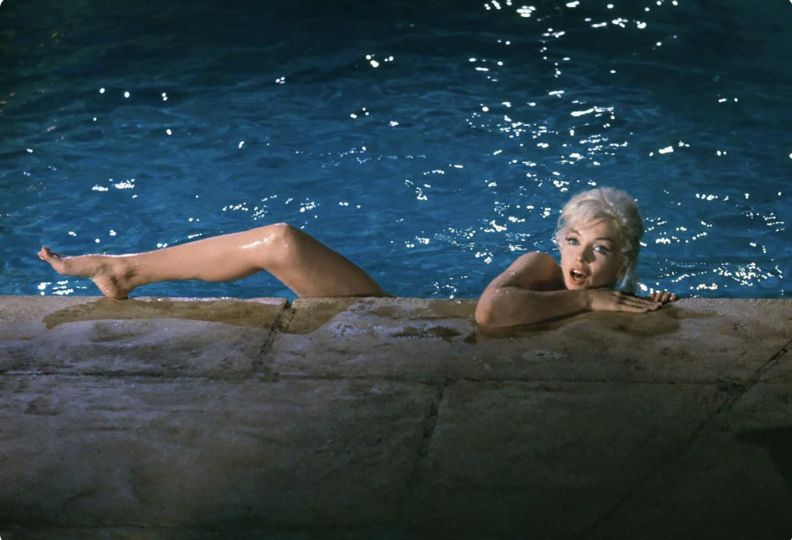
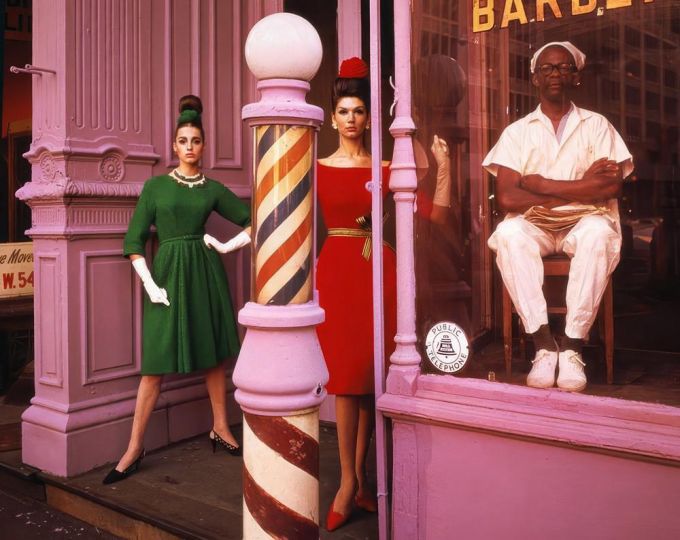
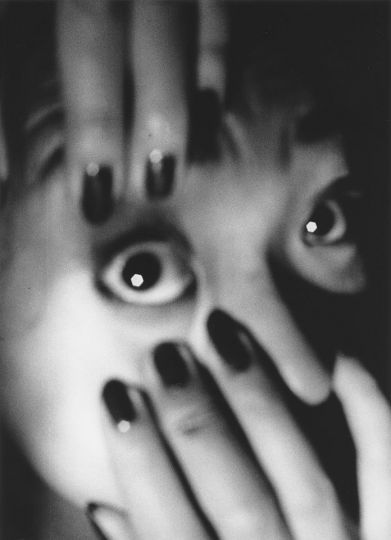
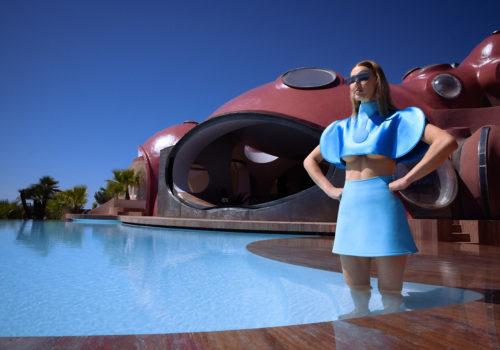
The Palais Bulles has always drawn artists like a magnet. Jean-Daniel Lorieux was among the first fashion photographers to set his lens here, fascinated by the alchemy between bodies and architecture: models glide across the terraces as if on a catwalk, melt into the walls, and become living sculptures. This master of vivid colors and glamorous atmospheres found here a setting worthy of his staging: terraces where models seem suspended over the void, water reflections that redraw faces, and portholes framing bodies like precious jewels.
Here, light does more than illuminate — it sculpts. In the morning, it floods the rooms with warm halos; in the afternoon, it carves sharp shadows onto the curved walls; at dusk, it wraps everything in a dreamlike glow.
Each shot becomes a manifesto. A fluorescent dress stands out against the blue of the sea; a white swimsuit blends with the coral hue of the walls; a face emerges from the shadow of a circular porthole. Photographers come here for what no studio can offer: shifting light, improbable perspectives, a constant dialogue between nature, art, and humanity. This place is far more than a backdrop — it is a silent accomplice.
Pierre Cardin turned it into a jewel box for his creations, a laboratory for his visions. He hosted fashion shows, soirées, and artists. The spheres resonated with music, laughter, and voices. Sometimes silence reclaimed its place, with only the sound of waves brushing against the glass. For the Palais Bulles is not just a living space — it is a living organism, breathing with the rhythm of wind and light.
Today, listed as a historic monument, it retains its unique aura — that of places untouched by time. One can admire it from the sea or the shore, but it can only truly be understood by allowing oneself to be enveloped within it. Then, angles disappear, thoughts loosen, and one begins to see the world differently: round, infinite, in motion.
Walking through it, one realizes that Antti Lovag and Pierre Cardin were right: curves soothe, they embrace, they make the mind freer.
In the end, the Palais Bulles is not a house. Nor is it a museum. It is a mineral dream, a fragment of the future set on the edge of the Mediterranean. A place where art, nature, and humanity no longer oppose each other, but finally merge.
Carole Schmitz