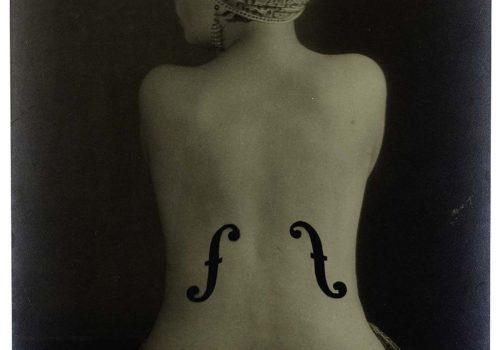
The Metropolitan Museum of Art presents the first major exhibition on the American artist Man Ray (1890-1976) and his experimentation with the rayograph. Comprised of 35 pieces of work, Man Ray coined the term rayograph to name his 19th-century technique of making photographs without a camera. The process involves placing objects on a sheet of light-sensitive paper and then exposing it to light and developing the work. What appears is silhouettes reversed, or negative versions of their subjects. The finished work has an air of mystery and mystique. The photograms are a blend of abstraction and representation, crucial to Dada and Surrealist art.One might say dreamlike, which led the Dada poet Tristan Tzara to describe the rayographs as capturing the moment “when objects dream.”
Man Ray’s ability to experiment is a testament to the artist’s belief that his craft was not strictly bound by a medium. He was aware that his art did have photographic origins though. This presentation of this work is the first—more than a century since he introduced the rayograph—to acknowledge this signature accomplishment in relation to his larger body of work.
Man Ray stumbled upon this new medium somewhat by accident. In 1921, while working in his Paris darkroom late one night, he inadvertently placed some of his glass equipment on top of an unexposed sheet of photographic paper he found among the prints in his developing tray. As he wrote in his 1963 autobiography, “Before my eyes an image began to form, not quite a simple silhouette of the objects as in a straight photograph, but distorted and refracted … In the morning I examined the results, pinning a couple of the Rayographs—as I decided to call them—on the wall. They looked startlingly new and mysterious.” This “accident” may have become the medium that’s considered the culmination of the artist’s work up to that point and how he would redefine his craft. It opened up new experimentations between dimensions, media and formats. He was casting aside traditions and creating anew at a time when Dad and Surrealism were at the forefront.
The selection of rayographs on view at The Met highlights the connection between the photograms and his other media, which includes assemblage, painting, photography and film. The focus on the rayographs is significant when studying Man Ray’s body of work, as this time period was considered his most productive and creatively significant period of his career. This would have been the years of 1915-1929 beginning with his ambitious paintings and concluding in Paris, fine-tuning of the solarization process.
Max Hollein, The Met’s Marina Kellen French Director and Chief Executive Officer, spoke of the current exhibit and Ray’s overarching impact as an artist. “As one of the most fascinating and multi-faceted artists in the avant-garde movements of the early 20th century, Man Ray challenged traditional narratives of modernism through his daring experimentation with diverse artistic mediums. Hollein added, “anchored by Man Ray’s innovative and mesmerizing rayographs along with new research and discoveries, this exhibition invites visitors to explore his ground-breaking manipulation of objects, light, and media, which profoundly reframed his artistic practice and impacted countless other artists. We’re so thrilled to include thirty-five works by Man Ray in this exhibition.”
Elizabeth Hazard
Man Ray : When Objects Dream
Now through February 1, 2026
The Metropolitan Museum of Art
1000 5th Ave.
New York, NY 10028
www.metmuseum.org