For its second edition, the Swiss Month of Photography has established itself as a nationwide event. From August 29 to October 5, 2025, nearly sixty venues across all linguistic regions joined forces—museums, independent galleries, festivals, and art schools together presenting a dense and diverse program. A digital platform gathers all participating events and features an interactive map that locates each venue across the country. Although the official month has ended, several exhibitions continue into 2026, extending the exploration of photography in its many forms.
Massao Mascaro – “Here, There” at the Centre de la photographie Genève
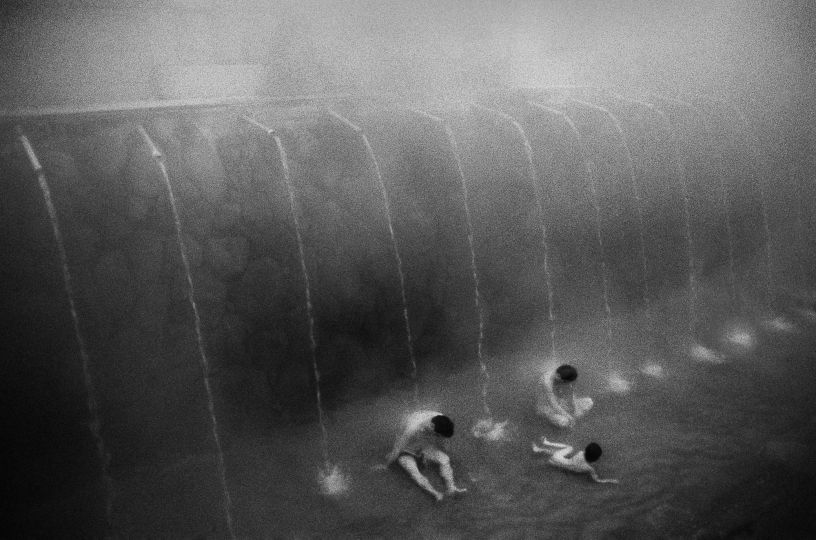
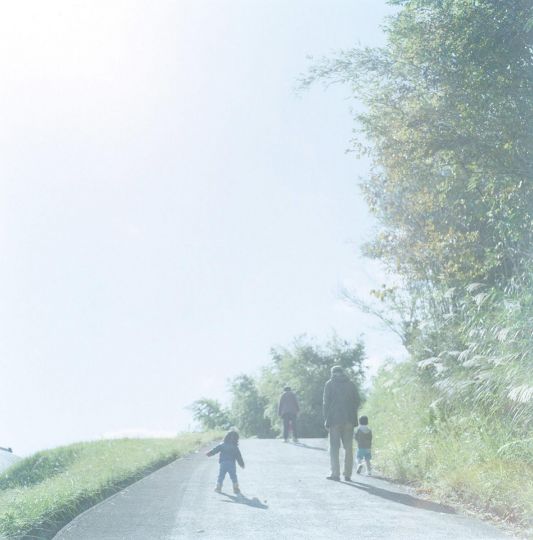
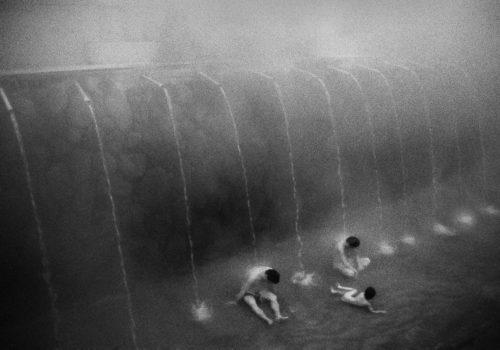
On view through January 9, 2026, in the raw concrete setting of the Maison de l’enfance et de l’adolescence at Geneva’s University Hospitals, Massao Mascaro’s exhibition juxtaposes two series: one following the Rhône along Geneva’s riverbanks, the other depicting his family table in his Brussels apartment. The monochrome silver prints appear almost vaporous, as if a dreamy veil had settled over the lens.
Fatherhood has transformed Mascaro’s relationship to time and space, nurturing a contemplative attention to the subtle variations of everyday life. His photographs of the domestic interior in Brussels elevate the disorder of post-meal moments the sunlight revealing the beauty of a lemon, scattered crumbs, or displaced objects ordinary scenes transfigured by light. This sensitivity to illumination, the raw material of photography itself, softens and refines his prints. By revisiting still life, Mascaro highlights what the eye usually overlooks.
“Flash! A Short History of Lit Photography” at the Swiss Camera Museum, Vevey
At the Swiss Camera Museum in Vevey, “Flash! A Short History of Lit Photography,” on view until February 22, 2026, traces the evolution of a technique that expanded the possibilities of photography. Modest in scale but rigorous in conception, the exhibition examines how flash technology—from the first magnesium experiments to modern electronic devices—opened new spaces to photographic vision.
The opening section vividly captures the perilous beginnings of this conquest of artificial light. The hazards of magnesium flashes combustions, smoke, accidents recall how dangerous was the mastery of light . The exhibition then follows the flash’s progression from illuminating underground and nocturnal worlds to becoming a tool for dramatic staging in Weegee’s photojournalism or the realm of the paparazzi. Harold Edgerton’s experiments in freezing motion appear alongside the accidental aesthetics of amateur photography red eyes, overexposures culminating in the contemporary irony of Martin Parr, who uses exaggerated color to critique reality.
While a broader selection of works could have expanded the scope, the exhibition is crucial in understanding how one innovation reshaped photographic language. It addresses both newcomers and specialists, reminding visitors of the importance of revisiting photography’s technical history, too often neglected in favor of its artistic narratives.
“Photogenic Domestics” at the Médiathèque Valais, Martigny
At the Médiathèque Valais in Martigny, “Photogenic Domestics” presents more than 600 archival images from the State of Valais and the Valais History Museum collections, on view until March 28, 2026. The exhibition spans thousands of years, pairing photographs from the late 19th and early 20th centuries with archaeological discoveries tracing the domestication of animals back to the Neolithic era, when agriculture and livestock first emerged in the Middle East 7,000 years ago.
The exhibition explores animal domestication through the species that have coevolved with humans in the Alps—cows, sheep, goats, pigs, mules, as well as chickens, bees, horses, cats, and rabbits. These photographs bear witness to a vanished agro-pastoral economy, revealing the ingenuity required to manage herds in the challenging Alpine environment, shaped by steep slopes, shifting seasons, and arid morainic soils. It is also a tribute to the resilience of mountain life before the arrival of roads, electricity, and running water.
Educational yet never simplistic, the exhibition appeals to all audiences. Its scenography includes reconstructed animal enclosures and fields that particularly engage young visitors. The wall texts balance scientific rigor with storytelling accessible to children. Notably, many Valais residents have returned to see images of their own villages from decades past—some even recognizing family members restoring to the photographic archive its original role as a vessel of collective memory
Adrien Golinelli: “The Sour Taste of Pomegranate” at Galerie Focale, Nyon
At Galerie Focale in Nyon, Adrien Golinelli presents a body of work produced in Syria during the summer of 2025, only months after the fall of the Assad regime. This sense of documentary urgency defines the exhibition: few photographers can access the region, where conditions remain volatile and movement depends on armed local guides. Known for his previous immersion in North Korea, Golinelli here captures a fragile historical threshold.
In a scenography designed by Aurélien Garzarolli, some forty images alternate between framed prints and large-scale wallpapers. Torn portraits of Bashar al-Assad mark the symbolic collapse of power. A panoramic view of Aleppo, taken from the citadel heights, reveals a wounded city where centuries of layered dwellings have become a contemporary ruin. The same tension permeates the ruins of Palmyra, once a military stronghold for various factions and now a site marked by a double destruction that of antiquity and present conflict.
Yet beyond the ruins, Golinelli also documents the resilience of the Syrian people: a woman holding a bouquet of helium balloons in a village being rebuilt, cargo ships gliding across the Mediterranean. Though tension and instability remain, his rare access makes this series a crucial photographic document of a country largely absent from the international press. As suggested by the title “The Sour Taste of Pomegranate,” the fruit’s bittersweet flavor encapsulates the complexity of today’s Syria.
Maeva Dubrez
More information