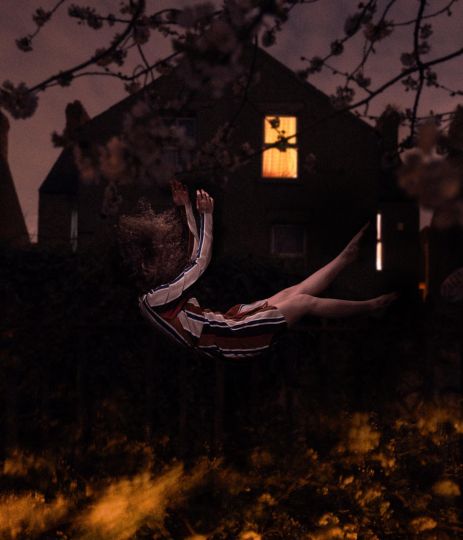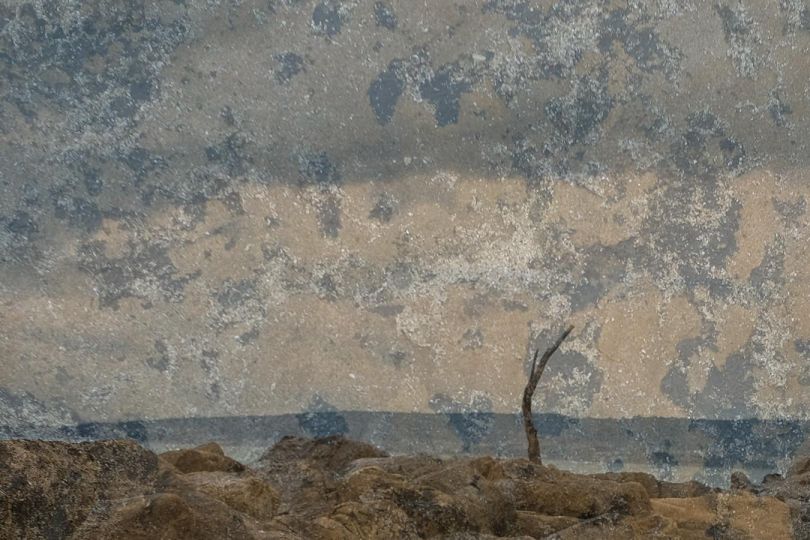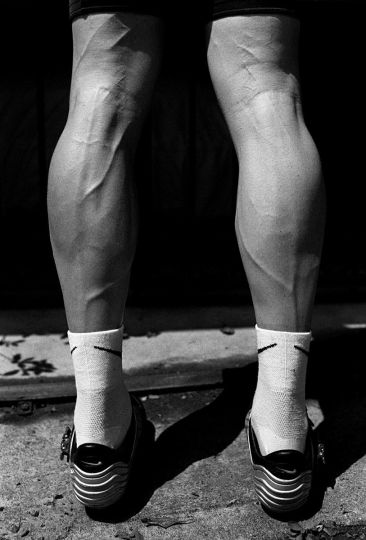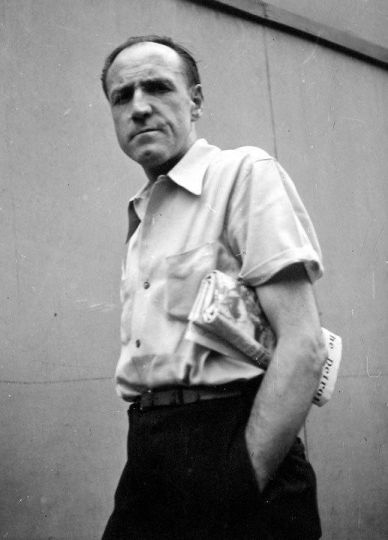
A girl in a striped dress and white socks reading a book, her knees on the floor and her elbows propped on the seat of a distressed white chair (Mädchen am Stuhl, 2006). A white towel draped over the edge of a rectangular bench angled just so in an otherwise empty, dimly-lit room (Stool, Cloth, 2010). Rustic tins and a single spoon on a rough-hewn ledge, above which a curled snapshot has been pinned to weathered clapboards with a bent nail (Picture, 2013).
While these sentences may be unjustly brief descriptions of works in Oskar Schmidt’s oeuvre, they serve a schematic purpose: to highlight a key but seldom discussed aspect of his artistic practice, that of the photographer as auteur. Little in Schmidt’s pictures is unscripted; each, in fact, is the result of a highly rigorous process that starts with an idea and follows with a series of decisions that get worked out within the confines of his studio.
Notwithstanding the myth that the photographer needs no more than a world to photograph and a darkroom in which to process and print, there is nothing novel about this general approach. Well before the high production values of Thomas Demand, Andreas Gursky, Jeff Wall, Cindy Sherman, Christopher Williams and others became de rigueur, many photographers since the early years of the medium had gone to great lengths to orchestrate every detail of their pictures towards artistic ends, often borrowing motifs and compositional devices from painting. Even so, Schmidt has carved out a distinct and fertile niche within this mode of picture-making. His taut but expansive body of imagery, developed gradually over the past decade, has made the case for the special ability of his medium to question its own nature at a time in which it has been thoroughly incorporated as just another tool in the contemporary artist’s bag of tricks. His exquisite finished prints, constructed with a masterly sense of craft, are suffuse with texture and light, even as they betray his tendency toward an unadorned minimalism laden with symbols and signs.
In his most recent compositions, Schmidt has become even more boldly reductive, pushing his imagery to abstract, unfamiliar territories. The patinaed surfaces that had previously lent his pictures an anachronistic, old-world character have been traded for texture-less backgrounds and smooth, reflective surfaces.
The enormous attention to detail required to create the authentic-looking sets for his Walker Evans-inspired imagery from “The American Series” has been channeled into investigating what precise shade of blue, green, pink, or beige harmonizes best with a given subject. And while Photoshop was formerly a cloaked part of his workflow, Schmidt has given himself over fully to the possibilities and linguistics of the virtual, digital space that photography is now inextricably associated with. “Liquid” therefore refers not only to the improbably sinuous streams of water featured in a number of the new images, but also to the fluidity of making and modifying—and the confounding slipperiness of reading— photographic images in the twenty-first century.
The shelves in Schmidt’s studio are filled with disposable items from bygone eras—a complete, folded American newspaper from the 1960s, for example, or soda cans and waxed paper beverage cups from the 1980s—that he has been collecting via eBay as potential fodder for his photographs. He had been initially drawn to such pristine vintage objects as artifacts of an “absolute economic efficiency” (ironically the reason for their relative scarcity), but as he worked with them, he discovered that the subjects with the most potential bore an ambiguous sense of time and place. “I wanted to stop time, to show timelessness,” he has noted, “so I became interested in objects that were neutral and sculptural, but that had a universal, iconic character as well. A Starbucks cup from today has for me the same iconic value as Campbell’s soup cans or Coke bottles from the 1960s
and 70s.”
It should come as no surprise, then, that another of Schmidt’s references for his new series are the period product shots and print advertisements that helped make these brands ubiquitous. Primped and idealized, the image promoted by these ads bears little relation to reality, yet they manage to tap into everything we want to have, or be. If we look back today at ads from past decades, however, the hollow pictorial strategies of marketeers are laid bare—the images are specific enough so that we might each identify with them on some personal level, but banal enough so that as much of the general population as possible can imagine themselves possessing the dream being sold. It is this gap between the ideal and the real, the specific and the homogenous that Schmidt has been mining all along, with his most recent pictures focused on the exploration of what could be called the anonymous sublime.
Despite the apparent simplicity of the new images, they are the product of painstaking labor that is as much an activity of editing out as it is deciding what to include. As it turns out, it requires a great deal of effort to make objects look totally neutral and decontextualized, without a trace of the world or process that brought it into being. Schmidt starts by scrutinizing the thing itself on a set of surfaces (glass, polished chrome) chosen for their objective character. He then custom mixes paint to create a monochromatic background inspired by a range of sources including stock photographs, computer desktop wallpapers, and colors commonly used by the healthcare industry to suggest a sense of wellbeing. Finally, after illuminating the tableau with a soft, even light, focusing his view camera, and making an exposure with film, he scans the negative and imports the image into Photoshop, with which he “transforms and modifies the inner structure, the DNA” of his images in a “digital vacuum.” The resulting pictures are uncanny: acutely described but ultimately impenetrable set of perfectly isolated—perhaps even lonely—surfaces.
What can we glean from these new pictures? One answer, perhaps, can be found in a 1983 statement by Sarah Charlesworth, one of the coterie of “Pictures Generation” artists Schmidt holds in high regard:
To live in a world of photographs is to live in a world of substitutes, stand-ins, representations of things, or so it seems, whose actual referents are always the other, the described, the reality of a world once removed. I prefer, on the other hand, to look at the photograph as something real and of my world—a strange and powerful thing—but not a thing to be viewed in isolation, but as part of a language, a system of communication, an economy of signs.
Indeed, Schmidt has immersed himself in the realm of substitutes and stand-ins, and has emerged with the beginnings of a series that intends to explore a disembodied world of strange, intractable forms so paradoxically banal and seductive that they might even be considered sublime. Take for instance Table (No. 3), which features a jellyfish-like glass form tinged with amber at its base, set upon a low surface of clear glass, against a field of pale pink. As we ponder the object, which is at once alien and ambiguously familiar (could it be an empty perfume container, circa 1972, turned upside-down?), we are drawn into its whorled vortex. In it we glimpse unexpected flashes of green and blue; the pencil thin horizon that defines the edge of the clear support simply vanishes. And though Portrait (No. 1) depicts a different subject altogether—a young woman (?) of vaguely Asian descent, set against a nondescript background of sea green—it poses a similar conundrum. Cropped from high-cheek to mid-chest, the identifying features of the sitter are omitted, leaving us to ponder and consume the remaining surface details: shiny bee-stung lips, unblemished yet plausibly imperfect skin, and a constellation of beauty marks. These are pictures that provoke questions rather than provide answers. To quote Charlesworth once more: “ What is photography? What is the nature of the medium? What does it signify through its presence in our lives? What are its conventions? Its syntax? What are the values it represents? What does it deny?”
In light of photography’s digital revolution, Schmidt has come to understand that “photographs no longer have a deep connection to the real world; they are increasingly ahistoric and we must ultimately accept that they can never refer or relate to anything but themselves.” By charting this brave new image-world of coded surrogates and symbols, Schmidt is doing nothing less than advancing the pioneering work that Charlesworth and her colleagues began more than three decades ago: to soberly confront the authority and condition of images in the world, and by extension, to develop a productive relationship to them.
Essay by Joshua Chuang, Chief Curator Center for Creative Photography, Tucson
EXHIBITION
Oskar Schmidt, Liquid
From November 5th, 2015 to January 23rd, 2016
Parrotta Contemporary Art
Augustenstrasse 87
D-70197 Stuttgart
Germany
T +49.711.69947910
http://ww.parrotta.de
ALSO
Oskar Schmidt, Liquid
In part of Situations #31
From February 4th, 2016
Fotomuseum Winterthur
Grüzenstrasse 44
8400 Winterthur
Switzerland
http://situations.fotomuseum.ch