Sandro Miller and Matthew Rolston Reflect on Their Beginnings in Photography, the Nature of Portraiture and Where They’re Headed Next.
The photographers, Chicago and Hollywood-based respectively, met for a wide-ranging conversation.
It’s unusual for prominent artists working in the same field to sit down and openly compare notes. Professional courtesy, the guarding of trade secrets, the nature of competition and the preservation of a certain ‘mystery’ all work to prevent such public exchanges.
However, during last year’s holiday season, a pair of well-known American photographers sat down to talk about their storied careers in front of an audience of about 100 enthusiasts, a kind of ‘two-for-one’ experience. Chicago-based photographer Sandro Miller had invited Hollywood photographer Matthew Rolston to his West Huron Street studio for an artist talk curated by the speakers. The point of this somewhat intimate Saturday afternoon event was for the artists to co-promote their latest works, though a more likely reason was the curiosity that each had developed for the other.
Sandro and Rolston have been only recently acquainted, but have discovered (and perhaps been fascinated) by each other’s similarities and differences. Both men are of around the same age. Both have been in the business for about the same number of decades. Both have expressed themselves primarily through the practice of portraiture, and both have enjoyed a commercial success that has allowed them to develop more personal projects – work that they might refer to as their fine art practices. Both artists are currently debuting significant later-in-life volumes of their work. And both grew up in an era revering American photography greats such as Richard Avedon and Irving Penn. Most importantly, both men are using their extensive experience to explore portraiture in new, highly idiosyncratic and innovative ways, in order to question the nature of portraiture itself – its inherent construct and portrayal of identity.
The afternoon was introduced by Doug Fogleson, a friend and colleague of Sandro’s, as well as a prominent Chicago-based photographer himself. Fogleson is a co-founder of Chicago’s Filter Space Gallery and a board member of Filter Photo, a related Chicago-based organization that aims to foster meaningful dialogue around contemporary photography, serving a vibrant and inclusive community of image enthusiasts.
Following is an edited transcript (with illustrations that originally appeared on a screen behind them) of that talk.
TALK TRANSCRIPT
[Doug Fogleson]
Today, I have the pleasure of introducing two iconic, highly accomplished artists, both true masters of their craft, each of whom excel in the commercial and artistic realms of photography, particularly in portraiture, consistently pushing the boundaries of the medium, exploring themes and concepts that resonate with both the heart and the mind.
This is no easy feat. One must simultaneously be able to manage and orchestrate so many moving parts while also connecting meaningfully with the person on the other side of the lens, and in the larger sense, bringing all of us as viewers along.
These two artists have been role models for others for so many years, certainly through the range of works they’ve created, ones that exude a combination of fearlessness, adventure, warmth and a certain glamour.
Both men are of a ‘certain age’ now, and it’s natural that they’re reflecting on their journeys. As artists, they’re making work that, each in its own pointed way, is ruminating on the mythology of life and death itself. As such, they’re sharing their latest books with us, which signify the parallels and divergences between their stages in life and in their creative outputs.
The format of today’s conversation was constructed by the two photographers themselves in a collaborative way that’s both unusual and revealing of their kinship. It’s a double-interview where each artist will ask and answer questions to the other. These are questions that they have written together as a way to plumb the depths of their practices and experiences, past, present, and into the future.
After the conversation, we’ll have a Q&A, followed by a meet-and-greet with book signings and the like right here. So now, without further ado, please help me welcome Sandro Miller and Matthew Rolston to the stage.
[Sandro Miller]
Thank you Doug. And thank you, Matthew. I thought that I would begin by letting you know how Matthew and I came to meet, and how is this moment here even possible.
At a very young age, early 20s, I was deeply studying the great photographers. Penn, Avedon, Karsh, Arbus, and… Matthew Rolston [laughs].
Matthew Rolston at a very early age was producing iconic work – in his early 20s. I thought for sure he was 10, 15 years older than I was. So I had no idea when I met Matthew that I was meeting Matthew Rolston.
In July of this year, I was in LA. I had an exhibition at the Leica Gallery called “Love Between Us, Hatred Behind Us”. I was wandering the crowd. And this wonderful young man [Matthew laughs] came up to me and was commenting to me on my work, saying, “Your work is really, really beautiful.” He said some really beautiful things to me. And as I would do, I said, “Well, thank you so much. You know I’m Sandro, what’s your name?” He goes, “I’m Matthew Rolston.”
And I kid you not, like a little 14-year-old girl who just met Taylor Swift, I screamed –
“You’re Matthew Rolston?”
Just like that. And I was, “Oh, my, what did I just do? Oh, my God, that was so embarrassing.” But he took it very, very kindly. He was very gracious. We spent some time together. Unlike myself, had I met somebody like that, I would have run out the door and never wanted anything to do with that person again!
[Audience]
[laughs]
[Sandro Miller]
But three weeks later, I got a call from Matthew and he said, “Sandro, I’d love for you to join me on stage at Leica in LA to discuss our careers and our work.” And I’m thinking to myself, “This is incredible, Matthew Rolston asking me to participate with him.” And after our LA meeting, he came up to me and said, “Sandro, I would like to reciprocate, and if you’d like me to, I’d come out to Chicago.”
So here’s Matthew Rolston right now, from LA. He came out to meet with us here in Chicago. So thank you, Matthew. I am very grateful that you’re up on stage.
[Matthew Rolston]
[to Sandro] It’s my pleasure.
[to the audience] Yes, it’s true we’ve only known each other for a short time, since earlier this summer. As you mentioned, the occasion was your exhibition at Leica. Beautiful, a very evocative show. My recollection is that we were actually standing back-to-back in the crowd without realizing it. And I said to Paris Chong, who is the director of Leica, LA, and a big connector of people, she’s sort of the den mother of LA photography,”I’m dying to meet Sandro.” She’s like, “You’re standing next to him!”
[Audience]
[laughs]
[Matthew Rolston]
And then you heard the rest. So shortly after that, as Sandro mentioned, I was having my own show at Leica that was meant to include an artist talk.
Another part of my professional life is as a director, mostly of music videos and commercials. I’m a member of the Director’s Guild. When you go to DGA in Los Angeles for screenings where there are talks, it’s always framed as directors talking to directors for directors. And the director in question always chooses another colleague, a friend and director, to interview them on stage.
Leica LA is a place where photographers come together. So I thought, “What other photographer could I talk to that has some kinship with my practice, but yet is very different?” And we discovered, even in the short amount of time that we’ve known each other: we’re both portrait photographers, we both came from the commercial world, we’re both about the same age (I’m not saying what that is, but it’s pretty old).
[Audience]
[laughs]
[Matthew Rolston]
And we’re both questioning the nature of portrait photography itself. Sandro has created the master class of all time on the critique of ‘what is a portrait’ with his famous “Homage” series with John Malkovich, one which indelibly questions the nature of ‘constructed identity’. [Turns to Sandro] I think it’s rather cerebral, although I don’t think that you may have invented it in that spirit. [Back to the audience] But it is deeply intriguing to me because you’re using portraiture in fine art as a conceptual object, the vessel of an idea. It’s not just a portrait anymore. In fact, there’s so many meta layers going on in Sandro’s Malkovich series, it’s hard to know where they end. There are a lot of layers to unpack!
I’m still new to the Sandro world that all of you are clearly a strong part of, but through our conversations and contact, I’ve learned a few things and formed a few impressions.
Sandro seems to me a man of powerful passions. He ‘rages against the machine’, and he has a fierce love of humanity. Sandro is a man who appears fueled, to me, by insatiable curiosity. This is reflected in the visual diversity of his work. Sandro likes to try things, quite a lot of things. There’s anger here in this work, yes, against unfairness, inequality, iniquity, balanced out by a huge love of people, his coworkers, his colleagues, his family and friends.
All of you here, as well as the many different communities and subcultures that Sandro has documented, have received Sandro’s love through his camera, and I’ve discovered that this is a man who can perform as an artist both on a cerebral and animalistic level, sometimes at the same time!
[Sandro Miller]
[laughs]
[Matthew Rolston]
There’s the fine detail of a Swiss watchmaker – the craftsmanship of the Malkovich homage – and then there’s the bravado and spontaneity of a Jackson Pollock, flinging buckets of paint across a canvas. That’s when I think of the “RAW: Steppenwolf” project and the energy of some of those images.
Above all, it seems to me that Sandro has a powerful need to shape his vision of the world and communicate that by making his mark. And he makes that mark with a lens.
I’ve also heard you throw one hell of a party…
[Sandro Miller]
[laughs]. I have. And will continue.
[Matthew Rolston]
So I just want to say thank you to Sandro, thank you to Claudie, Sandro’s wife and co-conspiritor, and thank you to all of you for being here. To colleagues and studio members present, you’ve made me feel warmly welcome in your rather chilly city.
Thank you all so much.
[Sandro Miller]
Thank you, Matthew. I really do appreciate that beautiful introduction, and it warms my heart. One of the reasons why we’re here today is to discuss your new book, Vanitas. I’ve spent quite a bit of time with this book of Matthew’s. I’d like to start with a little bit about my feelings and thoughts on Vanitas.
When I saw the first few images of Vanitas, I certainly didn’t equate these images to the Matthew Rolston I knew. Had I not known Matthew created this work, my first thought was that it could’ve been Joel-Peter Witkin. Matthew, the man who made icons out of celebrities, the man who celebrated beauty and youth, the man that embraced glamour, elegance, the man that produced portraits that would live forever in our minds and become significant reminders that beauty is a fleeting moment in one’s life that must be captured before it becomes dust.
Then came Vanitas. I tried to get into Matthew’s head on why this body of work was created. My thoughts were, Matthew, like myself, was consumed by death and the loss of our youth. Like myself, I believe Matthew has spent a tremendous amount of time thinking about the inevitable aging and disappearance of beauty and youth, the inability to perform, chronic pains, illnesses, and the loss of purpose, the fear of dying and then death.
I believe Vanitas became a way for Matthew to consider his fate. Like so many of his famed portraits, in Vanitas, I think Matthew saw beauty and certainly wanted to find beauty. Maybe this would ease the pain. The corpse as a subject might shed light on what becomes of us after we die. I believe Matthew was looking to find what the corpse could reveal to him about death, and possibly lighten thoughts – thoughts that have haunted us both.
I see great similarities in Matthew’s Vanitas work and the work he’s produced for so many great glossy pages of Interview magazine and Rolling Stone ,for which he produced over 100 covers. That in itself is a great feat. For example, take the session Matthew did with Michael Jackson in 1985 that produced an image titled ‘King’, and the image Rolston created with Cyndi Lauper in 1986, ‘Headdress’.
In both portraits, his sitters are adorned with jewels and both become royalty. Fancy couture fashion so often adorned his subjects, and I find it interesting that in the Vanitas portraits, Matthew possibly sought out the same beauty he entertained and photographed in his LA studios and around the world.
There in the catacombs of the Church of Santa Maria della Pace, mummies dating from 1599 to the early 1900s wear over three centuries of Italian fashion, from the late Renaissance through Victorian and early modern styles. Most were clothed in the very best they owned.
Now, I began to ponder that maybe Matthew wasn’t seeking answers at all, but in his brilliance had discovered a way to photograph fashion like no one had ever done before! After all, everything has been done, and all we are doing are different versions of someone else’s idea. But photographing high-style fashion on the dead? Groundbreaking.
[Audience]
[laughs]
[Sandro Miller]
But in true ‘Matthew Rolston’ style, Matthew chose a very theatrical approach. He skillfully, and with extreme intelligence and experience, painted an exquisite light on this morbid, rotting flesh, these grotesque figures – Matthew claims the phrase, “Expressionistic lighting” – and treated them as if they were Madonna, Cybill Shepherd, Prince, or Isabella Rossellini just inches in front of his camera.
Matthew could have chosen the same path I chose to light my corpse in the Palermo Catacombs. That’s an image I chose to close my new book, ‘On Earth as it is NOT in Heaven’.
[Matthew Rolston]
[interrupting] Yet another amazing coincidence. We both photographed there for our latest books!
[Sandro Miller]
I used the light that was provided by those little windows that are positioned through the catacombs to illuminate just enough to define the forms of the grotesque, bizarre, distorted, unnatural, sunken-eyed figures. My choice to photograph in black and white added to the macabre and haunting atmosphere of the whole scene.
Matthew is someone who searches, discovers, and unfolds beauty like no one else in this practice of taking pictures. Instead of creating monsters, Matthew created art and gave us all something more to ponder. Will death be this beautiful? [Matthew laughs] I think heavily about the risk that he had taken here, turning his camera on what many would consider ‘sacred grounds’ and off-limits to cameras: “Leave the dead to rest.”
Many would ask the questions: If these corpses had a voice, would they themselves invite Matthew into their home of rest to photograph them in this grotesque state? Would the deceased’s living ancestors feel this was an inappropriate act on Matthew’s part?
My hope is that the dead still have eyes and they can see. That the descendents of these corpses that lie here in these catacombs will set eyes on the work Vanitas. Work done out of love, respect, and honor.
I see a fashion show in action, a walk down the precious catwalks of Paris and New York, and a photographer that showed up to honor his subjects. Thank you, Matthew Rolston, for your bravery. You followed your instincts and succeeded in producing and documenting images that will educate, be studied, and hopefully, will lessen the pain of many of our fears of the inevitable. Thank you, Matthew Rolston.
[Matthew Rolston]
Thank you, Sandro.
I have to say, that after I came back from that shoot, we had some people over to our house for dinner, and I had a few captures that I’d taken off the monitor. Someone at the table said, “Oh, you made them so beautiful.” And my partner, Ted, said, “Okay, here’s the deal. If you’ve been dead for 350 years and you need a really good picture, get that guy.”
[Audience]
[laughs]
[Matthew Rolston]
All right, so I’m gonna kick off the Q&A. We wrote these questions together. We’re both gonna take turns answering them and showing you visuals to support what we have to say. But I’m just gonna kick it off with the first question.
“Is there an image that you experienced in childhood that changed the world for you? One that made you want to become a photographer?”
[Sandro Miller]
There are a couple instances in my childhood in regard to photography that I’d have to say really changed my life. The very first image I saw… my father was killed in an automobile accident when I was five years old… I had just turned five years old, and because of how it happened, there were lawyers involved with my mother, who was an immigrant from Italy and because of that time in history uneducated. She was getting some help from some legal counsel, and it was a day we had a meeting at our home. One of the lawyers brought over photographs of my father’s car that he was killed in. That was the very first image that struck me to a point where something changed in me. I was looking at gray, white, and black on paper. I’ll never forget that image. It’ll never leave my mind.
So then fast-forward, 1973-74, my mom sends me to the grocery store, that she so often did, to buy whatever we might need. And at that time, there were these long racks of magazines. I would always spend a lot of time in those magazine racks looking at photography.One day I picked up a copy of American Photography magazine. I brought the copy home to my bedroom, sat on my bed, opened up the pages, and I saw this portrait of Picasso.
[screen shows Irving Penn’s portrait of Pablo Picasso]
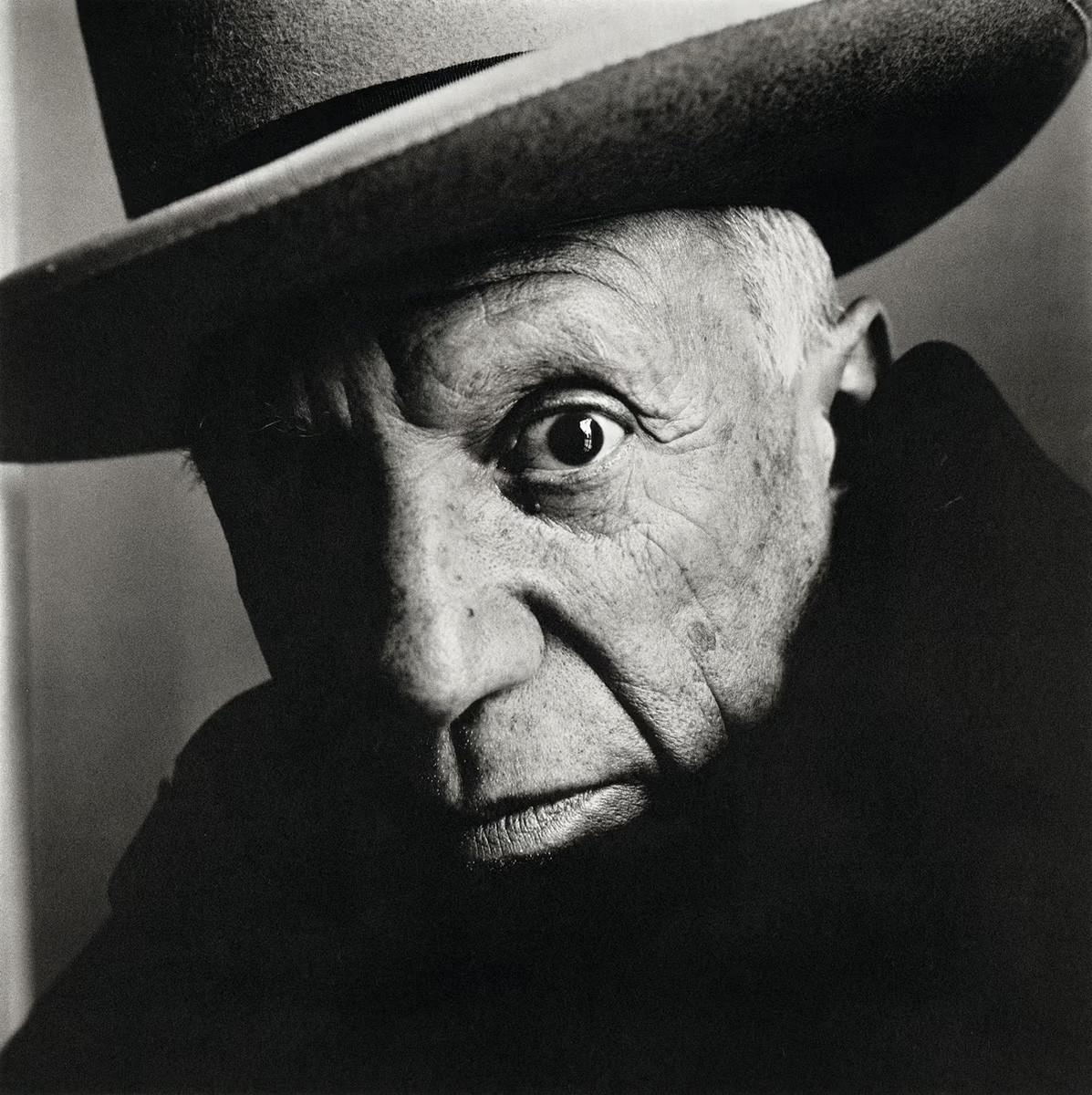
Irving Penn, Pablo Picasso at La Californie, Cannes, 1957
This is Pablo Picasso, and the image after it is Colette.
[screen shows Irving Penn’s portrait of Colette]
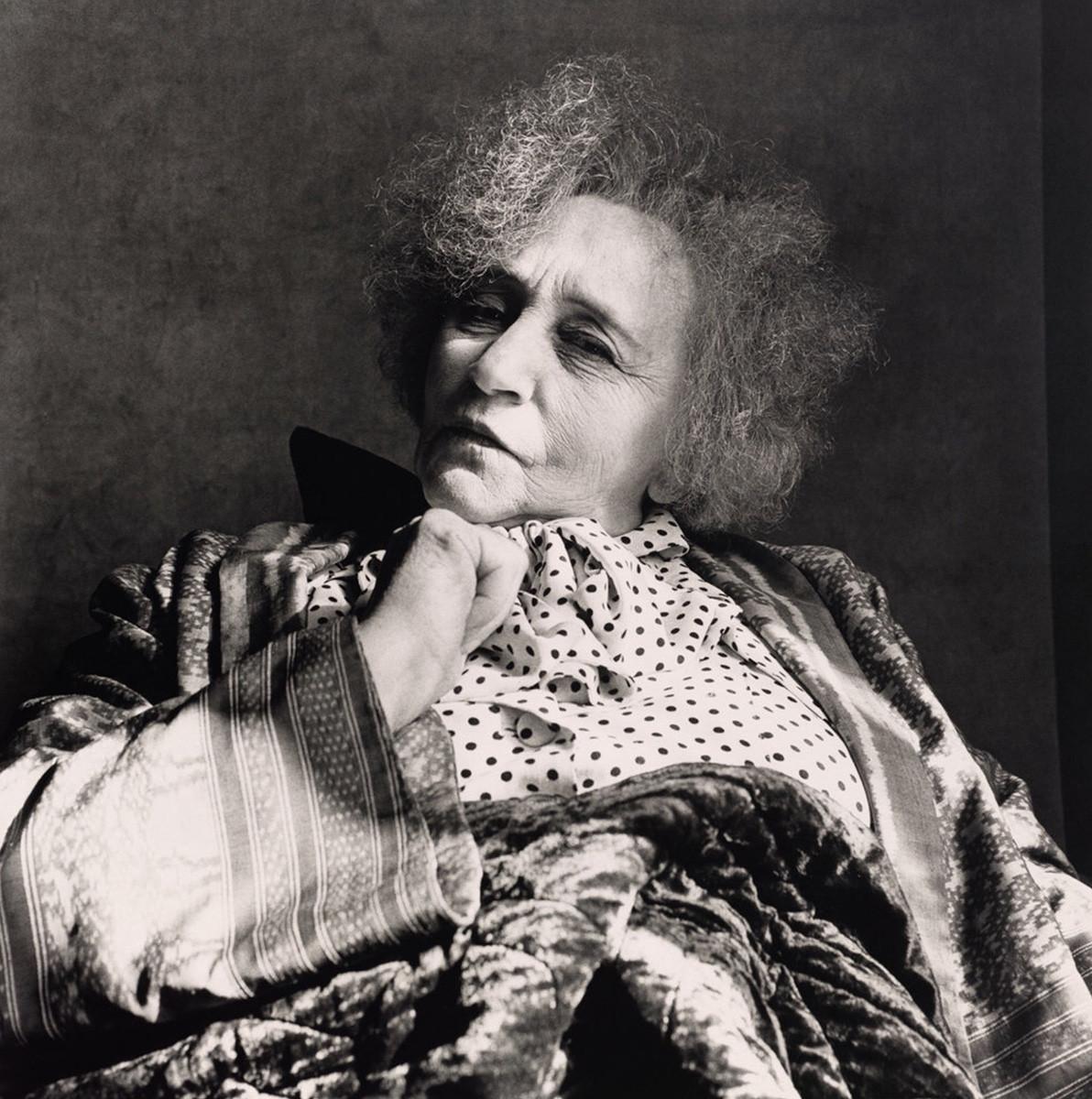
Irving Penn, Colette, Paris, 1951
It was a double-page spread in the magazine, shot by Irving Penn. I didn’t have any idea who Irving Penn was at the time. I had no idea who Picasso was, or Colette. But because of the power of these two images, it wasn’t long before I could tell you everything about Penn, and Colette, and Picasso, because my curiosity had kicked in. And this was the defining moment in my photographic life. This is the moment I wanted to become a photographer. These two images.
[Matthew Rolston]
Excellent, a double take. All right, your turn to ask me the same question!
[Sandro Miller]
Ok Matthew… [audience laughing] … is there an image that you experienced in your childhood that changed the world for you, one that made you want to become a photographer?
[Matthew Rolston]
Yes, there was.
[Sandro Miller]
[laughs]
[Matthew Rolston]
My maternal grandfather in Los Angeles, where I grew up, was a doctor. He was also the chief of staff of the Cedars Hospital. And in his private practice, which was in Beverly Hills when my mom was growing up in the ’30s and ’40s (way before I came along), his patients, private patients, were all Metro stars. That’s what they called the people at MGM, it was always called “Metro”.
So around his office, when I got to visit as a young person in, I guess the mid ’60s, he still had a lot of framed portraits from photographer George Hurrell’s portrait studio at MGM. And these were, you know, Jean Harlow and Joan Crawford with big, florid signatures. And they were pictures of faces next to gigantic orchids with the most incredible skin you’ve ever seen. I didn’t know what they were. I certainly didn’t know at that point who George Hurrell was. I barely knew what Metro was. But those pictures, the confection of the skin, the otherworldly quality, I’ll show you one of those images, it just captured my heart.
[screen shows Hurrell’s portrait of Joan Crawford]
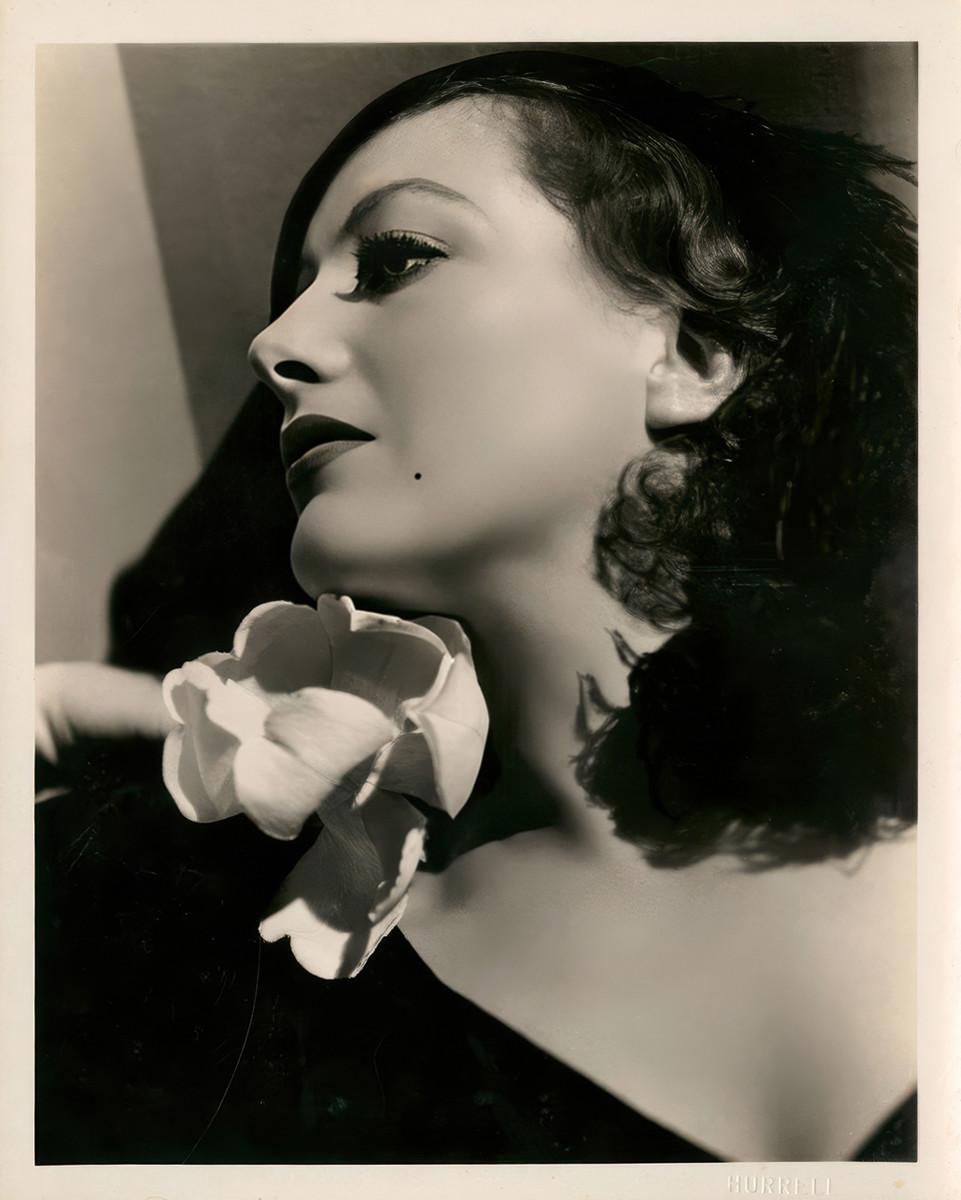
George Hurrell, Joan Crawford for Possessed, c.1931
And that is my image. Not unlike how Penn was for you as a young person. This is what set me on the path towards photography, although it was kind of a circuitous path.
I didn’t actually get to a camera in my hand ’til I was about 19 or 20. I was the ‘art school kid’ in the family. But this image and several others that were scattered around my grandfather’s office were my first exposure to glamour photography in Los Angeles.
[Sandro Miller]
I find that so interesting, Matthew. If you look at the image you chose and your body of work, you definitely see where it all came from. I think it’s the same with mine. You look at those raw images by Penn. What he created. And there’s definitely a lineage in my work there.
[Matthew Rolston]
Yes, it’s very direct.
[Sandro Miller]
It’s very direct.
[Matthew Rolston]
All right. Sandro, next question.
“Why do you photograph? What interests you most in an image?”
[Sandro Miller]
I photograph to remember. As human beings, we forget 90% of the details of our past life. But when I take a look back at my books and I go through the pages, I remember.
[screen shows a series of Sandro’s images in succession]

Sandro Miller, Ulises Ortiz Herrera, Blood Brothers

Sandro Miller, Alexander Quiala, Blood Brothers

Sandro Miller, Andres Lamoru/Richardo Serrano/Adan Soroa/Latron Soroa/Asdrubal Cfini/Luis Alberto Carrion/Jose Lamoth, Blood Brothers
I remember where I was, who I was photographing, the feelings that I was having that day. It’s amazing… it’s like a diary. These books, these photographs are like a diary of my life, and they help me remember where I was, what I was doing at a certain age. I have a terrible memory, and I just love being able to go through these books and remember my past.
[screen shows a series of Sandro’s images]

Sandro Miller, Nina, Dakar, Senegal, 2019
From the book Crowns: My Hair, My Soul, My Freedom

Sandro Miller, Amontance, Dakar, Senegal, 2019
From the book Crowns: My Hair, My Soul, My Freedom

Sandro Miller, Koketso, Johannesburg, 2019
From the book Crowns: My Hair, My Soul, My Freedom
The other reason that I photograph is because I consider myself a ‘cultural’ photographer. I love cultures. I love asking questions about cultures, and I love learning about cultures.
[screen shows two of Sandro’s New Guinea images]
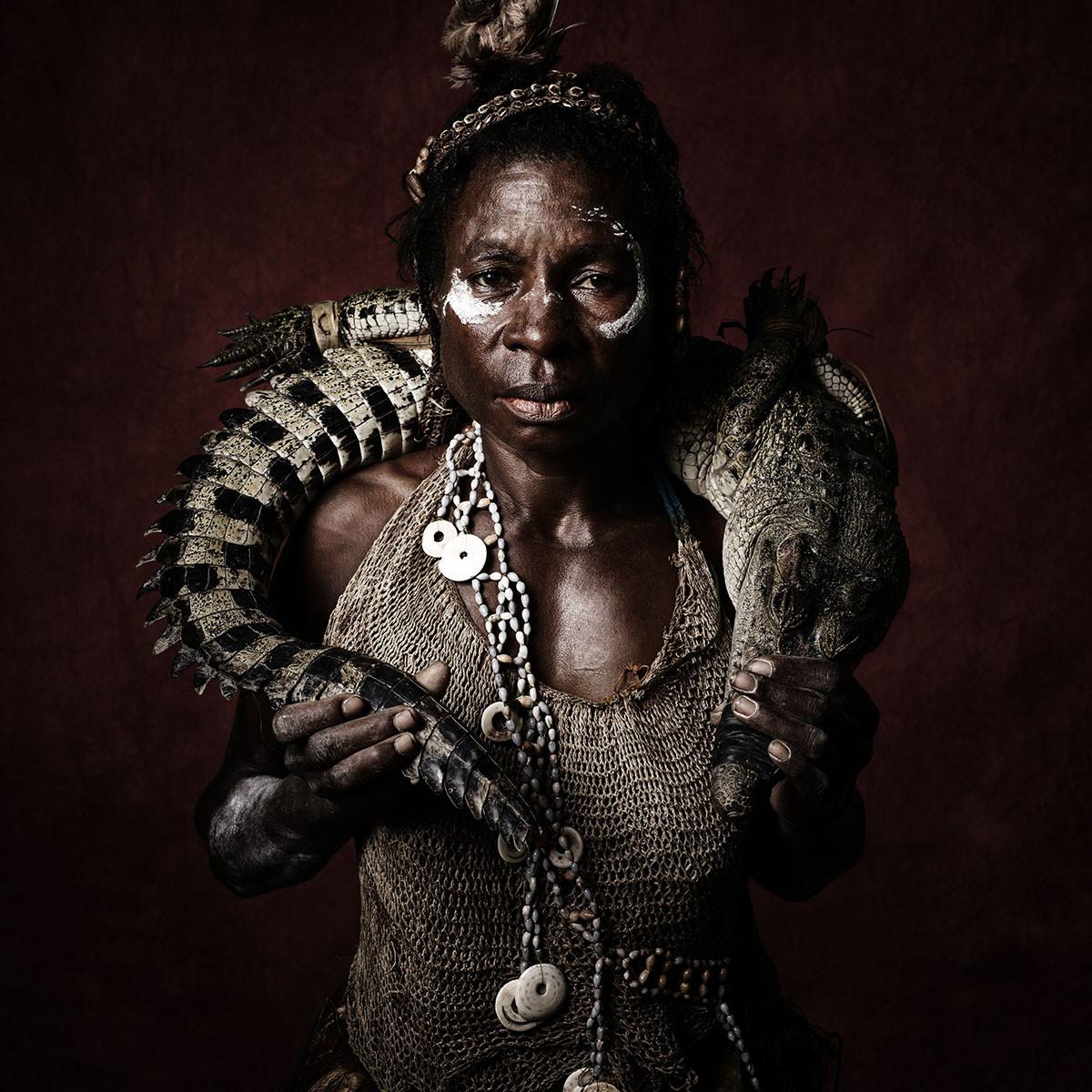
Sandro Miller, Quentin, Papua New Guinea, 2016

Sandro Miller, Eddie, Yenchan Village Tambaran, Papua New Guinea, 2016
Like, for the Papua, New Guinea image here, I had just finished watching the documentary on young Michael Rockefeller. His father had sent him over to Papua to gather primitive art. It was a wonderful documentary.
[screen shows Sandro’s double-portrait of two indigenous women in native dress]
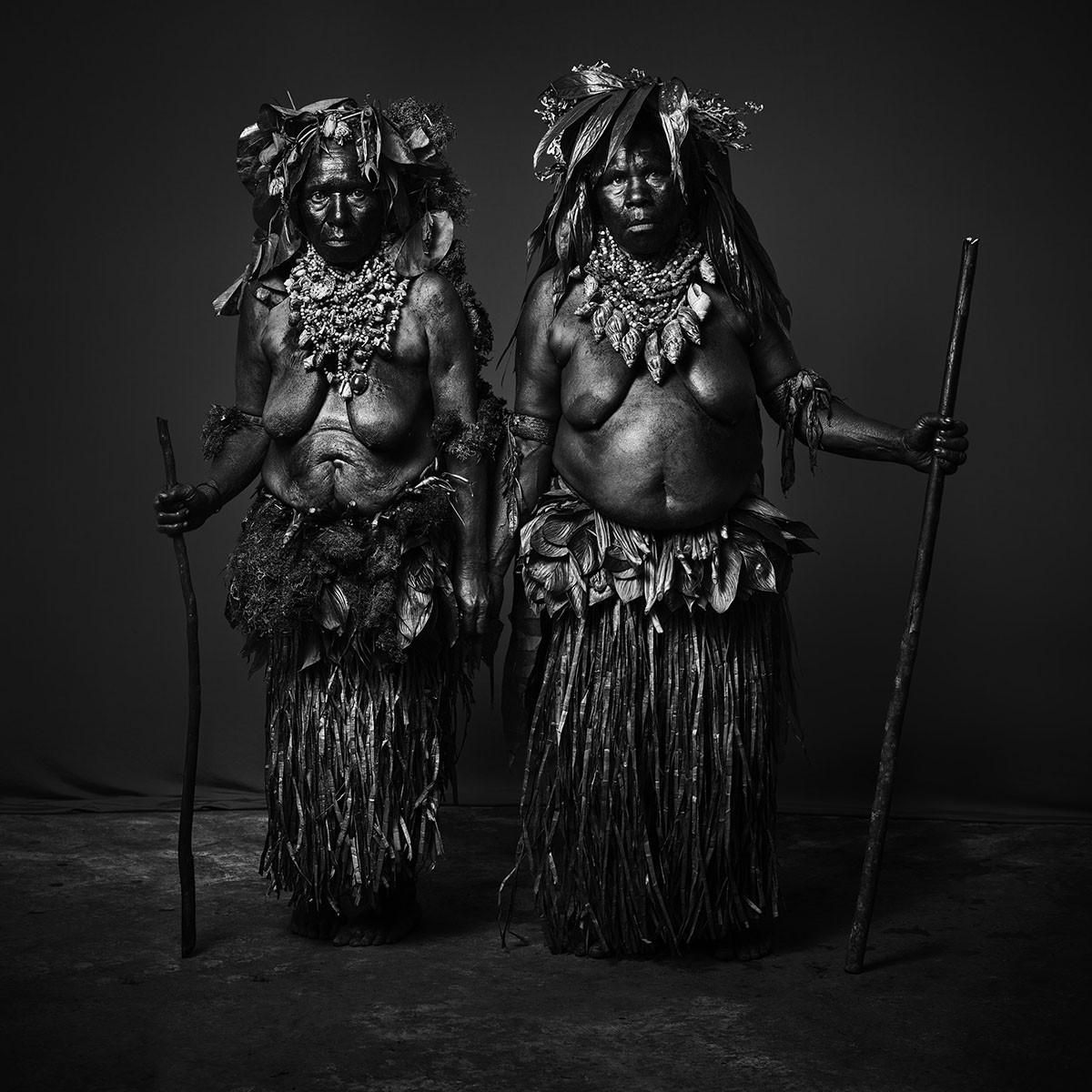
Sandro Miller, Sabina & Anna, Warawau Tribe, Papua New Guinea, 2017
I don’t know if you know the story. He had a boat that was filled with primitive art, and the boat capsized. Young Rockefeller swam to the shoreline of Papua New Guinea, where he was eaten by cannibals.
So that right there was enough for me to want to go to Papua, New Guinea!
[Audience]
[laughs]
[Sandro Miller]
It doesn’t take much. But I wanted to learn about the culture. Back in the late 90’s, I was in the Philippines, and I had a beautiful conversation with a transgender person.
[screen shows Sandro’s portrait of a two seated transgender females]
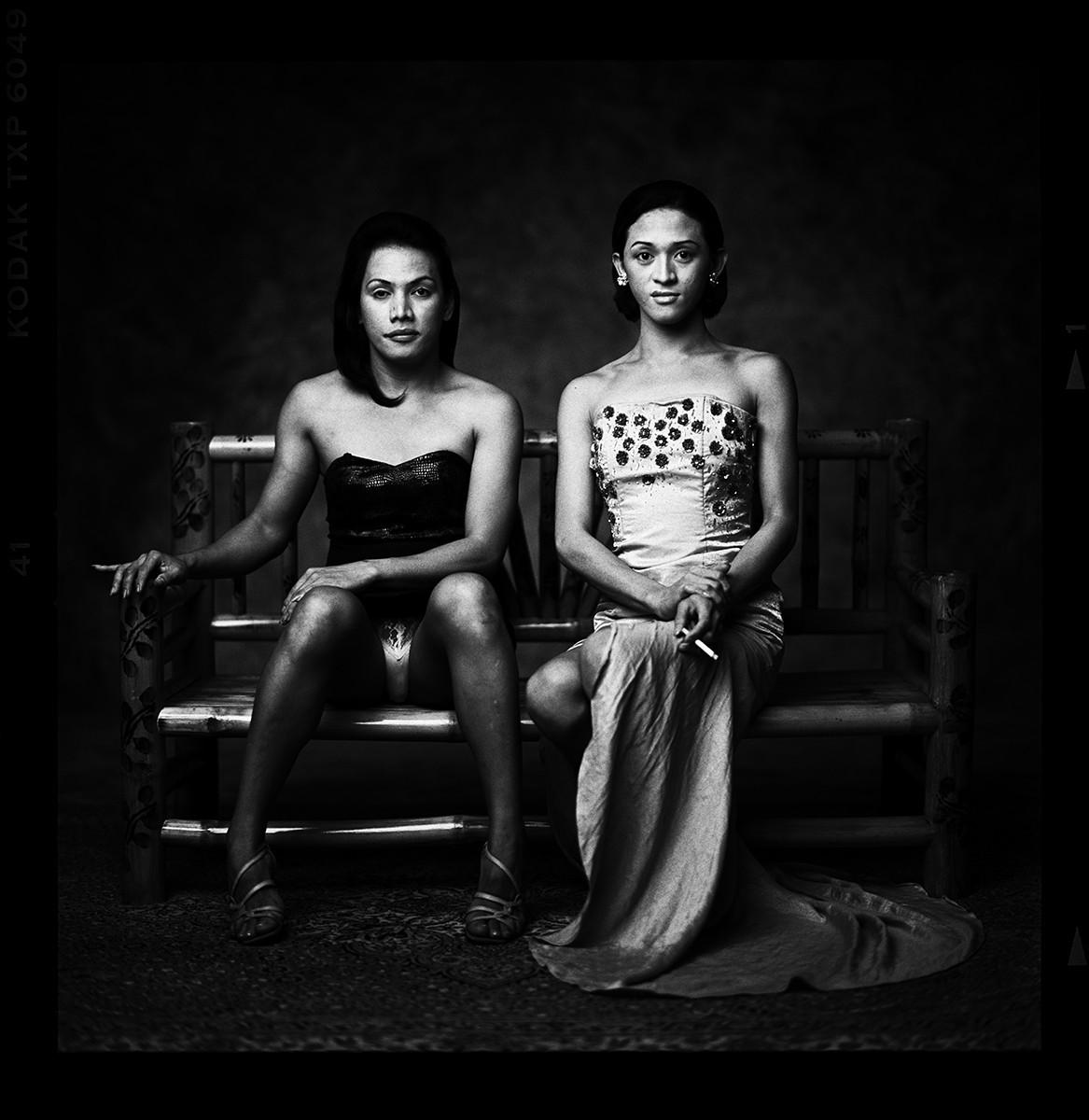
Sandro Miller, Chuchie and Jessa Ferrera, Phillipines, 1999
It was my very first conversation with a transgender person. I was young…. naïve. I was a young naive boy from the suburbs of Chicago. I didn’t know much about this culture, and I wanted to learn more.
I’ve now traveled around the world, and wherever I travel, I set up photo sessions with transgender people.
[screen shows two of Sandro’s portraits of seated transgender females]

Sandro Miller, Lexxanne, New Orleans, 2019
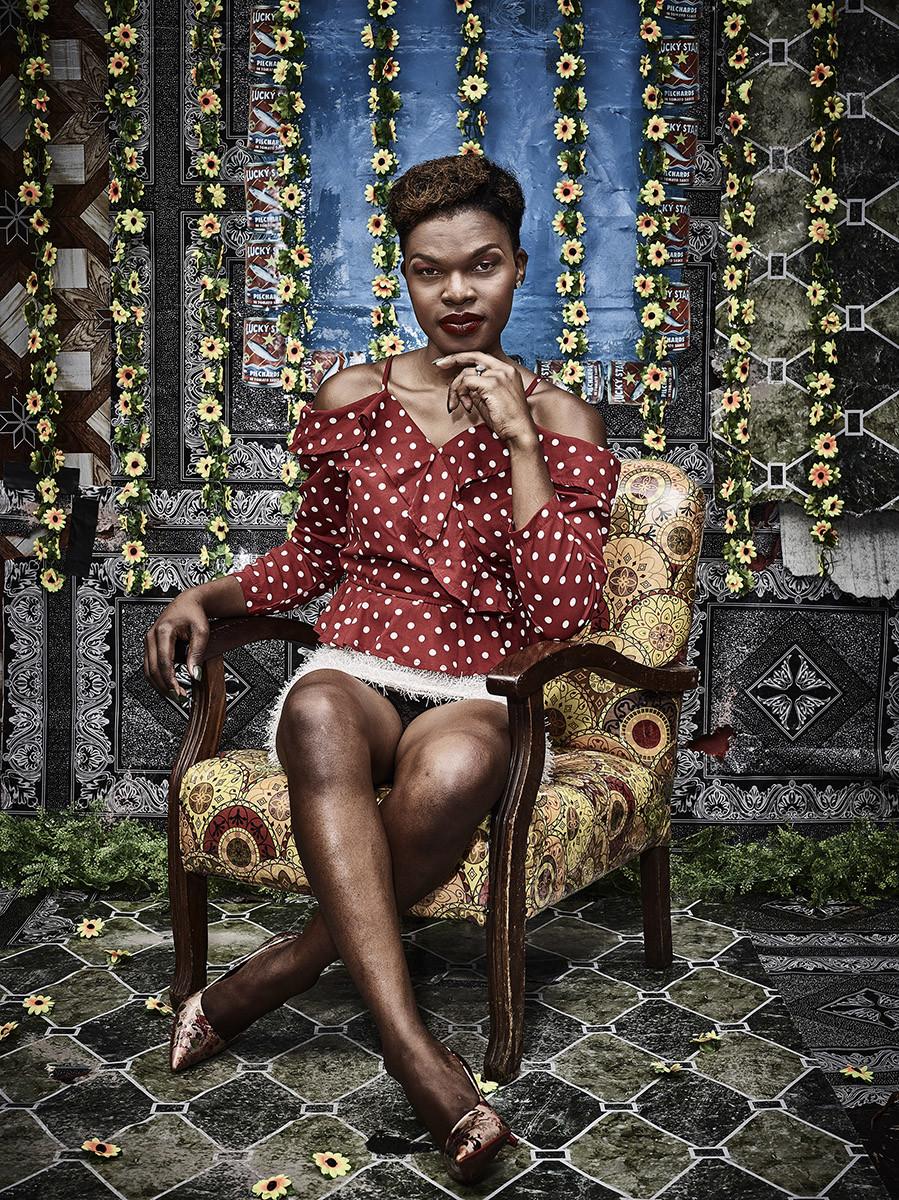
Sandro Miller, Katlego, Johannesburg, 2019
And again, with what I do, I’m able to learn while I am photographing these cultures. I’m able to teach others by photographing these cultures, because now I can talk intelligently about them, and hopefully I can change people’s minds on what they think about these specific cultures.
So Matthew, why do you photograph, and what interests you most in a photograph – in an image?
[Matthew Rolston]
Well, there’s plenty to consider with me, but I think that my theme, the real thing that connects the work, is the nature of human imagination. That’s, to me, what makes us human. That we can imagine things and make them real. That’s a nearly divine condition. I don’t know any dolphins that have built a rocket ship and actually gone to the moon. All right? So humans have a very special capacity to imagine and manifest.
The second thing I’m most interested in is style. Style is a form of human intelligence and refinement. When those things come together, imagination and style, that’s my sweet spot.
And then there’s a third element, which is contradiction. We are contradictions because of our imagination. We’re animals. We piss and shit and cry and have babies, and live and die and turn into dust, but we also have our heads in the clouds so we can imagine impossible things like perfection, or God, or religion, or things that make no sense at all, like money…
[Audience]
[laughs]
[Matthew Rolston]
… or the human perception of time. So to me, the ‘secret sauce’, the special sauce of the thing that I love the most, is contradiction mixed with high style. And the image that stands above all others for me on this subject is this:
[screen shows Avedon’s Dovima with Elephants]

Richard Avedon, Dovina with Elephants, Evening Dress by Dior, Cirque d’Hiver, Paris, August 1955
I’m not gonna show you a variety of images as Sandro did, we’re just gonna deconstruct this one.
I’m sure everybody knows this image. It’s considered by most to be the masterpiece of fashion photography of the 20th century. It’s Richard Avedon’s “Dovima with Elephants”, and it contains a multitude of contradictions, mixed with high style. This is the literal diagram of what I’m talking about. [To the audience] Anybody want to venture some of the obvious contradictions? Please, contribute.
[Audience Member]
The chains around the elephant’s ankles that you don’t notice at first, but it gives a very violent sort of overtone to the whole thing once you do notice it.
[Matthew Rolston]
Mm-hmm. Yes, freedom versus being enslaved or enchained. Dovima looks like she’s about to levitate. Human sophistication against animal instinct… civilization and wildness… black and white…
[Audience Member]
The trunk and the sash.
[Matthew Rolston]
And the sash, absolutely. Those are similarities and contradictions. You could go on and on and on framing contradictions. From a formal perspective, the compositional technique called triangulation is at work here, which has an incredible energy to it. At the same time, there’s symmetry, which has a stasis. So that’s another contradiction right there. We could go on and on and deconstruct this image for quite a long time in terms of the smooth versus the rough, et cetera. This image taught me a lot and has influenced me throughout my career.
[Sandro Miller]
Truly one of the most beautiful images ever taken by any photographer. Matthew, if I could just share a really quick story from my Homage images that I did with John Malkovich – I tried to do this image, but at the time, PETA made it very difficult for me to be able to get elephants. There is a sanctuary in South Carolina where they were gonna charge me $50,000 to work with their elephants. I would’ve had to bring John and the crew there. It just became an impossible feat. There were actually two images in that series that I wanted to re-create with elephants. There was the famous Dovima and the elephants, and there was Mary Ellen Mark’s portrait of an Indian elephant trainer.
[screen shows Mary Ellen Mark’s elephant trainer]

Mary Ellen Mark, Ram Prakash Singh with His Elephant, Shyama, Great Golden Circus, Ahmedabad, India,1990
[Matthew Rolston]
Wasn’t meant to be.
Let’s move on. Next question.
“What was your first big break as a photographer, the moment that got you noticed?”
[Sandro Miller]
In 1989, I started photographing bikers. I would travel around the country and do portraits of bikers. Tina Brown, who was at the time was the photo editor at The New Yorker magazine, probably the most–
[Matthew Rolston]
[interrupting] Editor-in-chief!
[Sandro Miller]
Excuse me. Editor-in-chief of The New Yorker magazine, probably the most read magazine in the world at that time. It had 6.5 million readers. That was my social media. Remember, we didn’t have social media at that time. So 6.5 million people were having this magazine delivered to their home and were gonna see these images of my biker portraits. That’s when ‘Sandro’ became a household name.
[screen shows three of Sandro’s biker portraits in succession]

Sandro Miller, Chris Laws (Scuba), from the book American Bikers, 1995

Sandro Miller, John Swenderman (Father Time), from the book American Bikers, 1995
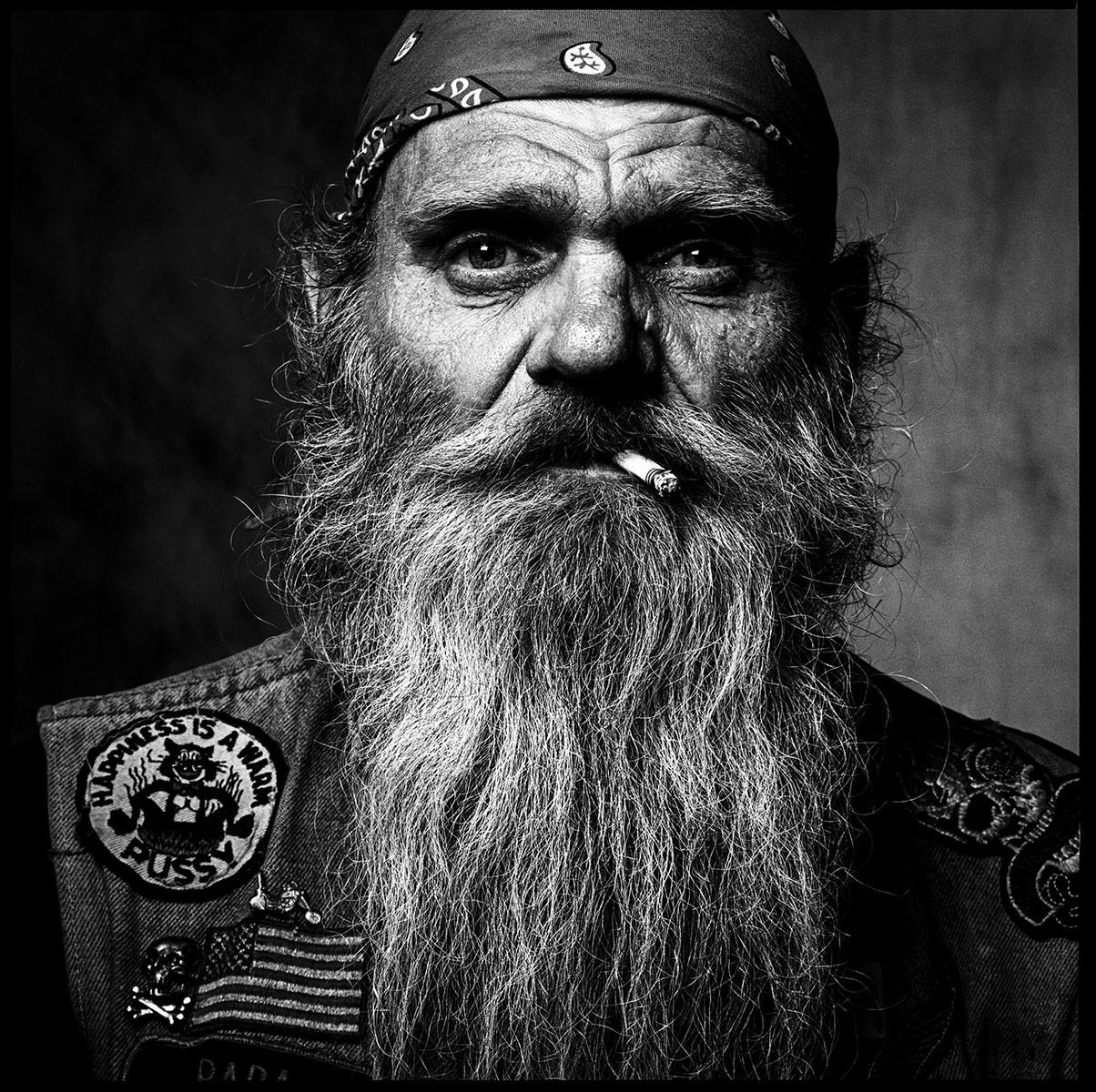
Sandro Miller, Paul Buneta, Jr., (Papa Smurf), from the book American Bikers, 1995
[Matthew Rolston]
Also, we should mention it was very rare for The New Yorker to publish photography.
[Sandro Miller]
Very rare.
[Matthew Rolston]
It was an innovation at the time.
[Sandro Miller]
Well, it was actually that year that Richard Avedon was hired by Tina Brown.
[Matthew Rolston]
As far as I know, Avedon was the first photographer to be published, to have full page photographs published in The New Yorker. The New Yorker had never published photography. That lack of photography was an important part of their identity.
[Sandro Miller]
Avedon began doing a portrait or two a month for the magazine.
[Matthew Rolston]
That’s right.
[Sandro Miller]
Tina hired Annie Leibovitz to cover the O.J. Simpson trial, which came out about a month before my biker issue. So that was the very beginning of The New Yorker publishing photography.
[Matthew Rolston]
That’s something very precious and a very, very unique opportunity at that time.
To be continued…