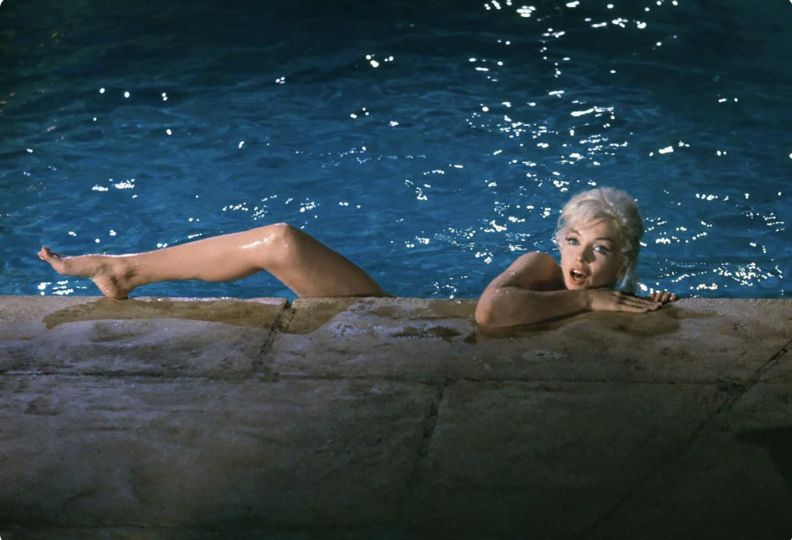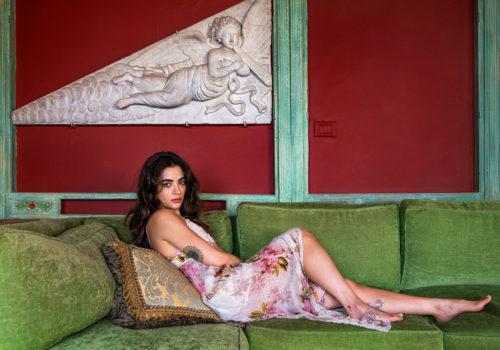
Where Do I Go? لوين روح is a new book by Rania Matar presenting approximately 128 color portraits of young women in Lebanon. Coinciding with the fiftieth anniversary of the Lebanese Civil War, the book reflects life in a nation still shaped by decades of upheaval. Rather than centering destruction, Matar directs her lens toward creativity, resilience, and dignity in uncertain times. The title derives from graffiti she encountered on an abandoned wall, a question that reverberates throughout the work: “Where do I go?” لوين روح . As the war is raging again in Lebanon, the work seems, once again, to resonate.
The project began when Matar returned to Beirut after the 2020 Port explosion and started working closely with women across the country. Having left Lebanon herself at age twenty, she recognizes her own experience in many of her subjects, who now face the same painful decision of whether to stay or leave. The participants play a significant role in shaping the imagery: they select the locations and decide whether to climb trees or rocks, enter abandoned buildings, or step into the water. Matar describes these portraits as collaborations, allowing the women to assert agency over both setting and representation.
“I am both an American and an Arab and these identities are sometimes at odd with each other, not every day, not even often, but once in a great while I become a mountain that some terrifying earthquake has split.”
—Etel Adnan, In the Heart of a Heart of Another Country
The photographs traverse coastlines, mountains, urban districts, and border zones, moving from the Mediterranean and Mount Lebanon to Beirut’s eclectic architecture. Matar works in notable neighborhoods and remote landscapes alike, juxtaposing grand abandoned mansions, shuttered theaters, former hotels, and ordinary streets bearing the visible residue of conflict. Bullet-scarred interiors overgrown with vegetation contrast with open fields of poppies, yarrow, and thistle, or elevated mountain vistas. As collector and archivist Georges Boustany observes, “Rania has crisscrossed Lebanon, each time discovering the most incredible places to serve as a backdrop for her radiant subjects.” Curator and writer Leila Reichert notes that the azure sky, recurring throughout the photographs, holds both “the hope of a life beyond its borders” and the gravity of departure.
Place operates as psychological architecture throughout the series. Matar balances strength without triumph and vulnerability without collapse, using environments not as decoration but as extensions of inner life. Material decay in her photographs carries meaning without becoming illustrative, and even when the images drift toward pastoral or lyrical registers, her compositional restraint prevents sentimentality. The portraits convey maturity and ethical attentiveness, allowing each subject to retain complexity and interior presence.
“People have all sorts of stories to tell me. They insist on praising the heroic feats of a war that shouldn’t inspire any pride. But for the stories of women, it’s something else. The women have kept contact with the earth, if I may say, in the ancient roles of witnesses and memory keepers. They have surpassed themselves: their strength has overcome their habits and their prejudices.”
—Etel Adnan, Of Cities and Women
An accompanying exhibition, Rania Matar: Where Do I Go?, لوين روح؟, opens March 5 and runs through August 2, 2026, at the Sidney and Lois Eskenazi Museum of Art in Bloomington, Indiana. The book includes an essay by curator Leila Reichert and an introduction by Mariah Keller, the museum’s now former Interim Director. Keller situates the project within Matar’s long commitment to collaborative portraiture, writing that the work “is both a plaintive cry and a hopeful quest from Matar and Lebanon’s women for a more tranquil and fruitful future.” Reichert’s essay acknowledges that few artworks about Lebanon escape its tragic history yet notes that Matar’s photographs uniquely attend to the present and to the possibility of a more sustainable life.
Writer Youmna Chamieh, herself close in age to the women portrayed, confronts the difficulty of narrating a country conditioned by recurring catastrophe, asking what remains of language when disbelief becomes habitual. She addresses the politics of representation, stating: “Arab life is, ultimately, disposable. It is never the central story. It is rarely the story at all.”
Journalist and author Kim Ghattas reflects on a life informed by war, recalling childhood crossings through the city’s most dangerous zones, later reporting on conflicts as a journalist, and returning repeatedly to Beirut as violence persists. “Survival,” she writes. “All your senses are awake. Every sunrise is a gift.”
Georges Boustany’s essay places Matar’s photographs in dialogue with vernacular archival images from his collection. He juxtaposes anonymous family photographs with Matar’s portraits to extend the book’s historical dimension and argues that both bodies of work express what he calls “absurdity as a way of life.” “All these photographs,” he writes, “those of Rania and those in my collection, express what makes up the essence of our life in Lebanon.”
“Beirut was then the mythical city of the world. That was the way it was. It was something else. Life was exciting, truly, but also painful. Painful was not necessarily the right word; the reality of Beirut was of a complexity defying definition.”
—Etel Adnan, In the Heart of a Heart of Another Country
Rooted in Lebanon yet resonant far beyond its borders, Where Do I Go? addresses female experience, with themes of belonging, migration, and the uncertainty of living through political and economic instability. At a time when women from the region are often reduced to symbols of victimhood in Western discourse, Matar’s portraits insist on presence, complexity, and self-determination. Together, the images speak to the human condition with clarity and nuance, standing as records not only of place, but of endurance and hope that others can recognize.
www.raniamatar.com
NEW BOOK: Where Do I Go?