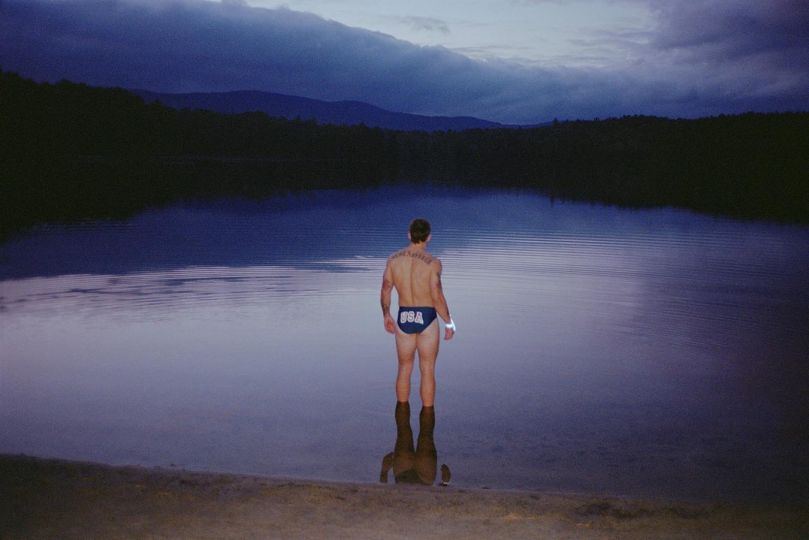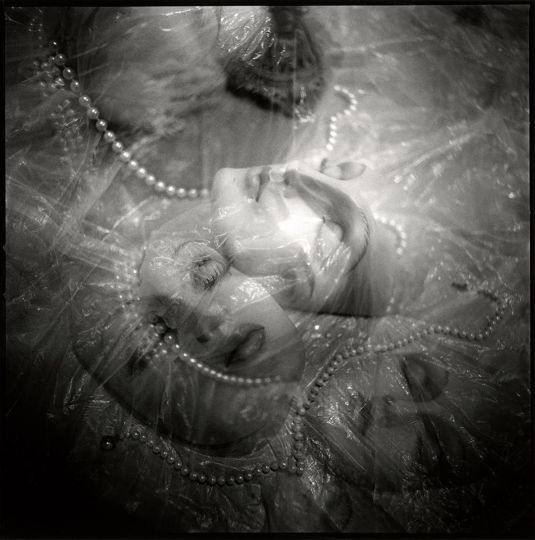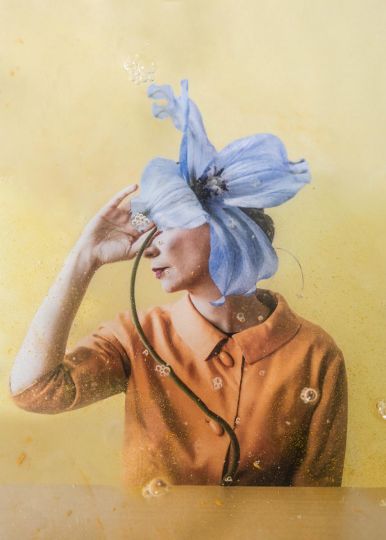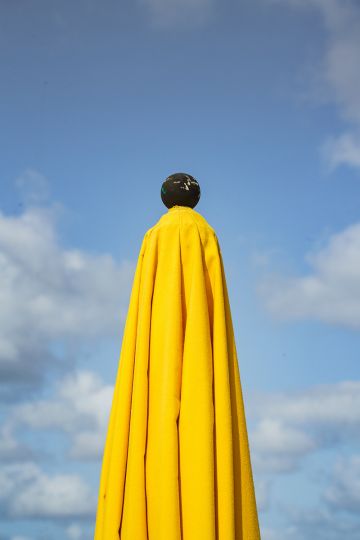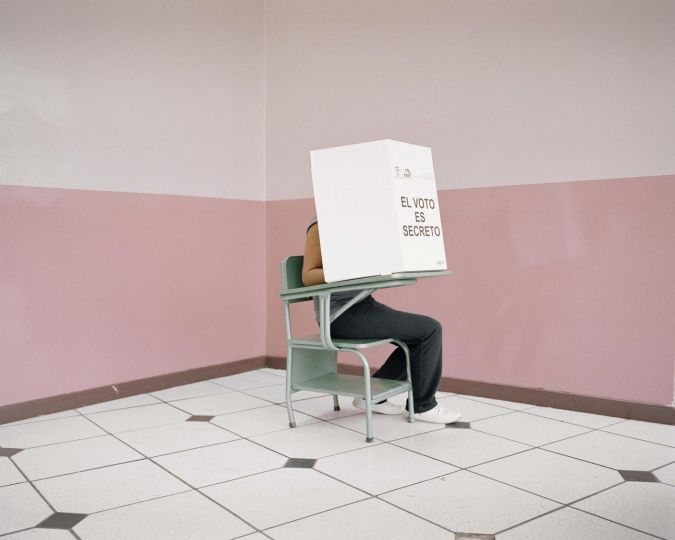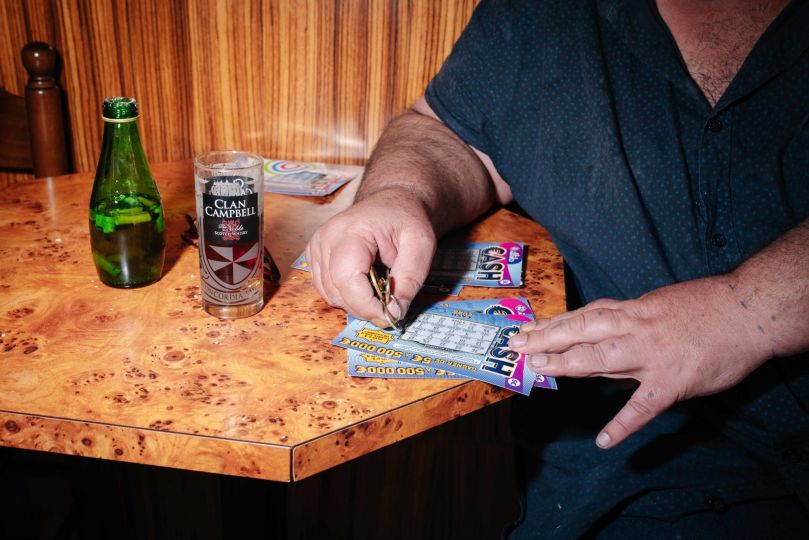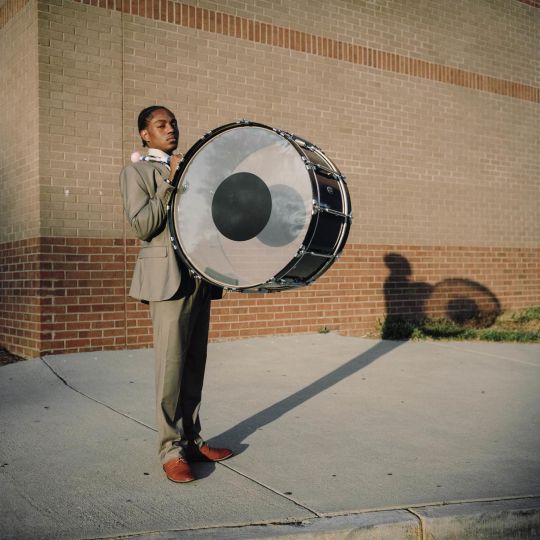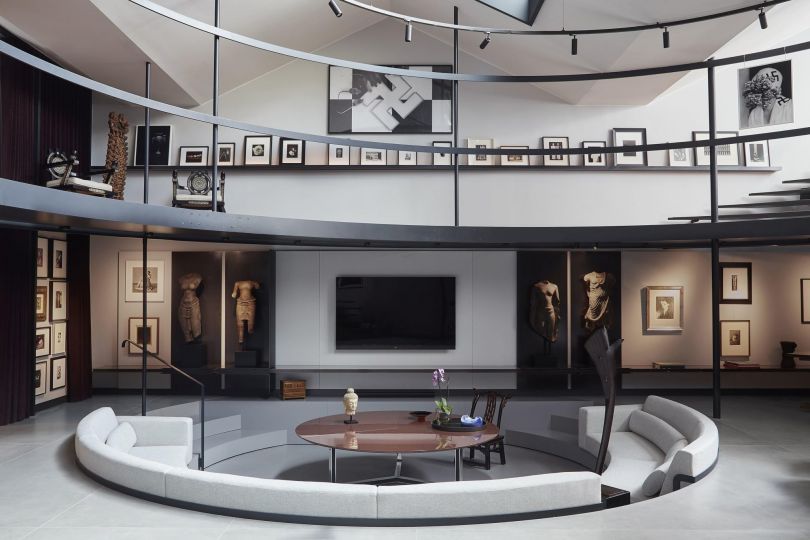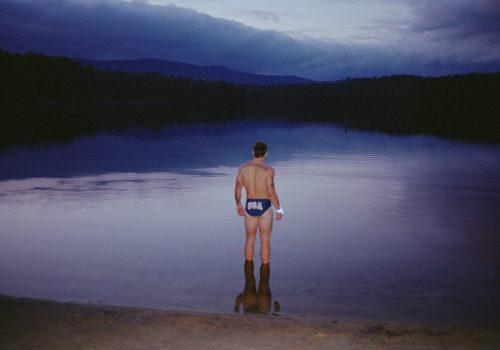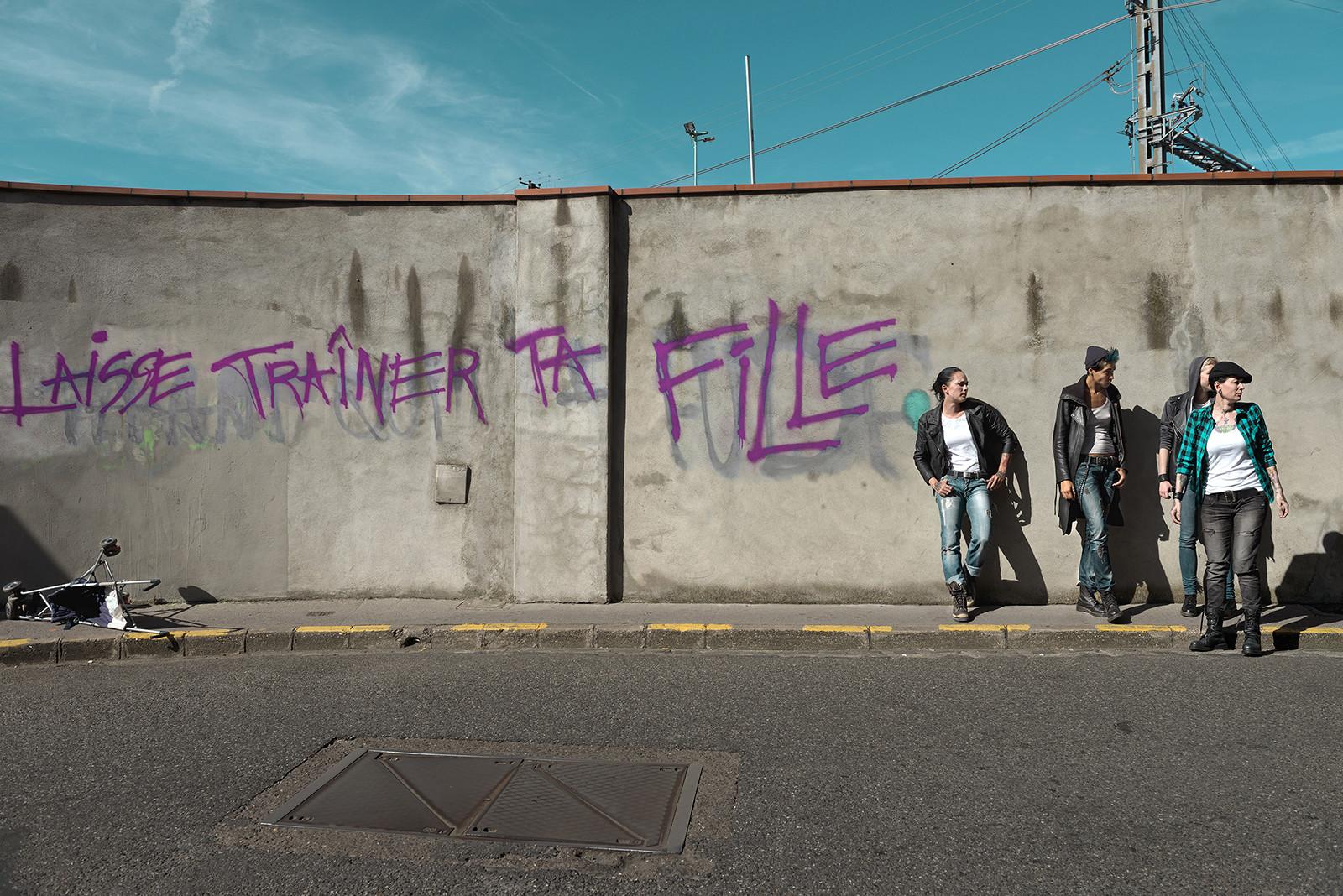



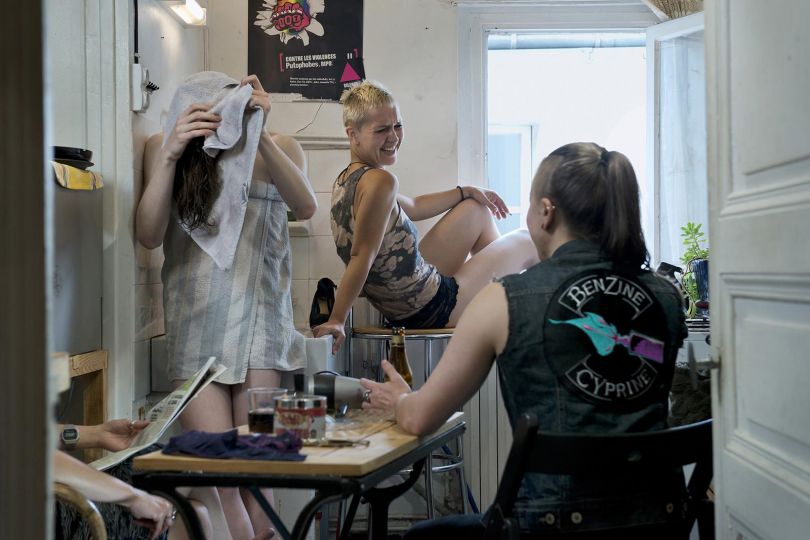


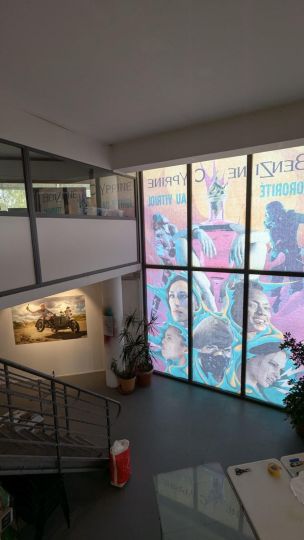

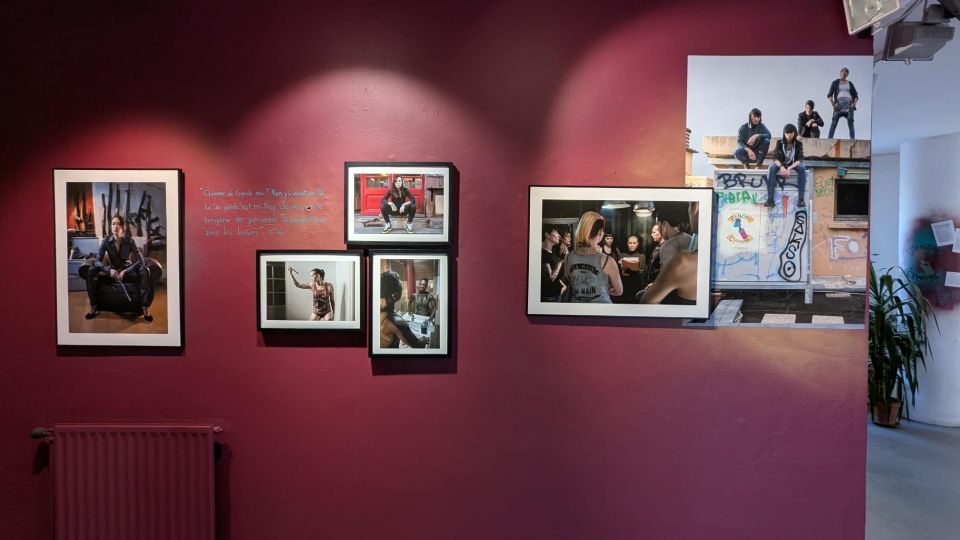

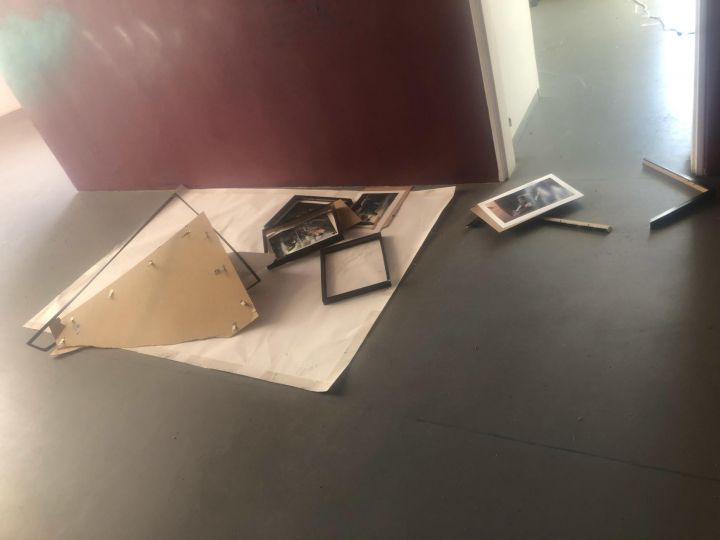
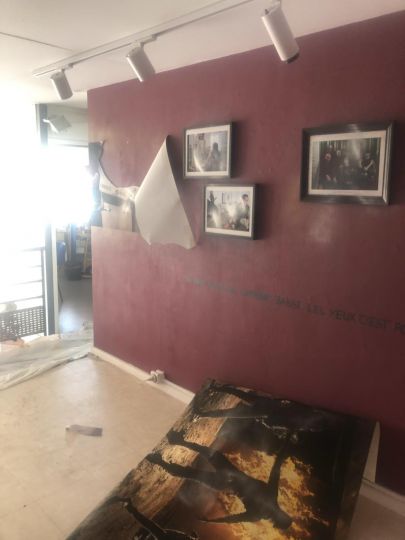


The photography exhibition “Benzine Cyprine” by Kamille Lévêque Jégo, on display since April 11 at the NegPos Center for Art and Photography in Nîmes, was violently vandalized overnight between April 25 and 26. Nearly all of the prints were damaged or destroyed—ripped from their frames, trampled, and thrown to the floor. Phallic graffiti was sprayed onto the gallery walls. While an investigation is underway, we wish to express our solidarity with the artist, her freedom of expression and creation, as well as with the NegPos Art Center. We publish a selection from the artist’s series, as well as views of the exhibition and the ransacking and destruction of the works.
Below is Kamille Lévêque Jégo’s full statement:
“Benzine Cyprine” is a long-term documentary project centered on a women’s gang of the same name. It also serves as a symbol of identity.
The project stemmed from an urgent need to respond to a deep existential discomfort around the experience of being female. It was a persistent sense of powerlessness, fueled by repeated, degrading microaggressions I had to endure simply for being a woman. That awareness was deepened by the overwhelming number of harassment and sexual assault stories shared by women close to me—stories too often silenced by fear of dismissal.
To expose the clichés and ingrained beliefs that perpetuate this discomfort and oppression—and to offer an alternative to stereotypes that cast femininity as weak, childlike, and diminished—I began photographing symbols of a distinct feminine identity. One that merges sensuality and strength, defying the notion that women are inherently victims. This identity is brought to life through the lived moments, personalities, and attitudes of the women in the gang. The gang, in this context, is not a criminal narrative of turf wars and profit, but an echo of organized resistance. It embodies empowerment, cohesion, dignity, and the ability to claim space—an antidote to vulnerability.
My intent was to present a defiant, radiant vision of femininity, standing in stark contrast to the saccharine, hypersexualized portrayals of women that saturate mainstream media—from screens big and small, to print and advertising.
This documentary began in 2014, with initial photo shoots unfolding over six to seven years. It predates the now-widespread awareness of systemic sexism brought to light by the #MeToo movement. At the time, the issue was still largely overlooked in public discourse, which was reflected in how women were depicted. When I photographed two members of Benzine Cyprine performing a stunt on a sidecar, “Mad Max: Fury Road” hadn’t yet been released. I was mostly thinking of pin-up imagery, where objectified female bodies were posed alongside machines they were never shown controlling. In car ads, it was always the man behind the wheel, and the woman in the passenger seat.
Perhaps mindsets have shifted since then—but not for everyone. Quite the contrary. The recent destruction of “Benzine Cyprine” at the NegPos gallery speaks volumes. It fits within what Susan Faludi theorized as the “backlash”: a term that refers to the hostile, often violent reaction from parts of society when marginalized groups or women progress in obtainig their rights.
What happened at the NegPos Gallery:
An electrical fire damaged the gallery’s offices and archives. For safety and reasons of hygiene, the entire facility—including the exhibition space and the artists’ residency apartment—was closed pending an official inspection. During this time, one or more individuals broke in through a window and vandalized the space on two separate occasions. The final act, on the night of April 25, completely destroyed the exhibition.
Prints were torn from the walls and stomped on. Others were defaced with spray-painted phalluses or blotted out with paint, covering faces and bodies. Strangely, the texts displayed as part of the scenography were left untouched. The phallic imagery that marked the destruction points as a reactionary, male-supremacist mindset—one that upholds masculine dominance in opposition to gender equality. But given the sheer violence of the act, I doubt the vandals were capable of articulating such ideology. This felt more like a visceral, irrational hatred aimed at representations of strong, defiant, or body-liberated women—in other words, almost the entire exhibition.
The Benzine Cyprine celebrate a formidable femininity. They are an explosive mix of desire and emancipation, expressing sovereignty through individuality. They demonstrate that one can embody gender beyond the dictates of assigned sex. Yet even today, that journey is neither spontaneous nor innate. It must be built, influenced, nurtured.
I never imagined that such an obvious truth would still need to take the form of resistance. What does women’s emancipation and bodily autonomy take away from others—except the ability to control and exploit those bodies?
I leave it to theorists, researchers, and sociologists to deepen this conversation. There is a wealth of brilliant scholarship dissecting these issues. I’ve drawn inspiration from them—from Virginie Despentes’ scathing brilliance, Lydia Lunch’s licentious sarcasm—but my medium is photography.
For me, it’s crucial to recognize how visual representation shapes personal identity and social norms. I wanted to depict the Benzine Cyprine as a kind of gendered brand—seductive, powerful, marketable. My concept of a female gang was meant to feel real. I wanted to generate enthusiasm and pride in the spirit they represent. I deliberately mimicked the visual codes of advertising: glossy aesthetics, graphic design, slogans, real-world projection. It’s an ironic move, reflecting a world where emotion trumps intellect, entertainment overshadows critical thought, and image eclipses words.
That visual impact has proven effective—but the deeper goal of this work is to invoke thought and reflection.
What’s most important to remember, based on the support I’ve received, is this: men and women alike were appalled to see masculinity reduced to a phallus, expressed through destruction. Benzine Cyprine is a project that provokes reactions. Since its debut at various photography festivals, it has sparked awareness (do you know what “Cyprine” means? Try asking people across generations), raised meaningful questions, and opened up dialogue. And if the Benzine Cyprine evoke fear or threat, it’s likely only for those who cannot bear to see women freed from patriarchal intimidation. Otherwise, they inspire affection—and admiration—for a femininity that is vibrant, powerful, and full of humor.”
— Kamille Lévêque Jégo
Statement from the LUX Network
“The LUX network, Diagonal, and Les Filles de la Photo express their outrage and deep concern over the malicious acts targeting exhibitions by women artists, especially those addressing topics related to womanhood, feminism, resilience, and equality.
Following the hateful attacks recently suffered by Sandra Reinflet during her exhibition “Nouvelles Reines” at the Saint-Denis Basilica Cathedral—threats, insults, and intimidation campaigns by far-right groups—it is now Kamille Lévêque Jégo whose work has been vandalized and destroyed at the NegPos Art Center in Nîmes.
Her exhibition “Benzine Cyprine” was deliberately targeted. The artist describes “an ignorance that manifests as an impulsive and deeply visceral reaction”: works torn down, trampled, tagged with obscene symbols, walls defaced, scenography obliterated.
These intolerable actions foster a climate of hostility toward women who dare to speak out, share the complexity of their experiences, and assert their place in artistic and public spheres.
They reflect a broader trend of dangerous intolerance, in which sexist, racist, and reactionary ideologies are becoming normalized and seek to censor artists and institutions offering them visibility.
We unequivocally condemn these attacks and stand in full solidarity with Kamille Lévêque Jégo, the NegPos gallery, and all artists facing intimidation.
As professional networks committed to defending artistic freedom, diverse perspectives, and gender equality in photography, we call on institutions, elected officials, cultural actors, audiences, and media to protect and uplift these essential voices.
We will not give in to intimidation or violence. We will continue to support and exhibit artists who question, challenge, and enlighten our society.”
— LUX Network – National network of photography festivals and fairs (including NegPos and Photo Climat/Sandra Reinflet)
— Diagonal Network – National photography circulation and production network
— Les Filles de la Photo – The first professional women’s network in France dedicated to the promotion of photography and its ecosystem
More information