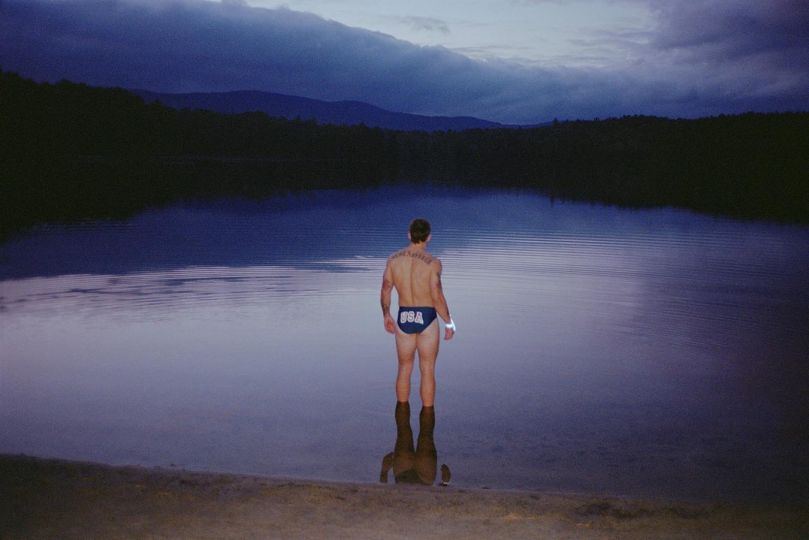
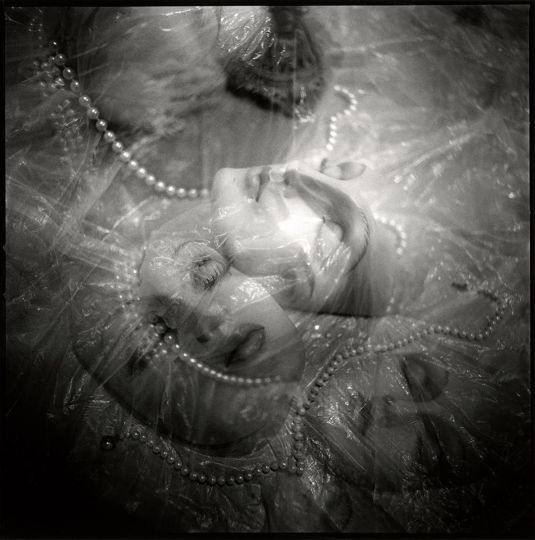
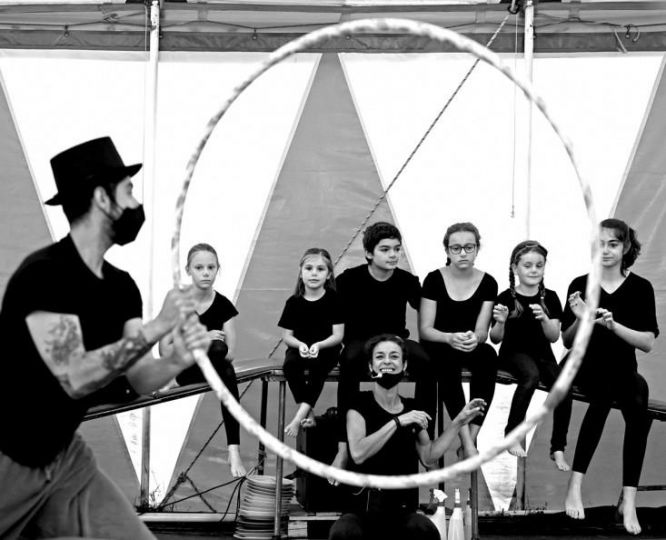
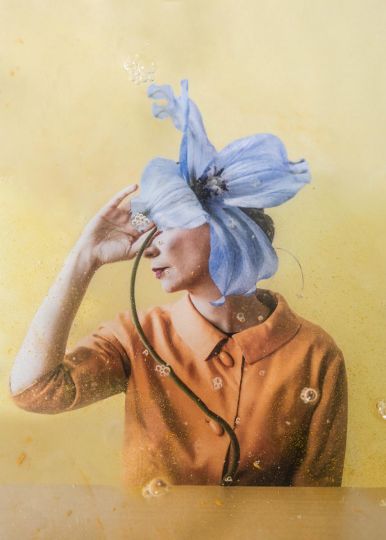
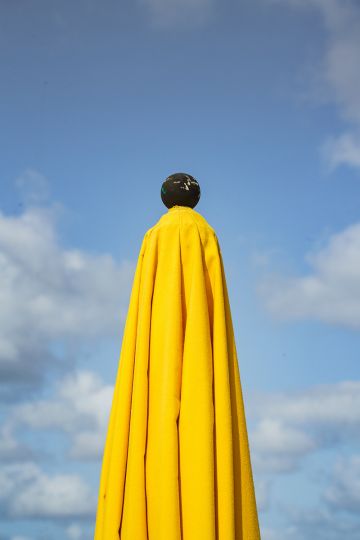
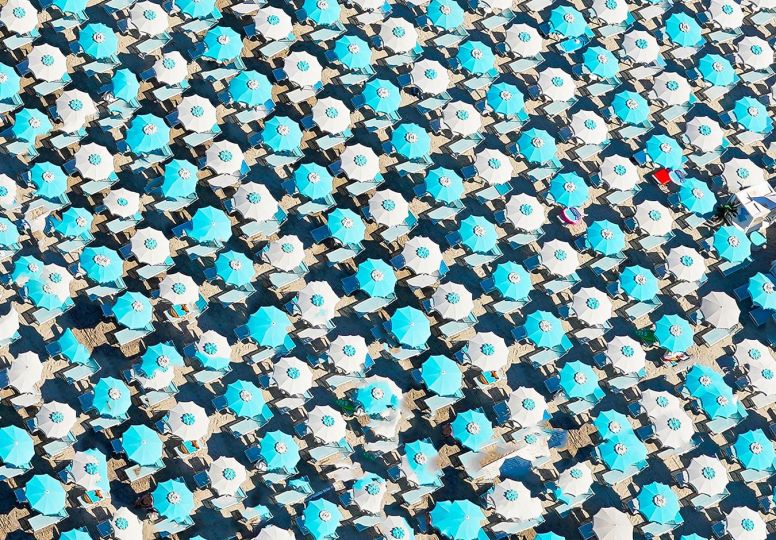
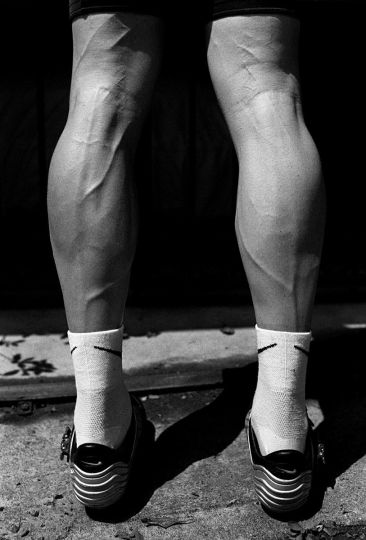
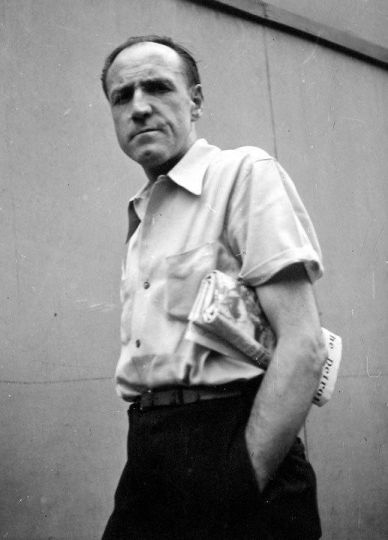
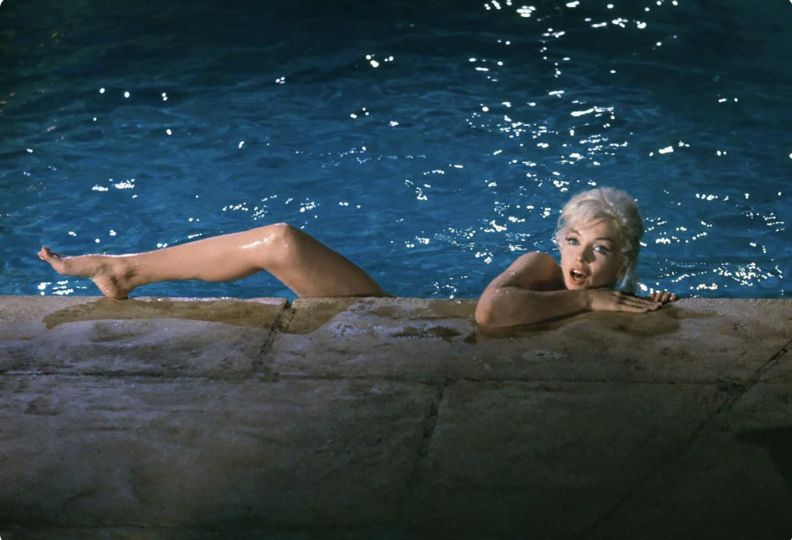
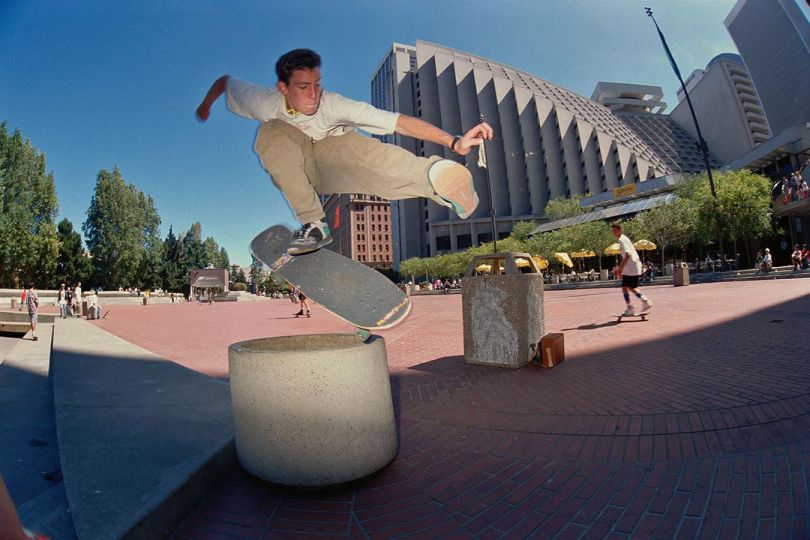
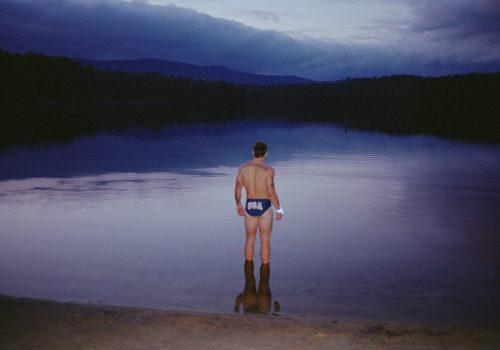
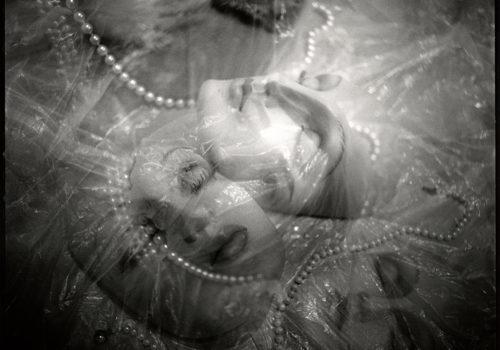
At Palazzo Roverella in Rovigo, the retrospective dedicated to the American photographer Rodney Smith transports visitors into a world where formal perfection conceals a quiet melancholy and glimpses of hope. The exhibition features over a hundred images where the photographer had combined rigorous composition, elegance, subtle irony and a touch of surrealism, creating photographs suspended between reality and enchantment and referencing the paintings of Magritte and the movies by Hitchcock and Wes Anderson.
The exhibition path winds through six conceptual themes. Starting with The Divine Proportion, where each shot adheres to an almost mathematical compositional rigour, primarily the golden ratio, it moves on to Gravity, where figures and objects appear to defy the laws of physics, as if floating in a dreamlike and unreal universe. Ethereal Spaces and Through the Mirror (the reference to Alice, who passes between the two worlds “falling,” is reflected in the bodies that seem to defy gravity) play with the duplicity of planes of reality, in which no trace of places, times, or circumstances remains. The exhibition concludes with Time, Light and Permanence and Passages, exploring borders and thresholds that lead to an undefined elsewhere and dazzling light.
Rodney Smith, whose photographs have been published in publications such as TIME, The Wall Street Journal, The New York Times and Vanity Fair, and who has collaborated with renowned brands including Ralph Lauren and Bergdorf Goodman, was once a student of Walker Evans. However Smith was also a philosophy and theology scholar. He found in photography the language that enabled him to express himself most fully. For curator Anne Morin, Smith’s images stem from careful consideration of the relationship between man, God, and nothingness. This concept is rooted in the writings of Paul Ricœur (a philosopher in the tradition of phenomenology and hermeneutics), in quotes from Descartes, and in Spinoza’s idea that the most appropriate response to the mystery of God is to embrace the harmony of hypotheses.
According to Ricœur, man finds himself at the crossroads of these worlds, where fallibility and error lie. This concept of imperfection has always troubled Smith, so “Every image that Smith produces, with the meticulous precision of a silversmith, is a constantly renewed attempt to recreate that divine harmony and to reach a higher state, if only for a fraction of a second”, Morin explains.
His images have not been retouched; they are the result of meticulous composition during the shoot and absolute control of the scene. They contain weird details and out-of-place, surreal elements that produce scenarios in which anything seems possible. It is a combination of aesthetics and technique that creates the illusion of perfection and whimsical imagery. Every element, whether a tilted body, an unreal garden or an absurd situation, contributes to the creation of an unstable yet fascinating balance.
According to Susan Bright: “his photographs, although capturing a single distilled moment, are laden with anticipation and invite viewers to complete the story through their imagination. At the heart of every film lies a fundamental question: What happens next? This undercurrent of anticipation forms the lifeblood of cinema, fostering audiences’ innate desire for narrative and meaning. Photography, however, is often perceived as a moment distilled, so this leads most thinking around the medium to consider it in relation to time, capturing a moment never to be repeated”. Indeed, in Rodney Smith’s work, there is a sense of time suspension: “most of his well-known work was produced in the 1990s and early 2000s, yet these photographs evoke the 1930s. What we experience is imagined time, a homage to the style, elegance of an idealised era”, Bright adds. A single frame can encapsulate narrative intrigue, compressing storytelling into concise visual moments, transforming viewers into co-authors.
These are moments suspended between the certainty of formal control and openness to the unexpected, which come to life in the imagination of the observer, transforming the photograph into a small scene from a possible story. Despite the persistent veil of melancholy, Smith wrote that his surrealist photographs captured “a world of optimism, happiness, often whimsy and joy”. A restless inner life and a tension between perfection and imperfection had accompanied him throughout his life. And the tilted body, a strong reference to silent cinema, is a distinctive feature of his style and also a sign of the “middle ground,” of the mastery of the subject and the photographer, which requires perfect balance and control.
Most of the works on display are in black and white, as Smith only began working with colour in 20002. As Smith used to explain, “45 years and thousands of rolls of film later, I still have this unwavering love for black-and-white film. Colour serves a different function for me, but there is nothing to me like the blackness and luxuriant intensity of the black-and-white. It is an abstraction by addition.”
“Susan highlights the tension between aspirational perfection and underlying melancholy, while Anne reveals the torment of striving between nothingness and divinity. Together, they illuminate how Smith’s photographs—with their impeccable composition, imagined worlds, and enigmatic figures—embody these profound dualities. His work reminds us that being human is, at its core, an exercise in beautiful contradiction: capable of embodying multiple, seemingly incompatible experiences simultaneously”, Leslie Smolan explains.
The exhibition is accompanied by a catalogue, Rodney Smith. Photography between real and surreal, published by Silvana Editoriale, curated by Anne Morin and featuring texts by international curators Anne Morin and Susan Bright, and Leslie Smolan, Executive Director at Estate of Rodney Smith.
Paola Sammartano
Rodney Smith. Photography between real and surreal
From October 4, 2025 to February 1, 2026
Palazzo Roverella
via Laurenti 8/10, 45100 Rovigo
Italy
https://www.palazzoroverella.com/en/