The room is small, the exhibition modest, and the admission free.
In the tsunami of Parisian openings in the latest part of the spring 2025, it was so easy to miss it. A mistake, because a masterpiece awaits discovery, embedded in the history of intellectuals and artists, most of them émigrés, who made Berlin the center of the avant-garde in the 1920s.
The Musée d’Art et d’Histoire du Judaïsme (MahJ) is presenting an installation that is the result of extensive research by journalist Jérôme Lechevalier in family archives and French, German, American, and Israeli institutions. It is, at first, a file passed down from generation to generation: a bundle of photographs by Stella Furchgott Simon (1878-1973) and letters from Miklos Bándy (M. Neumann, 1904-1971), given to Lechevalier by Miklos’s niece.
Stella Simon is an American from South Carolina whose family was originally from Central Europe. A wealthy widow, she studied under the photographer Clarence H. White. In 1927, in Berlin, she met Miklos Bandy, a Hungarian revolutionary (as a high school student, he participated in the Council Republic). Banned from university because of the numerus clausus imposed on Jews, he passed through Berlin where, in 1925, he gravitated in avant-garde cinema circles, becoming friends with the filmmaker Viking Eggeling and his assistant Ré Niemeyer (a student of the Bauhaus, she would later marry Philippe Soupault).
Arriving in Paris in the summer of 1925, Bándy published in Richter’s magazine in 1926 and made his first steps on film sets shortly thereafter. Promoted assistant of the director Alberto Cavalcanti, he published in Hans Richter’s Dadaist magazine G-Material zur elementaren Gestaltung and in Germaine Dulac’s Schémas. Back in Berlin, Simon hired him as screenwriter and director of the film Hände, which she produced and for which she had come up with the idea.
Based on a love triangle, Bándy’s 17-page screenplay details the 170 shots of the film, originally titled Jungle, un jeu de mains. The only actors are hands, choreographed by Herta Feist, a dancer and gymnast trained by Rudof von Laban. The hands of Takka-Takka (Lucie Lindemann, 1890-1980), a dancer of Javanese origin, and those of Hertha Feisten bring the story to life. Complex sets by Max Dungert, a constructivist artist from the Novembergruppe, were installed to conceal the bodies of the dancers and extras moving on scaffolding. The American composer Marc Blitzstein (1905-1964), who completed his training with Arnold Schoenberg, composed the original music. Filming took place in Berlin in August 1927 with four technicians, the director, and a whole cohort of stagehands, extras, friends, and Simon. The film is part of the experimental research of Viking Eggeling and Hans Richter. The artistic effervescence seems to obscure political awareness, yet they knew of the dangers that lay ahead.
On August 31, the first rushes were shown at the Neumann-Nierendorf Gallery, a center of New Objectivity, in the presence of Fritz Lang, who wrote to Bándy, “The film made a strong impression on me.” In January 1928, Alfred H. Barr, the future director of the Museum of Modern Art, submitted photograms to Alexander Rodchenko, whose wife, Varvara Stepanova, published her article on Hände in the magazine SovietKino the following month. “Stella Simon reveals the natural properties of photography (…) Complex compositions, similar to Suprematist painting or Constructivist sculpture, produce interesting pictorial effects.” In February 1929 the film was edited into a silent version of 21 minutes instead of the planned 43 and screened in New York for the inauguration of the Film Guild Cinema, in Paris at the Les Agriculteurs cinema, and in Berlin in the “American Night” program organized at the Gloria Palast by the Novembergruppe.
In a climate increasingly hostile to the avant-garde and Jews, Stella Simon commissioned Alfred H. Barr to preserve Hände. The film reached MoMA, which commissioned a new, shorter 13-minute cut and financed the recording of the musical score by its composer in 1936.
Bándy’s film and Simon’s photographs are part of a period of intense but relatively brief creativity. Ruined by the crisis, Simon returned to New York in 1929, opened a photography studio, and exhibited at MoMA and the Julien Levy Gallery. In 1940, she moved to San Francisco. Bándy met his future wife, Ida Gurevitsch (1903-1973), in Berlin, an Estonian better known as Ina Bándy. They distributed their photographs through the Berlin agency Dephot before founding, in 1929, the Ecce photography agency, of which they were the only two photographers. Bándy, in the wake of the International Workers’ Relief (SOI), probably had Ecce financed by Willi Münzenberg, an influential member of the Communist International. The couple settled in Paris in 1929/1930 and married the following year. Ecce’s photographs were published in Vu, AIZ, L’Art vivant, Documents, Bifur, Le surréalisme au service de la révolution, all the elite of the avant-garde press that promoted photography. Under the credit Ecce, prints were exhibited in the galleries La Pléiade in Paris and Julien Levy in New York, in 1932, for “Modern European photographie” which included Man Ray, L. Miller, R. Parry, E. Lotar, Umbo, I. Bing, F. Henri, M. Tabard, A. Kertesz, Moholy-Nagy…) Miklos and Ina continued their photographic collaboration in Russia and then again in France until around 1937.
What remains is Bándy’s film and stills, as well as Simon’s photographs. How can we showcase the creative impulses of a generation with such diverse histories, origins, and training, united by a desire to break with conventions and experiment with the potential of their art: cinema, photography, dance, music, and visual arts? Jérôme Lechevalier and the MahJ curator, Pascale Samuel, have devised a system whose complexity of purpose nevertheless appears evident in its simple and didactic rigor.
There are three versions[1] of the film. On the big screen, the remarkable digital restoration allows for an exceptional viewing experience. The hands strut, deploying in arabesques, breaking the dance, the better to parade. The ballet develops in an abstract universe according to a choreography ordered by a formal aesthetic during sequences with a renewed rhythm. The projection is punctuated by incisions of short sentences illuminating the scenario of universal thwarted love.
Echoes of the film, photographs and photograms.
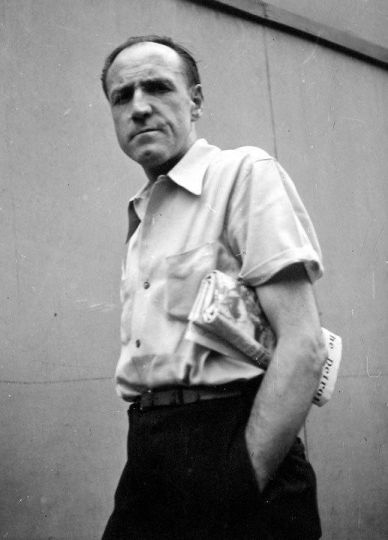
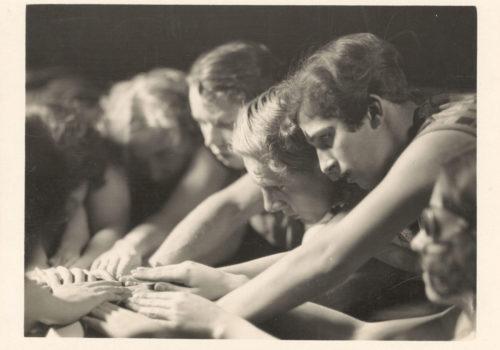
First, the portrait of Stella Simon, cigarette in hand, which we see for the first time in France, and that of Miklos Bándy in a surprising frame revealing his Parisian building, but also all the portraits of the film crew, also brought together in a group photograph. The whole is illuminated by short, well-documented texts by Lechevalier. The exhibition includes around forty images and documents. Simon’s photographs are not only a making-of of the film, which required special installations and even the construction of a swimming pool. In the spirit of New Objectivity, all of them stem from a desire for singular framing to represent the situation from the most favorable angle, best suited to the formal character of the project. The photographs reveal a true reflection on the relationship between fragments of bodies and elements of decor. The period photograms from Bándy’s personal collection also exalt the geometry of forms in an experimental approach freezing movement to bring out what the eye cannot grasp and rediscover elementary forms. Crossing other boundaries, in a seemingly limitless space that is both conceptual and physical, the hands emerge in their living reality with surprising lyricism. A language emanates from them that is far more complex than the object-based experiments of Bándy’s inspirations: Eggeling and Richter.
The installation proposed by Jérôme Lechevalier and MahJ curator Pascale Samuel is a journey through the cultural and artistic context of Berlin, whose bold, innovative aesthetics permeated photography in Paris in the 1930s.
Françoise Denoyelle
[1] The first, a 21-minute silent version, followed by the 13-minute MoMA version. The third, presented at the MahJ, is the one proposed by the Deutsches Filminstitut & Filmmuseum and restored in 2021 from a 35mm silent positive, preserved at the British Film Institute, with French intertitles (the 21-minute version shown at the Les Agriculteurs cinema) and for the sound, a copy from a 13-minute 16mm copy (Final Cut MoMA version) that they had.
Hände, 1927, installation at the MahJ
June 7–November 9, 2025
Musée d’Art et d’Histoire du Judaïsme
Hôtel de Saint-Aignan
71 Rue du Temple
75003 Paris, France
https://www.mahj.org/en