



Talking Heads by Matthew Rolston
If masks are, as Spanish philosopher and poet George Santayana wrote in the early 1920s,“arrested expressions and admirable echoes of feeling” then the Vent Haven Museum in Fort Mitchell, Kentucky, must contain one of the world’s more unique and evocative collections. It is a place like no other.
After discovering Vent Haven through an article by Edward Rothstein that appeared in the New York Times in June 2009, I became deeply intrigued by its inhabitants. I knew nothing of ventriloquism then, and still know very little, but I have learned of the poetry of these figures and the ways in which they were brought to life as an expression of their creators—the figure-makers and ventriloquists.
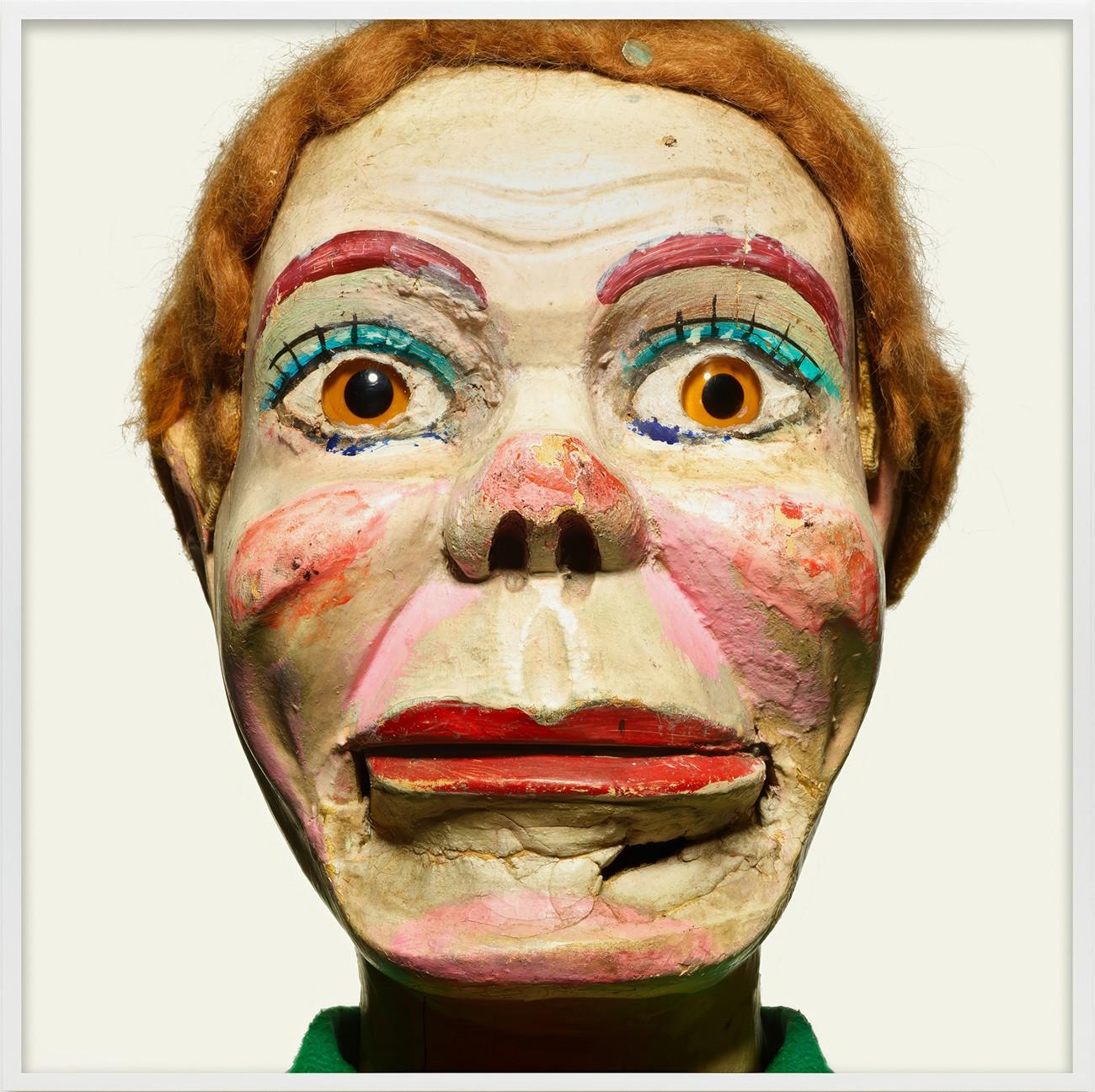
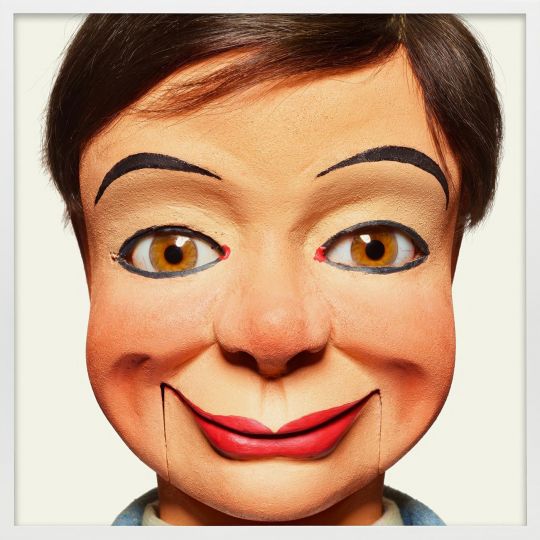
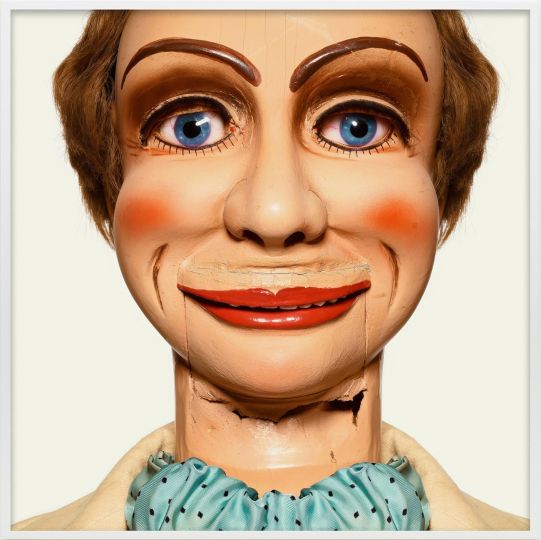
I began by approaching my subjects because of how they look, not necessarily because of their historic or cultural value. The faces that spoke to me most had expressions that I found enigmatic, pleading, Sphinx-like, hilarious, and disturbing—all at once. To me, the greatest portraits are mostly about finding a connection with the subject’s eyes. There’s an expression of yearning and desire in these eyes that I find disturbing.
Ventriloquism has ancient roots. Long before the music hall era, before vaudeville, radio, or television even existed, there was sha- manism and there was ritual. When the shaman spoke to the tribe, channeling the voices of spirits—sometimes animist, sometimes divine—no doubt he or she used the same techniques as those used by modern ventriloquists. All forms of modern entertainment and storytelling come from the same primal beginnings.
What makes ventriloquism as an art form and culture all the more fascinating is that it embodies the “God complex.” A man (or a woman) gives birth to a lifelike, moving, speaking facsimile of another human. This is both primitive and miraculous. In performance, the ventri- loquist literally has a hand inside the figure’s body and head, making it appear alive.
The dummies have moving parts: Mouths of course, but eyes that can roll, eyebrows that can rise and fall in surprise, heads that turn, and sometimes more. They’re not puppets. There are no strings to animate them, they appear to move and speak—often mocking their creators (or some social convention)—and they seem to be as smart as their creators, in fact, usually smarter.
The bond shared by the human and their wondrous creation is the part of ventriloquism I find most gripping. It’s the space between. Just as in a classic two-man comedy act, a ventriloquist and his or her dummy are partners—each other’s yin and yang. It’s always a give-and-take. After all, what’s a joke without a punch line?
What time has wrought on the figures speaks volumes, in a language both satirical and tender. Their expressions evoke a sense of serenity, a melancholy that suggests a spiritual longing, authentically embodying three telling truths: Nothing is perfect, nothing is ever finished, and nothing lasts.
Perhaps in their solitude today, separated from their makers, they represent a liberation from our materialistic world. No longer aided by the human voices that once spoke so magically through them, the Vent Haven figures now speak by the simple fact of their physical pre- sence.To paraphrase American poet Helen Hay Whitney: These old lost stars rise and gleam once more.The dummies don’t just channel humanity, they fetishize it. Human history is all over them. They are overwhelmingly, intensely human objects. They are my subjects.
Matthew Rolston
Dummies’ Dreams Fulfilled by Hunter Drohojowska-Philp (excerpt)
They stare at us expectantly, these dummies, as if awaiting a response. The inhabitants of the Vent Haven Museum regularly startle and impress visitors with their collective gaze. How to respond to such apparent yearning? Photographer Matthew Rolston succumbed to their silent pleas by making portraits of them. Each photograph is five feet by five feet in size, a larger-than-life square format of consider- able significance. They are neither conventional vertical portraits nor horizontal still lifes, but an intentional combination of both. Rolston sees these ventriloquist’s dummies as subjects, their individual personalities revealed by their hair and eye color, eyebrows, the shape of their noses and mouths, even the size of their ears.
The same characteristics that fascinate Rolston when he photographs fashion models, celebrities and entertainers encouraged him to make the canny decision to depict these handcrafted performers as though they were living beings, which is not so hard to imagine. They spent their lives on the laps of the attentive but controlling partners who brought them into being, commissioning them from specialist figure makers to have eyes that could roll with exasperation, brows that could rise with surprise, ears that could wiggle in amuse- ment, even the seeming ability to drink or smoke, just like their nightclub audiences. Some of them have traveled the world making people laugh, until they or their owners outlived their usefulness. In silent retirement, they perform no more.
In Rolston’s portraits these ventriloquial figures, as they are termed, look improbably alive. He was moved to reanimate them through the alchemical medium of photography, choosing about two hundred of his subjects from the Vent Haven Museum collection of more than seven hundred figures, simply because he responded to their appearance, which could be striking, exotic, or disturbing.
Certainly empathy was one reason that drove Rolston to expend the time and resources in pursuit of this project. He created these pictures for one of the defining reasons used by artists throughout history: he liked the way they looked and wanted to see if he could influence how they would be seen, how they could become part of the larger visual culture. An influence in this regard is undoubtedly the estimable Irving Penn.
Hunter Drohojowska-Philp
BOOK LINK: https://www.amazon.com/Talking-Heads-Vent-Haven-Portraits/dp/1938461002
PROJECT WEBSITE: https://matthewrolstontalkingheads.com