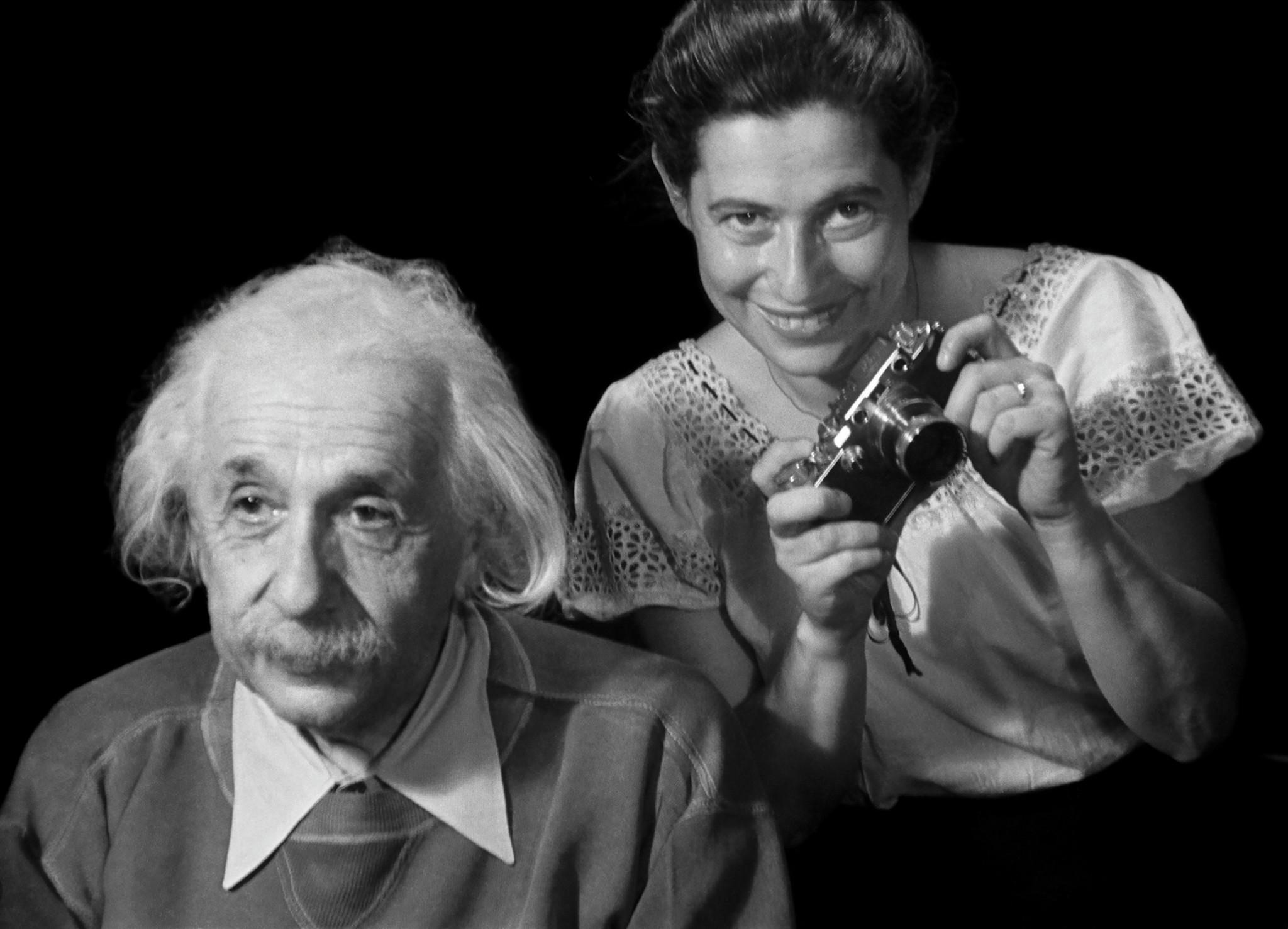
Albert Einstein, Sigmund Freud, Indira Gandhi, Frida Kahlo, Diego Rivera, Stefan Zweig… The most illustrious figures of the twentieth century sat before the lens of Marcel Sternberger. Drawing equally from optics and psychology, the Hungarian-born American photographer developed what he called the psychological portrait. His tragic death in 1956 cast this brilliant portraitist into obscurity. In recent years, however, his work is returning to the light.
Born in Hungary in 1899, Marcel Sternberger was one whose life was swept along by the currents of history. He served as an intelligence officer in the Austro-Hungarian army during the First World War, only to return home and find his native land annexed by Romania. His family settled in Budapest, where he studied law, but growing antisemitic persecution soon forced him to flee. After a period in Prague, he moved to Paris, earned a doctorate in law, and began working as a journalist for Le Soir.
In 1932, during a trip to Berlin, he met Ilse Naumann, a film student. They married the following year, just days before the Nazis confiscated Jewish passports. The couple took refuge in Paris. Ilse gave him a Leica camera, a gift that would change the course of his life.
Sternberger soon turned to photography and launched a dazzling career. While on assignment in Belgium for Le Soir, he was invited to photograph the royal family, later becoming their official portraitist. As Nazism spread across Europe, the couple and their children relocated to London, where Sternberger continued to rise, portraying figures such as H.G. Wells and Sigmund Freud, who Sternberger photographed for the last portrait sitting before his death. He also photographed Joseph Kennedy, then the U.S. ambassador, whose portrait was printed on a Christmas card sent to President Franklin Roosevelt. It was this connection that brought Sternberger to the United States, where the president invited him to create the portrait that would later adorn the American dime.
« Without optical and psychological depth your pictures – although possibly flattering – will lack that three-dimensional quality which alone can infuse them with life. »
Sternberger stood apart for his distinctive approach to portraiture, blending his background as a journalist with the tools of psychology. Each sitting became an interview of sorts, recorded through his Leica as he captured the subject’s shifting emotions, from laughter to tears. He combined this method with careful attention to lighting, optics, and body language, seeking to reveal the sitter’s inner life. A true Nadar of his time.
Unable to return to Europe during the war, Sternberger settled in the United States, where his list of sitters grew steadily: the political elite, Albert Einstein, the Indian Prime Minister Jawaharlal Nehru, who chose his photograph as his official portrait, Hollywood celebrities, and the legendary couple formed by Frida Kahlo and Diego Rivera. It was while visiting them in Mexico from New York that Sternberger died tragically in a car accident in 1956.
He left behind an extraordinary archive spanning twenty-two years of encounters with some of the century’s greatest figures, as well as an unpublished manual outlining his portrait protocol. In 1996, his widow Ilse entrusted the collection to the antiquarian Stephan Loewentheil. A few years later, his son Jacob, then a student of psychology and photography, rediscovered it. Thus began a devoted effort to restore the photographer’s legacy. In 2016, he published The Psychological Portrait: Marcel Sternberger’s Revelations in Photography with Skira and Rizzoli, a volume in which the photographs converse with unpublished materials from his archive and the original manuscript of Sternberger’s guide to portraiture. Recognition, at last, was underway.
Zoé Isle de Beauchaine
More information