Early this year 2026 the strong man in Washington declared he wanted to have the “honor to take Cuba”, his executive order effectively stopped all oil import to Cuba. The New Yorker wrote: “For most Cubans, the order meant that their already difficult lives were about to get considerably worse. For months, the island had faced daily electricity blackouts owing to a lack of fuel, along with severe shortages of food, water, and medicine. Economic activity had all but stopped, and the government, which was essentially broke and unable to secure new loans, had been incapable of providing solutions. Even garbage collection was virtually nonexistent, with huge mounds of refuse piling up on street corners. In the past eighteen months, three powerful hurricanes have destroyed countless homes and vast expanses of cropland, displacing more than a million people. When the executive order came, Cuba was on life support; Trump’s action effectively shut the oxygen off.” (“Is Cuba next?” Letter from Havana of March 23, 2026) Since then only a small Russian oil tanker has been allowed to deliver the minimum supply for the island to survive a few weeks.
For everyone of us still harboring romantic view of revolution, let’s not forget that by the 13th of August Cuba will be celebrating (if they still have food for celebration) the 100th anniversary of Fidel Castro, that is precisely the Achile’s heel of Cuba, a country long maintained on artificial life support by socialist patrons (Russia until 1990s and Venezuela until the kidnapping of Maduro by the US) now completely isolated on the world stage, except for the predatory imperialist USA that has a powerful and rich base of Cuban exiles in Florida
The long-lasting animosity between USA and Cuba dated back to the failed coup of Kennedy’s 1961 Bay of Pigs invasion and the subsequent 1962 missile crisis just prior to President John F. Kennedy’s assassination. That was the time Marc Riboud arrived on the scene in November 1963. What has Marc seen in Cuba of 1963? “For two weeks we visited the island, we met peasants, intellectuals, and ministers. (…) I watched and photographed. (…) On the one hand, we discovered dance: bright architecture open to tropical vegetation, but the discipline, the rhythmic steps, and the arched torsos of the teenagers awakened unpleasant memories. On the other hand, there was a rehabilitation center for former prostitutes: they were being put back on the straight and narrow path of socialist morality. In their new uniform of respectable whores, we found them beautiful, although less sensual.” (Excerpt from the photobook “Marc Riboud Cuba,” published by Éditions de la Martinière, 2016).
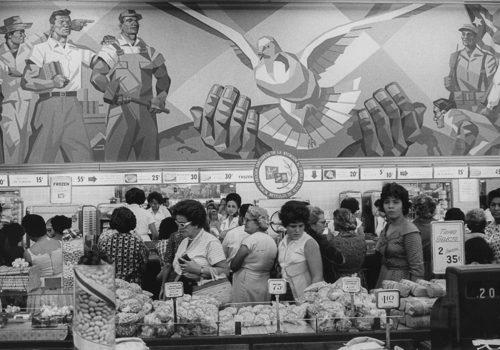
What was remarkable was Marc’s encounter with Fidel Castro, when as a fly on the wall he listened to the Lider Maximo’s logorrhea in an over 6-hour sleepless night in a hotel room telling French journalist Jean Daniel the stories of the Cuban Revolution and his fascination with President Kennedy and General de Gaulle. In the streets of 1963 Havana, slogans and propaganda on the walls still boasted the “USSR” friendship with Cuba, such as this dynamic fresco of a painted rocket with the hammer and sickle above the handwritten text: “the science of the people combined with all the natural forces are exalting the glory of peace”, with the symbol of peace represented by a white dove. Another panoramic wall painting shot by Marc Riboud inside a former Woolworth supermarket, celebrating the revolution with farmers, intellectuals, and soldiers, in a pure Soviet style prevalent in USSR, China and other socialist countries of the late 1950s and early 1960s. That was a strange period of Cuba when a minority of Cubans with US dollars sent from their exiled relatives could afford the luxuries while the poorer majority was facing empty shelves like these two children sitting at the bottom of a supermarket gondola, common sight of the difficult times in the 1960s lasting until today, when the US embargo cuts off fuel and food supply. Marc Riboud also saw in the office of a steel factory a Johnny Depp lookalike employee in front of his typewriter smoking a big cigar with his hair pulled back with hair pomade, behind him a slogan on the wall was addressing directly the US President: “Stop Mister Kennedy Cuba is not alone”. Those were the days when Cuban female militia and guards were so attractive that their relaxed attitude instantly caught the eye of Marc Riboud.
Forty years later, Marc’s son Alexei Riboud (also a photographer) came to Havana following in his father’s steps. In 2004, some forty years after Marc Riboud’s black and white vision, his son Alexei Riboud, also a photographer, used color films to document his vision of Havana after listening to Wim Wender’s Buena Vista Social Club. But his approach reflects the influences of the great American masters of color photography. Here and there in the sunlit streets with their strong contrasts, we cannot help but discern an affinity with Joel Meyerowitz, and see the shadows of Soul Leiter… Alexei’s challenge lies on the other side of the sunny facades of the buildings, in the ruins that huddle in the dark. One senses a tired city, one that has let itself go and no longer bothers to put on makeup. Even the electric poles seem to no longer stand straight, and this speaks volumes about the state of decay of Havana after half a century of economic sanctions by the Yankee governments, but also of the mismanagement and corruption of the dictatorial power in place, what Marc Riboud called “laziness.” From Fidele Castro to his successors, the Cuban class in power made no effort to get out of this mess. Without oil, it’s not sugarcane juice that could power the engines of these old vintage American cars, their image of nostalgia no longer attracts the few tourists. Even the deserted counter of a bar with tiled walls, captured by Alexei, reveals unoccupied stools desperately awaiting customers, and in the very back, one can just make out a solitary bottle of rum and a ghostly glass. Just as the father collected portraits of workers and militia women, the son has compiled a catalog of architectural structures, here echoing the father whose surveyor’s eye Cartier-Bresson praised. Fidele may chant “Homeland or Death,” but in the absence of revolution, it is the slow but certain death that is undermining poor Havana.
In the words of Alexei Riboud: “It was while listening to the soundtrack of Wim Wenders’ film “Buena Vista Social Club” that my desire to travel to Cuba materialized in 2004 with a 15-day exploration of the capital, Havana. And music remained the guiding thread of my visual wanderings through the city. On almost every street corner, coming from an apartment window here, a dark backyard there, or a café opening onto a square, the blended sounds of rumba, cha-cha-cha, danzón, pachange, and reggaeton punctuated my wanderings. A flyer I found one morning announcing a concert by the famous singer Omara Portuondo that very afternoon led me to the Gran Teatro de Havana to witness a performance as grand as it was memorable by the Cuban diva. However, lulled by the island’s gentle rhythms, the reality of crumbling structures, dilapidated buildings, and empty cafes quickly reminded me of the suffering of a people almost resigned to shortages and reduced, for the most part, to resourcefulness, bartering, and informal exchange. Far removed from any political or historical considerations, I wanted to visually represent this destitution through the “collapsing” structure of a worn-out and disillusioned population, yet one that remains standing and alive.”
Jean Loh, May 2026