Luc Delahaye is one of the most astonishing figures in contemporary photography.
One of the greatest photojournalists of the 1990s, he left Magnum and the news scene in 2000 and began to integrate his vision of photojournalism into contemporary art.
It has been 20 years since he last exhibited in Paris.
Quentin Bajac at the Jeu de Paume presents 70 of his works created since then. You will find the text here.
The Jeu de Paume is dedicating a major monographic exhibition to Luc Delahaye (born in Tours in 1962), covering his photographic production between 2001 and 2025. This period, decisive in his career, corresponds to his withdrawal from photojournalism and his commitment to the field of art. A major war photojournalist in the 1990s and former member of the Magnum agency, he is part of a generation of photographers who reworked the articulation between documentary practices and artistic dimension. For twenty-five years, his photographs, most often large-scale and in color, offer a representation of the disorders of the contemporary world. From the Iraq war to the Ukraine war, from Haiti to Libya, from the OPEC conferences to those of the COP, Delahaye explores the noise of the world and the places supposed to regulate it. Sometimes made in a single take, sometimes veritable compositions assembled by computer over months from fragments of images, Luc Delahaye’s photographs are always an encounter, whether immediate or delayed, with a reality. A reality that must be stated, in a form of documentary withdrawal, without demonstration: “To arrive through a form of absence, through a form of unconsciousness perhaps, at a unity with reality. A silent unity. The practice of photography is a rather beautiful thing: it allows this reunification of oneself with the world.” The exhibition, the first in Paris since 2005, offers a retrospective look at twenty-five years of creation. It brings together some forty large formats, some previously unseen and produced for the occasion, a video about the Syrian conflict on which Delahaye has been working for many years, as well as a large installation in a format new to the artist. Furthermore, the exhibition will also provide an opportunity, throughout the journey, to focus on the creative process, through visual sources and rejected images.
From the end of the 1990s, Luc Delahaye diversified the means of disseminating his images beyond the press, notably publishing several author’s books. Portraits/1 (1996) – a series of portraits of homeless people taken in photo booths –, Mémo (1997) – a collection of portraits of victims of the war in Bosnia taken from the obituary pages of a Sarajevo newspaper – or L’Autre (1999) – a series of portraits of metro passengers taken without their knowledge by the photographer without aiming at the eye – demonstrate a desire to erase the operator, to depersonalize the gaze. These strategies of avoidance prefigure a body of work which, after 2001, would continue this singular relationship with reality. Between 2001 and 2005, Delahaye used a panoramic camera, producing large images with elongated proportions. This format allowed for a broadening of vision, a distancing of the subject, and an open reading. The operator seemed absent; the viewer is never in the image, but facing it. For Delahaye, the panorama became a mean of constructing a space of observation devoid of affect, conducive to a broader vision of human situations—whether it be a refugee camp, a UN meeting, or a funeral ceremony in Rwanda. From 2005 onward, panoramic photography gave way to other modalities: digital compositions based on multiple, staged shots. Delahaye seeks to capture the complexity of a situation in a single image, while maintaining a fundamental ambiguity, rejecting any univocal interpretation. This evolution is accompanied by a broadening of formats, affirming the presence of the human figure. Detail becomes essential: it anchors the image in reality.
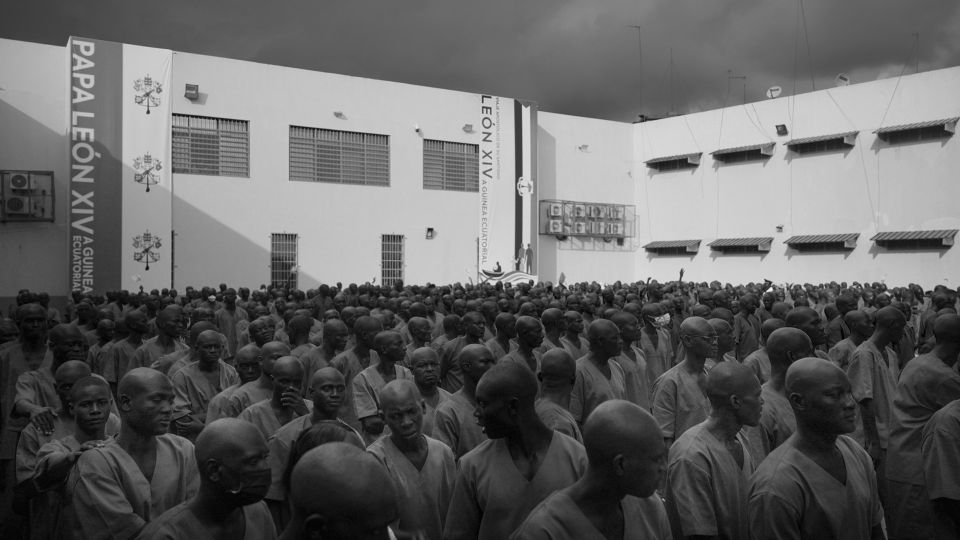
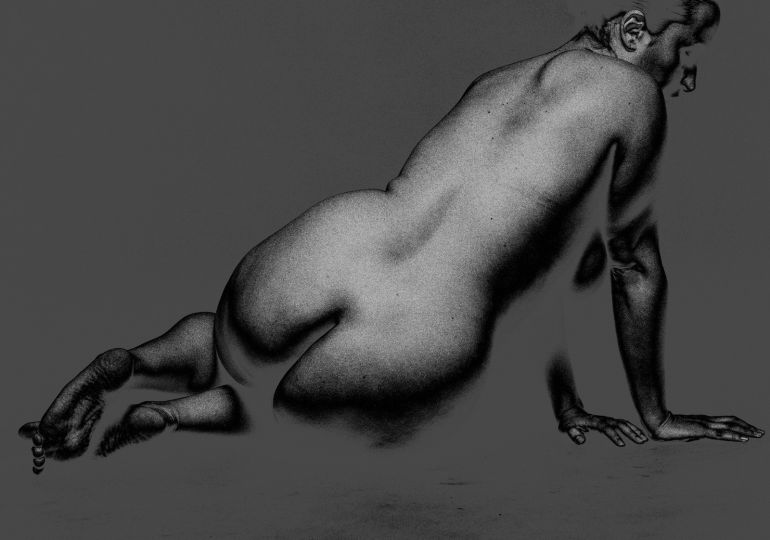
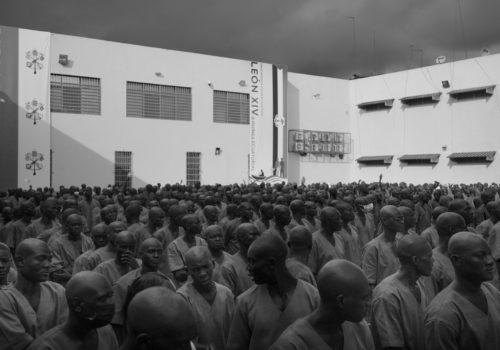
Over time, Delahaye traveled less, and for shorter periods; the computer was his main tool, and his practice became more akin to writing. The studio, a place of solitude and composition, became the laboratory for developing an essentially thought-out image. The process of transforming reality became more complex and lengthy. However, the moment of the shot remained central, and the works were always dated to the day of the initial capture. A revealing example of this logic, Luc Delahaye dated the work Soldiers of the Syrian Army, Aleppo, November 2012, to 2012. This complex composition, created in 2023 from views taken during the Syrian conflict, is shown for the first time in this exhibition. This fidelity to the moment reveals a tension between compositional work and presence in reality. The 2010s witnessed an opening of vocabulary, accompanied by new experiments: video, a return to black and white in an impersonal aesthetic, research to go beyond the single image, through sequences, series, or polyptychs. The treatment of the human figure also evolved: silhouettes became bodies, on the scale of the viewer. The individuals represented, often anonymous, acquired a universal value. Delahaye depicted a people suffering from pain: soldiers, prisoners, displaced persons, wandering children, vulnerable people, men and women absorbed in their task. The image seeks less to narrate than to give density to these silent presences.
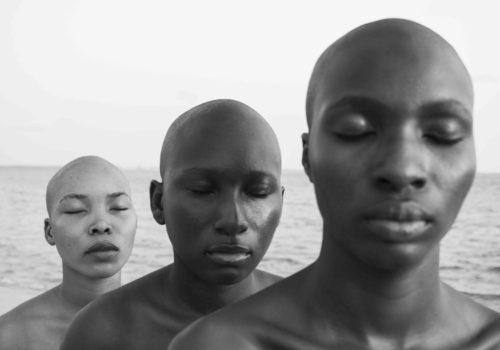
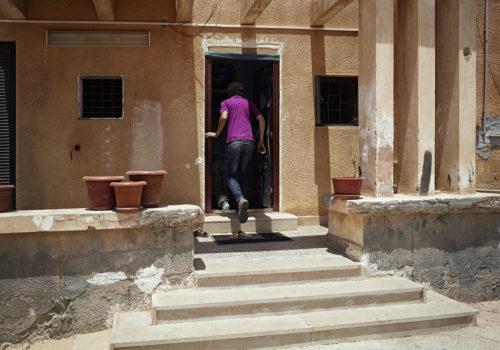
His works in India (2013), Senegal (2019-2020) and the West Bank (2015-2017) constitute closed ensembles, on the margins of his oeuvre. They focus on a form of everyday life of facts and gestures, underpinned by specific concerns: the planned disappearance of a village in India, manual work and what is sacred in Senegal, ordinary life and forms of resistance in occupied territory. Today, Delahaye does not exclude any of these avenues or methods – digital composition, staging, instant image even if staging and composition remain essential for developing images free from both the subjectivity of the author and the contingency of reality. Through the work of Luc Delahaye, the Jeu de Paume exhibition describes the state of the world in this first quarter of the 21st century. A tormented world dominated by tumult. A world in which conflicts and wars, as well as their echoes within international institutions and bodies, play a predominant role. The exhibition will be accompanied by a reference publication, in the form of a catalogue raisonné reproducing and cataloguing all 74 works created by the artist over the course of these twenty-five years.
Luc Delahaye : Le bruit du monde
October 10, 2025 – January 4, 2026
Jeu de Paume
1, place de la Concorde, Jardin des Tuileries
75001 Paris
Mo Concorde (lignes 1, 8, 12) +33 (0) 1 47 03 12 50
www.jeudepaume.org