Who has never been drawn to the unknown? Wanting to know what the world looks like and share it with others such was the mission Albert Kahn set for himself at the start of the 20th century. He sent twelve operators to travel the world and photograph it. This is how a collection of 70,000 autochromes color images reproduced on glass came into being, now on display at the Albert Kahn Museum in Boulogne-Billancourt (92).
The gardens are the museum’s second treasure. Each with its own style, they are open to visitors and currently host the “Mondes en communs” (“Worlds in Common”) festival dedicated to photography. For the past two years, the festival and the Friends of Albert Kahn have organized a photography competition. “Photographers submit work related to the concept of inventory,” explains Françoise Bornstein, founder of the Sit Down Gallery and a member of the jury.
Inventorying Brittany and Sudan
This year, the festival exceptionally honored two photographers: Claude Iverné and Aurélie Scouarnec. Iverné lived in Sudan for 25 years. “I was in Cairo when I met Sudanese people who offered to show me their country. Initially, I went there to write,” he recalls. From this long stay came eight photography books in an original format: loose A3 sheets, unbound not attached to each others. “This way, the reader can arrange the photographs in any order they wish,” the photographer explains. His works feature black-and-white street scenes and monuments.
Aurélie Scouarnec, who was also awarded the prize, spent three years photographing the preparations of traditional Breton dancers. “None of the photographs were posed. I photographed the dancers as they prepared backstage,” she says. Her images exude a mystical atmosphere. These precise, orderly gestures passed down from generation to generation emerge as fragments of moments suspended in time. The greenhouse hosting the exhibition evokes the lace of the dancers’ costumes. Nothing is left to chance: the choice of venue enhances the photographs.
Reinventing the Inventory
Ursula Böhmer’s cows, installed in the heart of the forest, have returned to their pasture. The German photographer creates portraits of calves, cows, and bulls. Perhaps they will encounter Peter Mitchell’s scarecrows objects that have almost vanished from the countryside now? Yet birds have not disappeared from the fields, as shown in Rebecca Topakian’s inventory of rose-ringed parakeets, a species introduced in France.
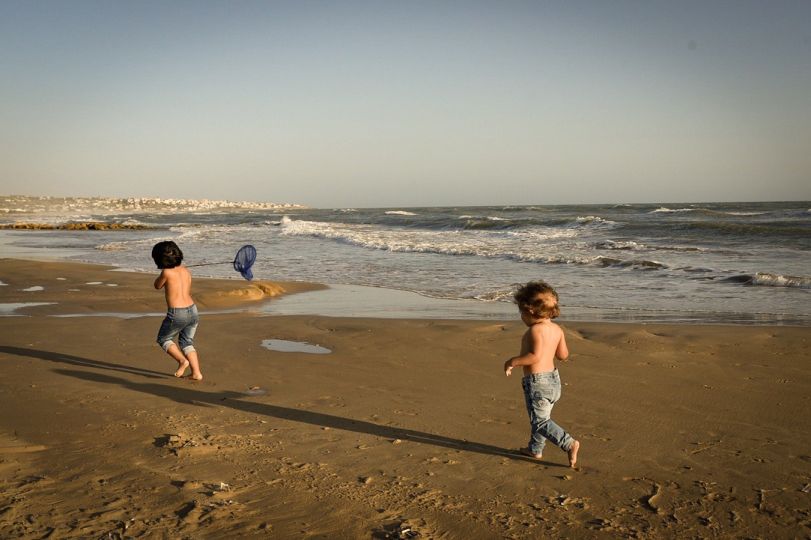
During a stroll through the gardens, visitors will also come across photographs by British therapist Siân Davey. During lockdown, Davey and her family transformed a wasteland into a magnificent garden. The place quickly aroused neighbors’ curiosity, who began using it to gather or pose in front of Davey’s caring lens.
A diversity of species in need of protection is also at the heart of Pedro David’s series, which documents the devastating effects of eucalyptus monocultures in Brazil. Luiz Braga also turned his lens on Brazil specifically on fishermen living north of the Amazon rainforest. An early riser, the Brazilian photographer roams the territory at dawn to capture magnificent colors. After the golden hour, perhaps the morning hour?
The Poetry of Ruins
Roberto Giangrande has focused on unfinished construction projects in Italy shopping centers, factories, apartment buildings abandoned for various reasons, chief among them corporate bankruptcies and mafia interference.
Looking up at the sky, we discover Thomas Paquet’s work. The artist captures the sun’s trajectory in a single image by combining the imprint of sunlight with a compression of time. To create a complete corpus of 365 images, he will need at least eight years. A promising project to follow closely.
Laurine Varnier
Festival “Mondes en commun 2025” – Continuing Albert Kahn’s Inventory
May 17 – September 7, 2025
More information on the Albert Kahn Museum website.