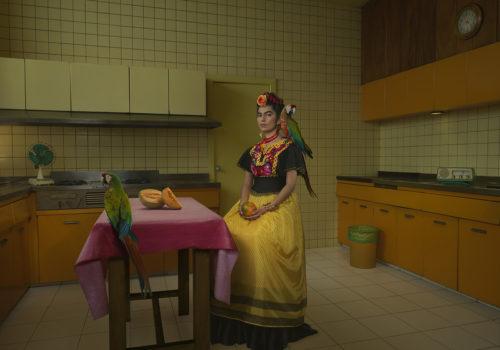
“Beauty and Pain” Frida Kahlo
Julia Fullerton-Batten living in London, United Kingdom, is a fine-art photographer renowned for her highly cinematic visual storytelling. Her large-scale projects are based around specific themes. Each image in the project embellishes her subject matter in a series of thought-provoking narrative ‘stories’ using staged tableaux and sophisticated lighting techniques.
“Since her death in 1954, Frida Kahlo has become an iconic figure in the art world and beyond. It’s hard to sum up her impact, because it spans art, culture, politics, and social issues. Her unique vision and fearless self-expression have made her a ‘Goddess’ figure whose legacy continues to grow, inspiring new generations of artists, activists, and admirers around the world.” Julia Fullerton-Batten
Website: http://www.juliafb.com
Lanza: What was the first image or emotional idea that made you realize Frida Kahlo could become an entire series?
Fullerton-Batten: In 2022, I travelled to Mexico for my retrospective exhibition and fell in love with everything about the country – the colours, the people, and its unhurried rhythm of life, so different from London. I was captivated by every encounter and every place I visited, and I knew I had to return to create a deeply personal photographic project.
The art of Frida Kahlo has fascinated me since visiting the V&A’s Frida Kahlo: Making Her Self Up exhibition in 2018. The exhibition, the first outside Mexico to display her clothing and personal belongings, offered a unique insight into her life and identity through items that had remained sealed away for fifty years after her death.
Her work is a vivid and complex tapestry, weaving together personal suffering, cultural identity, and political conviction. Yet it is her profound relationship with Mexico that inspires me most. Her love for her country is at the heart of her paintings, with its heritage expressed through the themes, symbols, and visual language she embraced.
Through her work, Kahlo offers a unique perspective on Mexican culture, identity, and the human condition, leaving an indelible mark on both national and international art history. More than seventy years after her death, her paintings remain strikingly contemporary.
With the help of local people, I was granted access to hidden and extraordinary locations rarely seen by outsiders: an abandoned mansion in the heart of Mexico City; a private residence designed by the internationally renowned architect Luis Barragán; ancient haciendas steeped in history; and the haunting Island of the Dolls on Xochimilco, famous for its floating gardens and shrouded in myth and mysticism.
These remarkable places became the backdrop for a body of work that celebrates the beauty, resilience, and rich cultural spirit of Mexico through my own visual language.
Lanza: Were you initially responding to Kahlo’s paintings, her biography, her relationship with Mexico, or the mythology that has developed around her?
Fullerton-Batten: Initially, I responded to Frida Kahlo’s paintings rather than her biography. I drew inspiration from her imagery, creating my own interpretations of her work. Although Kahlo insisted that she painted her own reality rather than dreams, her paintings combine autobiographical experiences with elements of realism, fantasy, mythology, and Mexican folklore. These themes influenced the development of my own images, particularly through my use of mirrors and reflections to explore ideas of identity and self-reflection. This approach echoes the way Kahlo expressed her complex sense of identity and experiences of physical pain through her art, while allowing me to communicate my own personal ideas in response to her work.
Lanza: What did you feel existing representations of Kahlo had overlooked and at what point did the project become your interpretation rather than an homage?
Fullerton-Batten: I felt that many contemporary representations of Kahlo focus on her recognizable appearance and iconic status rather than the emotional depth and psychological complexity of her work. I wanted to move beyond simply recreating her paintings and instead respond to the themes of identity, vulnerability and self-reflection that run through her practice. The project became my own interpretation when I introduced mirrors and reflections as a central motif. Rather than directly referencing specific paintings, I adapted these elements to investigate identity in my own way, creating a personal response inspired by Kahlo’s exploration of identity rather than simply reproducing her imagery.
Lanza: How did your experience of visiting Mexico change the concept you had developed beforehand? What would you hope a Mexican viewer sees that a European viewer might not?
Fullerton-Batten: Before visiting Mexico, my work was primarily inspired by Frida Kahlo’s paintings and the themes of identity, symbolism, and self-reflection that I found within them. Experiencing Mexico first-hand transformed this concept by giving me a much deeper understanding of the cultural and architectural environment that shaped her work. The colours, quality of light, landscapes, and atmosphere revealed details that cannot be experienced through photographs or reproductions of her paintings.
I wanted to incorporate some of Mexico’s most iconic locations into my work, including the historic Hacienda San Antonio Ometusco, built in 1695, Barragán’s Casa Gálvez, and Xochimilco, with its remarkable floating gardens and the ‘Island of the Dead Dolls’ a haunting chinampa where hundreds of weathered dolls hang from trees, placed by caretaker Don Julián Santana to honor the spirit of a drowned girl. These places helped me move beyond simply responding to Kahlo’s imagery, allowing me to create work inspired by the wider cultural landscape that influenced her.
Frida Kahlo is an unmistakable presence throughout Mexico and has become one of the country’s most recognizable cultural icons. While European viewers may recognize the references to Kahlo, I hope Mexican viewers will also identify the specific places, architectural details, colours, and cultural references that shaped my work. My intention is to present a perspective that celebrates not only Kahlo herself but also the history, atmosphere, and identity of the Mexico that inspired her.
Lanza: When you are simultaneously photographer and art director, how do you divide your attention between the larger concept and the immediate photographic moment? Do you create a written treatment, storyboard or shot list before production?
Fullerton-Batten: When working as both photographer and art director, I have to balance the larger conceptual narrative with the spontaneity of the photographic moment. I began by researching Frida Kahlo’s paintings extensively, not with the intention of recreating her work, but to understand the symbolism and emotions behind her imagery. I was particularly drawn to themes of solitude, physical and emotional pain, resilience, identity, and her challenge to traditional ideas of beauty. Folk art, nature, and animal symbolism also played an important role in shaping the visual language of my own work.
Before production, I developed a clear visual direction for each image through research, location scouting, and planning. With the support of my gallery, LSGaleria, and local collaborators, I gained access to significant locations, which I visited in advance. This allowed me to consider the lighting, composition, camera angles, and the story I wanted each frame to communicate. At this stage, every detail was carefully considered, including the choice of props, costumes, locations, and the selection of the model who would become the muse for each image.
The influence of contemporary Mexican fashion, particularly the 2024 Dior Mexico-inspired collection, also inspired me. Working closely with a film costume designer in Mexico City, I sourced authentic handcrafted Tehuana dresses from Oaxaca. These traditional garments were essential because they represent much more than clothing; they reflect heritage, cultural identity, strength, and individuality — qualities central to Frida Kahlo’s image and artistic expression.
Casting was another important part of the creative process. I searched carefully for models who could capture elements associated with Kahlo’s iconic appearance, particularly the strong gaze, distinctive features, and sense of presence. After extensive research, I found three young women who embodied the qualities I was looking for.
Although much of the process was carefully planned, the final photographic moment still requires responsiveness. The expression, movement, light, and atmosphere within the frame can create unexpected moments that shape the final image. My preparation provides the structure, but the photograph itself develops through the interaction between the concept, the subject, and the environment.
Lanza: Are your saturated colors and palette derived from Kahlo’s paintings, Mexican architecture, local light, or your own established palette?
Fullerton-Batten: I have always been drawn to rich, saturated colour palettes, which is one of the reasons I have such a strong connection to Frida Kahlo’s work. The colour in my images is undoubtedly influenced by her paintings, but it is also deeply rooted in the environment, culture, and visual language of Mexico itself.
While Kahlo’s use of colour was a starting point of inspiration, I found that Mexico naturally provides its own extraordinary palette. Even when working with flash, the natural daylight has a particular intensity and vibrancy that feels almost deliberate. The subjects I photographed, such as melons, parrots, traditional Tehuana dresses, embroidered textiles, and handmade details, already carry a richness of colour and history. When set against the painted walls, architectural details, and lush green foliage of Mexico, these elements naturally create a heightened, expressive colour world.
Kahlo’s love of bold reds, deep pinks, and floral tones, which was often reflected in the flowers she wore in her hair, strongly resonates with my own attraction to colour as a form of emotion and storytelling. My aim was not to replicate her palette but to respond to the same sense of confidence, intensity, and celebration of identity.
Visiting La Casa Azul, Kahlo’s home, several times was a particularly important experience. The fearless use of colour throughout the space reflects her personality: vibrant, intimate, and unapologetic. That same emotional relationship with colour is something I wanted to capture in my own work … allowing the colours of Mexico, Kahlo’s influence, and my own visual perspective to come together naturally.
Lanza: Visually your photographs feel suspended between biography and dream. Your process resembles directing a film within a single frame. Could you take one photograph from the series and reconstruct its entire evolution—from the first research note or visual reference through casting, location, wardrobe, lighting and direction to the final edit.
Dream Catcher began with Frida Kahlo’s painting My Dress Hangs There (1933), a work she created during her time in the United States. In the painting, Frida critiques what she saw as the superficiality of American capitalism and the moral decay of modern society. Reflecting on her longing for home, she famously remarked, “I may be in America but only my dress hangs there; my life is in Mexico.” That statement became the emotional starting point for my photograph.
Rather than illustrating the painting directly, I imagined what might happen after Frida’s return to Mexico. In my interpretation, she is no longer absent… she is fully present, rooted in her own culture and landscape. I chose a traditional hacienda as the setting, creating a space that feels both real and dreamlike. Ancient and colonial interiors, rich architectural details, and historic charm evoke the visual language that defined Frida’s world, while transforming it into a cinematic, contemporary scene.
Casting focused on finding a model who embodied Frida’s quiet strength rather than simply resembling her physically. I wanted someone capable of conveying resilience, introspection and dignity through gesture and expression. The wardrobe drew inspiration from Frida’s iconic Tehuana dress, floral adornments and layered jewellery, while remaining interpretive rather than costume-like. Every element was carefully selected to feel authentic to her spirit rather than become a historical reconstruction.
The peacocks became the emotional centre of the image. Frida kept peacocks at La Casa Azul, where they came to symbolise freedom, emotional resilience and transcendence. For a woman who endured lifelong physical pain and emotional hardship, the bird represented the desire to rise above suffering and continue creating. Their iridescent plumage also echoed her fascination with vivid colour and her carefully constructed personal mythology. I wanted the living peacocks to move naturally through the scene, becoming quiet companions rather than decorative props, reinforcing the sense that Frida has returned to a place where she belongs.
Lighting was designed to feel painterly, as though the photograph existed between memory and reality. Soft natural light was combined with carefully controlled artificial lighting to preserve detail while creating depth and atmosphere. Rather than illuminating every corner, the light guides the viewer’s eye through the composition, revealing textures, colours and symbolic details gradually, much like discovering a scene in a film.
Directing the image involved treating the single frame as a cinematic moment. Instead of asking the model to perform, I encouraged stillness and contemplation, allowing subtle gestures and posture to communicate emotion. Every object within the frame – from the architecture to the placement of the peacocks was considered part of the narrative, creating a photograph that invites viewers to construct their own story.
In post-production, the editing process remained restrained. The aim was not to create fantasy through digital manipulation but to refine colour, balance and atmosphere while preserving the authenticity of the scene. Rich, saturated tones enhance the emotional resonance without overwhelming the image, resulting in a final photograph that exists between biography and dream. Dream Catcher is ultimately not a reconstruction of Frida Kahlo’s life, but an imagined portrait of her emotional return home—a place where identity, memory and freedom are finally reunited.
Azul Portrait
In Azul Portrait, Julia Fullerton-Batten captures the introspective essence of Frida Kahlo through a worn mirror, where the reflection becomes a metaphor for fragmented identity and self-exploration. The presence of wilted flowers and cracks in the wall reinforce the idea of the passage of time and the persistence of the self beyond deterioration. As in Kahlo’s work, the mirror not only shows reality, but transforms it into a space of questioning and reaffirmation, where the figure’s defiant gaze resonates with the artist’s strength and vulnerability.
The Affair
Kahlo was a sexually liberated woman who engaged in love affairs with women, even during her marriage to artist Diego Rivera.
Kahlo’s marriage with Rivera was tumultuous with both having multiple affairs. Frida had affairs with both men and women. Rivera even had an affair with Kahlo’s younger sister Cristina which infuriated Kahlo. They divorced in 1939 but remarried a year later. Although their second marriage was as troubled as the first, Kahlo remained married to Rivera till her death.
Chinampas
Around the year 1350, the Xochimilcas founded Xochimilco, and developed an ingenious system of agriculture in chinampas to create artificial islands.
They made them on the surface of the lake to grow flowers, vegetables, herbs and other products. To move along the canals that served as streets, they used trajineras to transport their crops.
The Bed
Referencing Frida Kahlo’s paintings, the photograph portrays Frida being carried in her bed by laborers.
In the history of Mexican art, Frida Kahlo painted herself in different works while lying in bed.
One of Us
“Las dos Fridas” (1939) is one of Frida Kahlo’s most emblematic works, a painting that represents her identity and emotional duality. In it, we see two versions of the artist seated side by side, connected by their exposed hearts and a thin thread of blood.
Julia Fullerton-Batten, known for her visual reinterpretations of great works of art history, recreates The Two Fridas from a contemporary perspective. Her photography, with cinematic lighting and meticulous art direction, transposes Kahlo’s painting into a hyper-realistic, modern atmosphere.
Caught between Worlds
This image evokes a powerful sense of liminality and duality, key elements in Frida Kahlo’s life and work. The image, set in a ruined building with a weathered mural in the background, suggests a tension between past and present, between what was and what remains.
The central figure, dressed in an outfit that recalls Kahlo’s aesthetic, sits in a transitional space: a broken floor, walls that still hold traces of their former splendor, and a light that illuminates but does not invade. Her serene gaze, along with the rigid posture and the presence of flowers on her head, reinforce the sense of nostalgia and resistance.
Laundry at Dusk
Frida Kahlo washing her clothes, dressed in her traditional costume, is an image that fuses the everyday with art, identity and resistance. In an act as simple as this, Frida connects with her Mexican roots, proudly wearing her traditional dress, which is not only a symbol of her heritage, but also a statement of her individuality.
The act of washing clothes, although seemingly mundane, can be seen as a reflection of vulnerability and an intimate relationship with the everyday.
Marioneta
Frida Kahlo had a fascination with puppets, considering them an extension of her symbolic and playful universe. Her collection included cardboard and wooden puppets, many of them representing figures from Mexican folklore.
These small characters reflect her love for the popular and her ability to transform pain into art, for, as in her paintings, puppets could tell stories of suffering, identity and resistance with an air of play and magic.
Melon
The melon in Frida Kahlo’s work has a strong symbolic charge, especially in “Viva la vida” (1954), her last painting. In this still life, Frida depicts a cut melon with the phrase “Viva la vida” written on its flesh, a declaration of resistance and love for existence, despite pain and illness.
The choice of the melon is not accidental: its vibrant color and juicy interior evoke the vitality and ephemerality of life, in contrast to the death that haunted the artist in her last days.
Tehuana Dress
For Kahlo, the cultural life of the post-revolution focused on embracing all things Mexican, and that influenced her to dress in the style of a traditional Tehuana woman, as part of her commitment to reclaiming her Mexican heritage.
Frida Kahlo’s life was as indelible as the colors of those embroideries that characterize an Oaxacan huipil and for that reason, she lives on through multiple tributes. She paid homage to her own culture by wearing this Tehuana garment with pride.
Amarilla portrait
In Amarilla Portrait, the reflection in the rickety mirror seems to defy the decadence of the environment with its vibrant presence. The yellow of the dress and the purple flowers frame a face that embodies both tradition and renewal, evoking the resilience of Frida Kahlo, but with an identity of its own. The image suggests that memory and art not only survive the passage of time, but also reinvent themselves with each new look.
Text and Interview by Patricia Lanza