The World and Tenderness in the Photographs of Walter Rosenblum
Walter Rosenblum has photographed the lives of immigrants in New York’s Lower East Side, World War II, refugees from the Spanish Civil War in France, and life in Harlem, the South Bronx, and Haiti. He always approached his work with a focus on people and a socially conscious attitude. The essence of his more than 50 years of work is on display in 110 vintage photographs at the Centro Culturale di Milano under the title Il mondo e la tenerezza (The World and Tenderness). Walter Rosenblum. Master of Photography. The world and tenderness, because two dimensions intertwine in his images: “the world,” with all its social and human tensions, and “tenderness,” for the empathetic way he portrays even the most difficult realities.
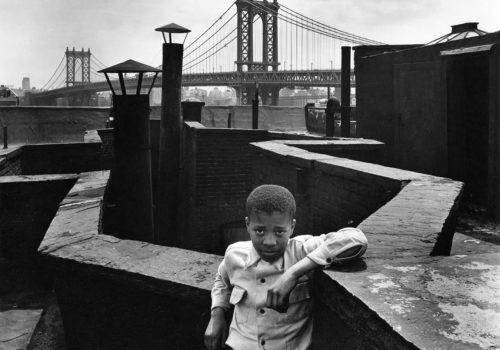
As curator Roberto Mutti explains, the strong connection to “the Photo League, the photographers’ cooperative he joined at the age of eighteen (later he became president of the exhibition committee and director of Photo Notes), is significant. The $5 registration fee was worthwhile for a programme of lessons on the fundamentals of photography, photojournalism and documentary photography. It was in this context that photos such as Boy on Roof were taken. In this photo, the child is captured with an intense gaze, one arm resting on the wall of a terrace as if he wants to show you his world. These are fragments of reality that would remain trapped in time and space — in New York in 1938 — if Walter Rosenblum’s camera had not rendered them in absolute dimensions.
The idea exchanges at the Photo League, a collective founded in the early 1930s with the aim of shedding light on human and social issues ignored by politics, were certainly interesting, especially given that its members included Paul Strand, Berenice Abbott, Robert Frank, Eugene Smith, Ruth Orkin, Dorothea Lange, Aaron Siskind, Lisette Model, and Weegee, to name a few. This was the place where the various paths of humanistic reportage took shape. Rosenblum’s encounters with Lewis Hine, a pioneer of social photography, and Paul Strand, his mentor and later friend, were decisive for him. Within a year, “the boy who had started taking pictures with a borrowed camera had not only figured out what his future career would be, but also put into practice the most important lesson he had learned, the one related to composition. He had been taught that achieving the right balance of volumes in a photograph allows it to tell a story by establishing an emotional connection with the viewer.
Instead, Walter did not need to learn about the world of the less well-off, a constant subject for the Photo League authors, who were convinced they could help redeem it, because it was his own world. In terms of authenticity, there was nothing better than portraying the neighbourhood where he lived, the Lower East Side, by pointing his lens at Pitt Street,” Mutti adds. A microcosm that serves as a metaphor for life, the search for humanity in everyday life, a humanism rooted in the politically progressive vision that characterised the Photo League. “All of this can be found in every assignment and single photograph taken by Walter Rosenblum”. Rosenblum sought to emphasize human dignity, portraying his subjects as people whose humanity survives intact despite adverse circumstances, rather than simply as victims. His approach to photography lies at the intersection of Lewis Hine’s social photography and Paul Strand’s humanistic reportage.
The exhibition features works taken between 1938 and 1990, representing the key themes of Rosenblum’s career, including images from World War II. One of the most decorated photographers of the war, he served as a photographer and cine-operator in the US Army, participating in the Normandy landings at Omaha Beach, and being among the first to film the Dachau concentration camp. According to Mutti, “Only a man of peace like him could photograph war in this way, highlighting the clash between the democracy he strongly believed in and the dictatorships capable of such horrors. Only someone who had experienced poverty could portray the Spanish refugees of the civil war or the inhabitants of Haiti with all the necessary compassion. Only someone who had lived on the Lower East Side woukd recognize the vitality with which the Bronx and Harlem knew how to react to life’s difficulties”. An important discovery was made by Rosenblum. “I realized,” he later said, “(…) that through my photographs I could pay them (his subjects, ED.) homage”. And that is why his subjects were at the centre of the scene. “Each of them contextualized. Each of his photographs is capable of containing a story (at least a suggested one) and shows attention to others and the social aspect,” Mutti concludes.
Rosenblum has combined his career as a photographer, which spans more than fifty years, with teaching. Together with his wife, photography historian Naomi Rosenblum, he has curated international exhibitions, including the Lewis Hine Retrospective. In 1999, they were both awarded the Infinity Award for Lifetime Achievement by the International Center of Photography.
The exhibition features films by Nina Rosenblum, an established director in the independent film scene. These include In Search of Pitt Street, which focuses on Walter Rosenblum’s photography, and They Fight with Cameras, which portrays Rosenblum’s work as a photo and film reporter during World War II, from Omaha Beach to Dachau.
The exhibition, produced by SUAZES, with the patronage of the Municipality of Milan and the U.S. Consulate in Milan, is accompanied by the catalogue Walter Rosenblum. Master of Photography, curated by Angelo Maggi and published by Silvana Editoriale.
Il mondo e la tenerezza. WALTER ROSENBLUM. Master of Photography
December 3, 2025 – February 19, 2026
Centro Culturale di Milano
Largo Corsia dei Servi 4, 20122 Milano
Italy
https://www.centroculturaledimilano.it/