Finally, I wrote in conclusion to my last presentation, animated, following Kertèsz and Bill Brandt, by a breath of fertile freedom, Virt, Sannes, as well as Diénès, inventors and practitioners of new resources or processes to circumvent, discredit or magnify reality, laid during the 70s, the bases of a mutation which, during the following decade, would upset, with the help of surrealism, – not to say revolutionize, the practice and perception of photography.
So here we are in the mid-80s, a time when nude photography diversified and settled into three clearly defined trends: glamour photography, which had appeared for about thirty years with the American magazine Playboy, which was then experiencing its most successful hours, thanks to a good twenty foreign editions generating record print runs exceeding seven million copies; it would be strongly in competition from then on, in addition to its counterpart Lui in France, by new titles such as Penthouse, Hustler, Private and many others, agents of the evolution of nude photography towards pornography, without forgetting publications intended to satisfy a public specialized in its inclinations such as Score, Busty and a number of gay or fetish magazines, all indications of the current social changes.
Secondly, aesthetic photography with an artistic tendency, − pictorial (D. Hamilton) and sculptural, affirmed, whose eminent representative was Lucien Clergue (1934-2014), with numerous unequalled publications such as Née de la vague, 1968; Corps mémoire, 1969; Genèse, 1973; Belle des sables, 1979; Visions sur le nu, 1982. I would be remiss if I failed to mention also the name of Fernand Michaud (1929-2012), whose reputation struggles to reach the level of excellence that is undoubtedly his. This trend, still alive and well throughout Europe, was carried by Swiss anthologies (the Schönheit die begeistert series, the Schönheit in Bild series, and the Fravex publications), and by talented, established professionals from Germany (F. Meisnitzer, Peter Basch, G. Vetter, Günter Rössler, Stephan Lupino, etc.), the Czech Republic (M. Stibor and J. Vavra), and Hungary (V. Lussa); a trend also present in the Anglo-American world (with P. Gotlob, Diénès, Yeager, Rawlings, and the remarkable periodical Figure photography quarterly), which was perpetuated in France by its sexy variant, so brilliantly represented by Jeanloup Sieff and J-F Jonvelle, but which was severely undermined by the overwhelming success of men’s magazines.
And then there is finally a minority and dispersed current, clearly personalized and individualistic, of creators, not necessarily photographers, but nevertheless almost always visual artists, for whom photography is more a means than an end, a tool to fix visions more intellectual and expressive than figurative, moreover most often imbued with symbolic connotations. Each of these creators, resolutely libertarian, has a style of its own which is in no way confused with that of his colleagues. Their commonality lies in their individual freedom, as does their indifference to the two movements mentioned above. Thus, we will highlight the montages of Marcel Mariën (1920-1993), close to Magritte, and the highly staged works of Richard Cerf (born in 1950), both influenced by surrealism. At the same time, professional photographer Christian Vogt offered us nudes framed by a systematic program, fortunately tempered by its many variations, which lend it an unexpected whimsy; or, to evoke a typology completely different from those just mentioned, we will enjoy dwelling on the strange and incredible transfigurations of Veruschka and Trülzsch.
Each of these books, extraordinary in their inventiveness, non-conformity and provocative power, deserves illustrations and detailed commentaries that would in themselves exceed the space of a column. I will therefore resolve to document this trend towards fantasy in nude photography of the 80s in two publications, which will allow me to submit to you on each book presented slightly more detailed comments and a greater number of illustrations, unusual and even rather surprising.
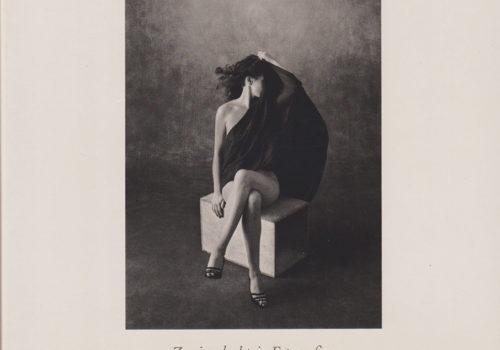
I begin today with the work, regulated like Swiss clockwork, of the Basel photographer Christian Vogt, who under a title meticulous to the point of mania, 82 photographs of 52 women (Zweiundachtzig Fotografien mit zweiundfünfzig Frauen, ed. Photography, Schaffhausen, 1982) [Ill. 1] has published a photobook which, with strictly uniform shots in front of a painted cyclo lit only by a spotlight on the top and as its only accessory, − the main character of this scene, a rectangular wooden crate open on one of its small sides, a book which could have simply been entitled “The Crate”. Among the many models who posed, Barbara, Marcellina, Sabine, Renée, Béatrice, Hildi… not always completely naked, but still quite naked, had the imperative instruction to use this box to their liking, but must not put it out of the frame: the gallery of portraits presented to us, always full-length, is jubilant, to see how each of the 52 young women used, exploited, diverted this constraint (this same constraint that Paul Valéry considered essential to artistic creation!). Among those who sit, lie down or climb on it, use it as a tea or aperitif table, or as a cloakroom [Ill. 2-7], or treat it as a negligible accessory, to the point of, − only once (Irene), ignoring the instruction and eliminating it from the frame, thus producing a photo “without the box ” (!), poor photographer, despite being the master of this series, finds himself reduced to being only the recorder of scenes conceived by his models. Paradox! If the eye behind the lens is no longer that of the creator, where is photography going?
The second book I will focus on is the one published in 1986 by the German painter and visual artist Holger Trülzsch (born in 1939) and his accomplice and current partner Vera (von) Lehndorff, known as Veruschka, also born in 1939, during a highly troubled time, since her father, a squire of the Prussian high aristocracy, lost his life in 1944 as an accomplice in the plot to assassinate Hitler, leaving her an orphan, held captive in a concentration camp. Nevertheless, she would later become one of the most sought-after top models in the American fashion press, sought out by directors (Antonioni) and photographers (R. Avedon). A busy and inventive career, at its peak during the 1960s, which led her to devote herself between 1965 and 1975 to body painting, magnified by the intervention of her painter friend into a true artistic practice: photography (which often used Polaroid) then became subsidiary, documentary, preceded as it was by creation. This book, entitled Veruschka, Transfigurations (Thames & Hudson, London, 1986) [Ill. 8], with a preface by the activist writer Susan Sontag, which they published under their two names as a joint work, has lost none of its relevance today, nor its power of illusion, especially in its final sections. Opening with simple, full-length body paintings of Vera [Ill. 9-10], sometimes made up as an elegant man [Ill. 11], a bit of a rogue, or opening in two with a fictional zip [Ill. 12], an impressive image, the book continues with scenes set in nature where she frolics in the autumn forest, or melts into the moss [Ill. 13] before confronting and confusing her body with the oxidations of the old, disused fish market in Hamburg (pp. 86-144) [Ill. 14-18], a submissive accomplice in the fantasies of “industrial mimicry” of her partner who deploys all his talent as a painter [Ill. 16] to make her as indistinguishable in this industrial environment as a chameleon among the foliage. Is this art of camouflage really a branch of photography? I won’t comment on this serious issue; the fact remains that these are indeed nude photographs, and for me, that’s the essential point.
I’ll add before concluding that, although somewhat neglected by posterity, this extraordinary publication (which can be purchased online for a few dozen euros) has retained the fervor of a few fans and survived fifty years without losing any of its power or appeal: since the distant era of the exhibition of their creations at the Pompidou Museum in 1982, the various avatars—transfigurations—of Veruschka invented and painted by Trülzch, which constitute the raw material for their book, were again exhibited in Trieste in 2021.
Alain-René Hardy
L’ivre de nus
livresdenus[email protected]
P.S. I cannot refrain from quoting here the brochure by Jan Vegter, a Flemish body painting enthusiast, self-published in the late 1980s under the title Body-Art (52 pages in A4 format with spiral binding)[Ill. 19] presenting 23 laminated analog photo prints of nude women entirely painted in various artistic ways. A draftsman and teacher, Vegter, born near The Hague in 1923 (subject to homonymous confusion), left hardly any traces, with the exception of narrative works drawn after his retirement for his own pleasure. His Body-Art, poorly documented, is a work of professional quality which only lacks an editorial duplication; we do not know how many copies were produced, probably a few dozen, no more, probably less. Vegter presents his body paintings of professional and amateur models, some of them vividly colored and very pleasing [Ill. 20/21], among which one cannot fail to notice a Portrait [Ill. 22] that is unmistakably reminiscent of H. Trülzch’s creations on the body of Veruschka.