My column No. X hadn’t yet been published when I realized that a path now opened up before me to present, as I intended, the next generation of marginal but fundamental creations in the shift photography was taking at the end of the 20th century. First, I’d like to conclude the 1980s, presenting, as announced, the work of Belgian surrealist Marcel Mariën, then Richard Cerf.
It will then be possible (Chronicle XII) to explore the scene of the 1990s, with books by photographers whose fame, though not talent, barely extends beyond a circle of connoisseurs, generally professionals: the Czech Yuri Dojc, the distant and friendly Dook, and our Belgian neighbor Greta Buysse. Fernand Michaud will also provide us with proof that despite his undeniable classicism, he was able to open himself up at the end of his career to a perspective free from norms, his own included, which gave him the best of his work, the most personal, Avignon and Arles well surpassed.
Richard Cerf (born in 1950) and Marcel Mariën (1920-1993), despite their generational difference, show a similarity of influence that connects them, in a more or less narrow and orthodox way, to the surrealist sphere of influence; they are surrealists, one might say, each in his own way. Where the elder, as a writer, manifests rather conceptual inspirations and reactions, the younger, a painter and sculptor by training, is to be considered a visual artist, but neither is strictly speaking a photographer; they only use photography as an ancillary medium to fix, to give lasting form to their inventions and stagings… worthy emulators in this of Kertèsz who was more of a photographer when he immortalized the streets and squares of Paris from the top of his apartment than when he installed his model in front of a distorting mirror.
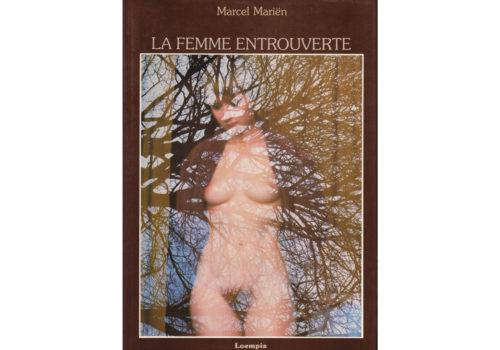
Mariën’s approach (La femme entrouverte, Loempia édr, 1985. Ill. 1; Le voyeur myope, Bruxelles, Les lèvres nues, 1987, with the collaboration of Tom Gutt for the texts. Ill. 5) is fundamentally intellectual, and aims only to challenge, surprise and amaze the complicit voyeur (and not the short-sighted one),,who is supposed to appreciate, be astonished, amused or shocked, that a spider makes its way towards a woman’s pubis (Ill. 2) or that a mouth with full lips is superimposed on the vaginal lips (Ill. 6), − evoking without the slightest doubt the myth of the vagina dentata, that a breast finally, topped with a wig (Ill. 7), can simulate a woman’s head, like Magritte’s Rape (Ill. 8) (on which, incidentally, Mariën published one of the first studies, in Brussels in 1943).
But ultimately his photograms are entirely utilitarian and have no other objective than to perpetuate a mental construction, shaped using cut-outs, collages and superpositions, developed from irreverent or indecent, even obscene, considerations, in any case almost always with a sexual connotation; from one page to the next, we only count hairy pubes, buttocks and breasts, and a few cocks… (Ill. 9 & 10). Boring after a while!
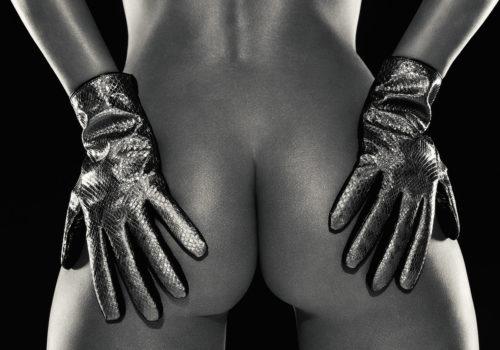
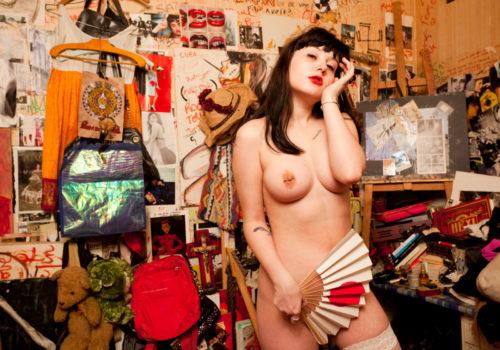
Less intellectual and less obsessive, Richard Cerf challenges us with more lengthy and finely conceived and elaborated scenes, in which an artistic representation dominates, rich in forms and colors. In his first reproduced works (Zoom, n° 76, 1980), the photograph fixes distressing or dreamlike scenes, strong in chromaticism (Ill. 11 & 12), in fact little foreshadowing of what he will soon publish, where the sexual element will become dominant, thematic. In his book published in 1982 in fact, abusively entitled Photographies (Paris, éd. Natiris) (Ill. 13), it is essentially a question of erotomaniac visions, where buttocks and pubis obsessively dominate… (Ill. 14-16).
But ten years later, the body, until then reduced to its sexual attributes, would reassert its rights and reappear, imperial and imperious, in the illustrations of his book published in Japan (Richard Cerf, Fiction édr, Tokyo, 1990) (Fig. 17), a magnificent gold-jacketed edition in which Cerf, in full maturity, suggests his most visually accomplished fantasies (Figs. 18-20).
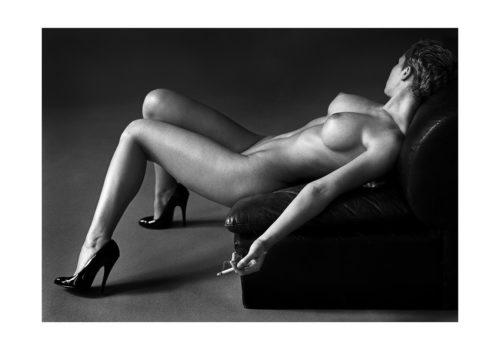
Finally, especially appreciated for his publications of old erotic photography, Serge Nazarieff, who combines photography with his multiple talents, has also published, to my knowledge, two books of nude photographs on the seaside, rather rough between rocks and sand, between the Count of Clugny and André de Diénès, producing strange and unusual images, sometimes surreal almost in spite of themselves, in spite of himself (Fig. 21).
Alain-René Hardy
L’ivre de nus
[email protected]