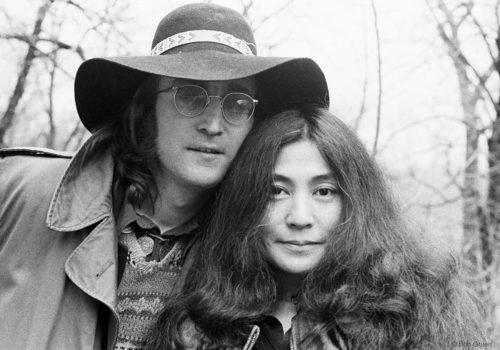
Bob Gruen is an icon of music photography. While he is world-famous as John Lennon’s photographer — capturing the musician’s legendary nonchalance in front of the New York skyline in 1974 — he is above all the portraitist of the entire rock and roll scene, which he witnessed erupt in the 1970s. For decades, he has captured this unique energy, guided by a single motto: freedom.
His encounter with gallery owner Sebastian Alderete opened the doors to a sometimes very exclusive world, that of art photography. Alderete works passionately to promote greater recognition of music photography through the Music Photography Gallery, which positions itself as the only gallery dedicated to the valorisation of vintage prints, an essential factor in gaining recognition for this still underrepresented genre: « Acquiring a vintage print is acquiring a moment, the recollection of a unique moment in time. »
In this sense, Bob Gruen’s collection is a true treasure, made up of prints he produced himself in his darkroom as early as the 1960s — silver prints, Cibachromes, Polaroids — all perfectly preserved and amongst the first physical prints ever made of music photography. Since 2016, the Music Photography Gallery has represented this body of work alongside about twenty photographers, including Mick Rock, Roberta Bayley, Marcia Resnick, and Daniel Kramer — whom Sebastian Alderete met through Bob Gruen.
Today, for L’Œil de la Photographie, the most regarded rock and roll photographer shares the story of his journey and his vision of photography.
Bob Gruen, how did you become a music photographer?
I learned photography from my mother when I was very little. She was an attorney, but her hobby was photography. She developed and printed her own pictures. When I was less than five years old, she built a darkroom and took me in. I was fascinated with the process of watching a photo develop on a blank piece of paper in a darkroom. I got my first camera when I was eight years old. By the time I was 11, I was taking pictures at summer camp and I would send the film home to my mother, she’d send prints back which I then sold to the campers.That’s basically what I’ve been doing ever since, except my mom doesn’t print for me anymore. After high school, I tried a couple of colleges that didn’t really work for me so I took Timothy Leary’s advice to « turn on, tune in, and drop out. » I dropped out to live with a rock and roll band, friends of mine from high school and I started started taking pictures of them. When they got a record contract, the record company found out about me and started to hire me for other jobs. And one thing led to another…
It all really started in 1970, thanks to Tina Turner.
Yes, in the summer of that year. A friend of ours told me to go see Ike and Tina Turner. I was totally blown away by her performance. I came back a couple of days later, this time with my camera. It was the first time I photographed somebody I didn’t know, and not my friends. I took some pictures that night and one was especially good, of her dancing off the stage to a strobe light. I had a few frames left in the camera and I thought that maybe if I would open the camera for one second to catch a couple of images of Tina in the flashing lights. One of the resulting images is absolutely perfect. It has been compared to Duchamp’s Nude Descending a Staircase (1912) because it’s five images of Tina kind of overlapping each other. It’s not Photoshop. It’s a one-second picture. It really captures all the excitement and energy that is Tina Turner. A few days later we went back to their show and a friend literally pushed me in front of Ike Turner. He looked at the pictures and liked them a lot. A couple of days later in New York, he introduced me to a publicist at a record company who took me to a party where I met two other publicists. One of them hired me to shoot Elton John, and then the snowball just started rolling.
This also led to your first photography exhibition at the Beacon Theatre in 1971, a landmark show that put music photography on the walls when it was only known through album covers or magazines.
I met a promoter who was putting on concerts at the Beacon Theatre. She was very excited to get in touch with Ike and Tina Turner so I introduced her to Ike and they played a big concert. To pay me back, she helped me produce a whole set of 30 by 40 prints that I made wrapped around masonite, which was a very unique process that only this lab I worked with could make. The guy was able to make a big 30 by 40 print and while it was still wet, he would wrap it around a piece of masonite, which is like wood and about a quarter of an inch thick. That way they would become a solid heavy panel. I put them up in the Beacon Theatre, which was basically my very first exhibition.
Using large prints was a way to introduce music photography into the realm of art. Did you ever have a link with this photography scene ?
I was not very connected to this scene. I was invited at one point in the 1970s to be part of the Rencontres d’Arles in Arles. And back then I didn’t really understand the importance of going there and meet people. I was really naive. I regret that I missed that moment to learn more about the art world of photography because I’ve always felt that I wanted to be part of that, but I never really had the connection. When I go to these kind of shows I find the images much calmer. My work is loud, it’s the sound of rock and roll. That’s why I was always using big prints : they had to be loud. And I think that was kind of shocking for the photography world. Things are changing of course and I was lucky to have my pictures shown in Paris Photo, Photo London and similar fairs.
What do you think was different about your pictures ?
I had a talent to take good pictures of people that was not just pleasing portraits. Ever since I grew up, my goal, my theme in life has been freedom. My first concert when I was 13 was Pete Seeger. I remember he talked about personal freedom and equal rights and things like that. I always lean towards music with a message. Bob Dylan, the New York Dolls, The Clash, or later Green Day : these people are using rock and roll to make a statement. To me, rock and roll is about freedom, it’s about the freedom to express your feelings very loudly in public. It’s about that moment when everybody’s screaming and nobody’s thinking about paying the rent. I’ve always tried to catch that feeling in the pictures. One of my favorite compliments is that people see my pictures, they say they can practically hear it. That’s what I’m trying to do, I’m trying to capture the feeling of being there. That’s why I’ve always thought of it more about art and not just journalism.
Looking at your photography, there is also a feeling that the freedom you mention seems long gone. With the rise of the industry, show business, nowadays musicians or other celebrities are very much in control of their image.
Yes, everything is much more controlled now. In the 80s when the corporations started seeing that there was money in the music business, things changed. They started trying to control things a lot more. You had to sign a contract that you could only take certain pictures. You know, Rolling Stone only started around 1967 and Cream magazine around the same time. There wasn’t a lot of media back then. Rock and roll bands did not get into the New York Times or even the New York Post. In the 70s, people were thrilled that you would take their picture because and put them in a magazine. Nowadays they get reviewed regularly, they are part of the culture but at the time, choosing rock and roll was still deemed that you went on delinquent music. I remember when it all started people used to say « it’s going to pass, it’s not important. » But it is important because it’s a rhythm of freedom that opens people up. And it’s spread around the world. It’s the language of the world now. It’s interesting to me because it turned out I was actually capturing a culture.
Another thing you sensed at the time was the importance of prints. You still have incredible vintage prints from that time.
I’ve always had my own darkroom and made my own prints. A lot of other photographers had to go to labs and have them made, and that would be expensive. So they would only have one or two prints made that they would send to a magazine. I always had extra prints made. You know, I only took two classes in my life, at the Fashion Institute of Photography. That’s the only formal photography training I’ve had. One of the things I learned from the professor there was that whenever you’re making a print, always make two or three, because the only reason you’re making the print is because somebody liked that photo and you’re going to give it away.
But if you don’t have a print, you don’t have a photo. So I always made extra prints and I have lots of them now that dates back to 50 or 60 years ago. And it turned out that there is a big market for the vintage print today.
One of your most famous pictures is the one you took of John Lennon in front of New York’s skyline. But if you could choose one pictures amongst the many you have produced throughout your career as a music photographer, which one would it be ?
Well, this is like asking for my favorite child. I have a lot of favorites, certainly the Tina Turner picture I mentioned earlier but also certainly several pictures of John Lennon.
Not just the New York City picture. Even more important is the picture I took of him at the Statue of Liberty. That’s one of the few pictures that I thought of in advance. I don’t usually plan my pictures.I usually just go wherever the subject is and try to get a good picture of him in that space very spontaneously. But for that one… John Lennon was being charged by the government. They wanted to deport him and send him out of the country. I felt that the Statue of Liberty was a good symbol of welcome. We should be welcoming people like John Lennon. I suggested it to him, he liked the idea. He was very aware of the media and he understood the power of a picture like that.
We went out there, it was just very simple. The two of us just took the ferry and took a couple of pictures in front of the Statue of Liberty. That picture has taken on a lot more meaning since he passed away, because I think that John Lennon and the Statue of Liberty both represent personal freedom. And like I said, that’s been my theme all my life. So I would have to say that’s one of my favorites.
Interview by Zoé Isle de Beauchaine
The Music Photo Gallery TMPG
[ by appointment only ]
118 S 3rd St.
Brooklyn, NY 11249
www.musicphoto.net