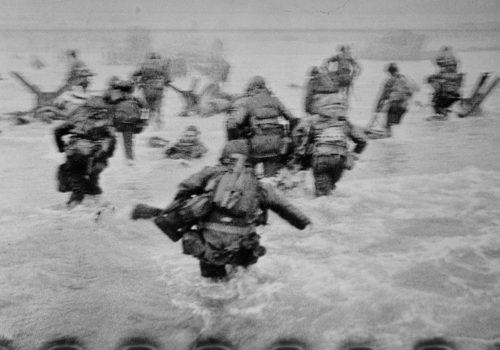
Timothy Floyd sent us his essay on Robert Capa‘s D-Day pictures from June 6, 1944. We found it quite fascinating, so here it is. In remembrance of D.Day it will be in free access for all until Sunday.
The saga of Robert Capa’s D-Day pictures from June 6, 1944, is well-known among photography enthusiasts, professional photojournalists and editors, and D-Day history buffs. The self-made Capa, who had been dubbed the greatest war photographer in the world by Picture Post editor Stefan Lorant, was selected to accompany men of the battle-hardened 1st Infantry Division as they assaulted Omaha Beach—one of the most dangerous and heavily defended fortifications in all of Europe—for the sake of defeating fascism and liberating the people of Europe from Nazi tyranny. It would be the greatest invasion in history, a photojournalist’s dream assignment. That much is not disputed. The rest of the story has generated much controversy, especially recently.
Capa’s Story
Multiple versions of this story have been told, the earliest naturally coming from Capa himself and his picture editor at LIFE magazine, John Morris. In this version from his memoir Slightly out of Focus,[1] Capa rode to the Easy Red sector of Omaha Beach early in the morning among the first waves. After his LCVP (Landing Craft Vehicle Personnel) struck sand and lowered its bow ramp to debark its cargo of men, Capa—who had been standing at the rear of the boat—made his way forward to photograph the men as they charged into the enemy’s fire. His goal was to record this epic, historic drama then get the film back to LIFE offices in London as soon as possible.
As he made his pictures from the ramp using a Contax II camera, the boatswain kicked him off and into the water. Surprised at his sudden change in fortune, he sheltered behind tanks and obstacles placed in the water by the Germans to thwart the landing while he photographed soldiers doing the same thing. He finished his first roll of film then made his way to the sandy beach where he found refuge behind a small berm of sand and cobblestones known as the shingle. There he exposed an entire second roll of film in his other Contax II camera.
After an hour or more at Omaha Beach a large transport vessel landed close enough to him that he figured he could board it. He waded out to the ship while holding his cameras above his head. Once on board he went to the engine room to dry himself and his film. After photographing wounded on the deck of the ship he transferred to another ship and made his way to England where he learned that another photographer who had been with the 29th Infantry Division had arrived two hours earlier with the scoop. Disappointed, Capa handed his films to a courier who took them to London for processing while he boarded another ship and returned to France.
He later learned that almost all of his pictures were ruined in the LIFE photo lab by Denis Banks, an inexperienced, adolescent darkroom assistant who hung the developed film in a heated cabinet to dry in time to make a deadline for the next issue of LIFE magazine. Banks had closed the cabinet door, which normally was kept open, to trap heat to speed the drying process. However, the higher heat caused the emulsion to melt, destroying all of the pictures except ten or eleven on the first roll of film. John Morris was able to rush these few pictures through the censorship process just in time to get them to a courier who would initiate their journey to New York where they made the June 19th issue of the magazine. The second roll of film has become infamous as the “missing roll” since its fate is unknown. It may have been ruined and discarded or retained by censors, only to find its way to a large, undergound government vault somewhere.
That story stood, with minor variations, for decades. It was told and retold at the annual Magnum shareholder’s meeting. It was published in books and magazines and repeated in interviews on radio and television. It was the premise of Phillip Toledano’s recent work, We Are at War.[2]
Enter A.D. Coleman
In his blog, Alternate History, Robert Capa on D-Day,[3] and in other online articles and presentations, A.D. Coleman and contributors J. Ross Baughman, Charles R. Herrick, Rob McElroy, Tristan da Cunha, and others have challenged this narrative. Herrick has written a book summarizing their interpretation of events. They claim that Capa did not arrive as early as he had claimed and that he stayed at Omaha Beach for only thirty minutes or less. During this brief stay they believe he exposed the end of a roll of film in his first camera. They claim he never made it out of the water to the shingle on the beach. This implies that he never exposed the missing second roll of film and that all he produced that morning were the ten surviving pictures later known as the Magnificent Eleven.
Coleman et al. believe that the great war photographer was embarrassed by his lackluster performance and ignominious retreat from battle. They contend that Capa and Morris conspired to fabricate the story about the emulsion melting in a hot drying cabinet to salvage Capa’s reputation, and that of LIFE magazine, and in the process threw Denis Banks under the bus. Coleman has implicated multiple individuals and institutions who, over decades and multiple generations, have guarded and kept this fabrication. He calls these co-conspirators the Capa Consortium, which includes the International Center of Photography, Magnum Photos, Time-LIFE, the National Press Photographers Association, as well as numerous biographers, historians, authors, curators, and editors.
Coleman et al. offer several proofs of their hypothesis. To start with, Herrick developed an argument that Capa could not have arrived any earlier than 8:20 am, because he was assigned to Regimental Commander Colonel George Taylor’s landing craft and this assignment was immutable. According to Herrick, Capa could not transfer out of Taylor’s boat in Wave 13, which was scheduled to arrive at the Easy Red sector of Omaha Beach at 8:05 am, but was delayed another fifteen minutes by currents, weather, and beach conditions.
Herrick bolstered his timeline theory by analyzing the water levels and distance to shore in Capa’s pictures and comparing them to a picture taken by Robert Sargent, a U.S. Coast Guard photographer known to have been at the beach in Wave 10 at 7:40 am, concluding that Capa’s pictures were consistent with an arrival time no earlier than 8:20 am. Unfortunately, Herrick compared Capa’s pictures taken with a 50-millimeter lens on 35-millimeter film to a picture taken with a four by five-inch Speed Graphic using a 90-millimeter lens.
Herrick also offered eyewitness accounts that corroborated Capa’s own story that he boarded his escape ship, LCI(L)-94,[4] probably earlier than 8:50 am, leaving him in the water for less than thirty minutes. In this scenario, Capa would not have had time to make his way to the shingle and expose a second roll of film.
Capa’s version really falls apart under the Coleman analysis when considering the story of the emulsion melting. Coleman himself tested this by hydrating some old film he had stored then dried it in a hot environment. He observed no emulsion melt. He commissioned Tristan da Cunha, a French photographer, to perform a more elaborate investigation. Cunha exposed, processed, and dried some modern emulsions as well as two rolls of film from the 1940s, then hydrated them and hung them in temperatures exceeding 300 degrees Fahrenheit. He observed no melting of emulsion, although at the higher temperatures he did observe deformation and failure of the acetate. Coleman and da Cunha concluded that Capa had indeed lied about his D-Day experience.
Coleman further criticized this emulsion story by noting that he felt it would be unusual for anyone to leave the cabinet door open during drying, because this would only invite dust and other particles onto the film. Coleman sees the entire account as ludicrous.
According to Coleman et al., this is strong evidence that Capa (or Morris, or both) fabricated the emulsion melt story, which he calls the “darkroom myth,” to shift the responsibility for the dearth of images from Capa to Banks. In this fabrication, the pictures were missing, not because Capa did not take them, but because Banks had destroyed them. In this version of events Capa remained heroic, Morris became heroic, and poor Mr. Banks learned a valuable lesson for which he later was forgiven by the gracious and merciful Robert Capa. LIFE got its pictures, Capa kept his reputation, Banks was not fired. Win, win, win.
Somehow, presumably through force of personality and charisma, Capa and Morris were able to coerce the thirty-five LIFE employees at the London office, U.S. Army censors and couriers, and all subsequent generations of individuals who would curate Capa’s pictures to accept and perpetuate this story. Coleman doggedly pursued Morris through the last years of his life, harassing him to come clean with the truth. After years of denial a fatigued Morris eventually capitulated before his death at age 100, but this did not stop Coleman from continuing his criticism of Morris posthumously.
In some circles, the work of Coleman and his colleagues is becoming recognized as the real story behind Robert Capa’s D-Day pictures, which also is the subtitle of Herrick’s book, Back into Focus.[5] Herrick’s supportive work has been lauded as an excellent forensic photographic analysis. Cunha has been praised for his experimental design and results. But there are just a few problems and inconsistencies with the entire Coleman construction, besides the flawed comparison of Capa’s images with Sargent’s.
Inconsistencies
First, there is the issue of Capa’s arrival time, which according to Herrick and Coleman did not afford Capa enough time on the beach to expose his second roll, hence the need to prevaricate on the fate of Capa’s film in the darkroom and create the entire fable.
While it is true that landing tables for Operation Neptune—the name for the amphibious assault on France—clearly showed one “press photographer” (Capa) assigned to the 1st Infantry Division on D-Day, and that photographer was assigned to Colonel Taylor’s boat, all of that changed at the last minute. There were two landing craft in Taylor’s 13th Wave, an LCVP that held a medical team, and Taylor’s Landing Craft Mechanized (LCM), which held ninety-eight soldiers plus crew. Fifty-seven of those men were assigned to Taylor’s command echelon.
At the last minute, Taylor decided to switch with the medical team to their smaller LCVP with a lesser capacity of thirty-six men, meaning that he could not take all of his command team with him on the smaller boat. He had to make choices, and a press photographer probably was not a high priority for him. Besides, General Eisenhower had granted American news magazine correspondents considerable freedom of movement within the theatre of war. That is, they could move about at will within a command. Capa had already thought about going in the earlier Wave 11 with Company B, so when this opportunity presented itself, he switched out to the earlier wave. We know this from the personal accounts of three eyewitnesses.
Charles Hangsterfer was a company commanding officer and Battalion Adjutant in 1st Battalion, 16th Regiment. He was responsible for loading all boats in Wave 11 and later recalled that Capa landed with Major Edmund Driscoll’s LCVP at 7:50 am.
Driscoll was 1st Battalion Commander. Also in Driscoll’s boat were 1st Lieutenant William M. Kays, a liaison officer from 1st Engineers to Major Driscoll, and Kays’ radio man, Lenny Doyle. Doyle also gave an account of being with Capa in Wave 11.
Kays wrote letters home from France within days of the landing, in some of which he mentioned being in the same LCVP as Capa and conversing with him about the nature of the ordnance that was exploding on the beach. Kays, who had a baccalaureate degree in engineering from Stanford University, later became the dean of the School of Engineering at Stanford and lived to be 98. His family remembers him as an honest man of integrity with an incisive memory.
Coleman and Herrick claim that all three of these men lied about being in the same wave as Capa on D-Day. Coleman calls their mendacity “borrowed glamour” while Herrick calls it “parasitic legend” in which a person associates with a more famous person to gain some degree of collateral legendary status. This would be like bragging about being on the same plane as a famous actor.
According to Coleman and Herrick, knowing that Robert Capa landed at the Easy Red sector of Omaha Beach on D-Day, just as they had done, these three men independently claimed to have been in the vicinity of Capa just so they could brag to their friends and family about it. Coleman called it “self-mythification.”
I found the accusation appalling that these three courageous men, who had survived D-Day and the entire war, lied about their experience to their families just to appear important. Doyle’s daughter wrote a comment on Coleman’s blog identifying him as one of the soldiers in Capa’s pictures, but Coleman immediately shut her down, saying that her father could not have been correct about his D-Day experience because Herrick had proven that Capa arrived in a later wave than her father.
When I read this exchange, I realized that Coleman et al. had to dismiss these eyewitness accounts because they force Coleman’s entire scenario to come apart. Since strong evidence shows that Capa left the beach on LCI(L)-94 at 8:50 am, his earlier arrival in Wave 11 meant that he would have been at Omaha Beach for a full hour, during which time he would have been killed either by the rapidly rising tide or by German fire had he not made it to the shingle.
The 7:50 am arrival time means that Capa had the time and the opportunity to expose the second roll in his other Contax II camera, just as he said he did. It means that he did not freak out and leave the beach immediately. It means that he did his job.
Capa admitted to panicking after an hour or so of violence and carnage and wading out to LCI(L)-94 where he dried his films in the engine room where the air temperature reached 115 degrees Fahrenheit or higher. While it was drying, he took pictures on the deck with his Rolleiflex of U.S. Coast Guardsmen who had been mortally wounded by three German artillery shells that hit the bridge at the exact moment that Capa boarded the vessel. Three eyewitness accounts on board corroborate this.
The ship then left Omaha Beach and Capa transferred to another ship that returned him to Portsmouth, England the following morning where he was met by fellow LIFE photographer David Schermann, a character in the recent biopic Lee about photographer Lee Miller, portrayed by Kate Winslet.
The Darkroom Mishap
So, we now have strong evidence that Robert Capa’s story about his time and actions on Omaha Beach is true. What about the darkroom mishap? What happened there?
To understand this, it is important to know something about Capa’s friend and fellow LIFE photographer, George Rodger. As explained in Carole Naggar’s excellent biography, at the outbreak of World War II LIFE sent George on a four-week assignment to cover the war in Africa, the Middle East, and India.[6] The four weeks turned into four years, covering sixty-one countries and 75 thousand miles. George wrote about his experience in Desert Journey.[7]
George explained that it was so hot in Baghdad in August that he had difficulty developing his film. He could not get the temperature of his developing solutions below 100 degrees Fahrenheit, despite cooling with ice cubes. The warm water caused the emulsion on his film to dissolve. He circumvented this problem by adding a hardener, chrome alum, to the solutions, which made it possible for him to produce useable negatives that he sent back to LIFE in New York.
Photographic films of that era did not contain hardeners, possibly because these agents fouled the machinery used to manufacture the film. Hardeners could be added during processing, if necessary. Hardeners were not routinely added to photographic emulsions until the 1950’s, and it did not become standard practice until the 1960’s.
When Capa’s films finally arrived at the London LIFE office Morris had only a few hours to get the films processed and passed by the censors. This involved developing and drying the film, making contact sheets then cutting out each individual negative, making four by five-inch enlargements of each negative, and packaging them separately. These packages, and all the other packages of processed images from all the other photographers, then had to be taken to the Ministry of Information (MOI) in London for individual inspection by U.S. Army censors. Each package was opened, inspected, and discussed before a decision was made to release or hold.
Following this decision, the censor then packaged the released images separately in special packaging materials secured with special tape marked as passed. Morris was able to deliver the photographs to MOI sometime around 4:00 am on June 8. By 8:30 am the censor had finished inspecting and packaging Capa’s prints. Morris had only thirty minutes to travel two miles in morning traffic to a motorcycle courier waiting at Grosvenor Square. He arrived just as the courier was locking his carrying case.
Under this pressure, Morris had told his darkroom staff to “rush, rush, rush!” the processing on Capa’s film.[8] Hans Wild called Morris from the darkroom to tell him the pictures were “fabulous” but within a few minutes Denis Banks ran upstairs to tell Morris that most of the film had been ruined by drying it in the heated cabinet. He had closed the door to make it hotter to speed the process, since Morris had wanted them rushed.
Morris looked at the strips of film, which he described as resembling grey mud, before he noticed that some of the frames at the end of one of the rolls had survived. They had not melted.
This is balderdash, according to Coleman and others who have considered this story over years. Several experiments had shown conclusively that film emulsion does not melt when subjected even to high heat during the drying process. But these experiments were done on modern emulsions that contained hardeners. Cunha also tried it on film from the 1940’s and it did not melt, but the effects of dehydration and oxidation on that film probably hardened the emulsion over eight decades.
What is Old Becomes New
It was at this point in my investigation that I learned about a project that Mark Osterman to commemorate the introduction of the Leica camera in 1925, the first commercially successful 35-millimeter still camera using motion picture film. Mark, a specialist in researching and producing historic photo sensitive materials, was the process historian at George Eastman Museum, Rochester, NY from 1999 to 2020.
In the past year he successfully formulated the same 1920s era emulsion, coated film support, slit and perforated 35-millimeter film for the Leica project. He tested his film on several international trips and is satisfied it fulfills black and white films used up to the late 1930s. A key element of particular interest in my research, is the absence of a gelatin hardener which remained out of film emulsions beyond the 1930s. Osterman calls his film MO-1925 and agreed to let me have two rolls to use for these tests.
After receiving the film, I fine-tuned the ASA to my camera and chemistry, then exposed the roll in my front yard. I processed it in D-76, which was appropriate and common for that era, then stopped development in stop bath and fixed in fixer for ten minutes before washing archivally for fifteen minutes in running water.
I cut the film into two strips, one of which I hung to dry in my usual location (my shower stall) at 71 degrees Fahrenheit. I dried the other strip in low heat in a small oven with a thermometer showing the temperature as ranging between 115 and 120 degrees Fahrenheit.
The strip in the shower stall dried normally with no distortion of the images. The strip in the oven initially appeared to dry normally but suddenly, after about two minutes, the emulsion began to spread and appeared to melt. The images coalesced on the acetate, spread laterally, and began to run down the acetate with gravity.
I immediately pulled it out of the oven to stop the melting and let it air-dry at ambient temperature. I then placed the two strips side by side and made a digital contact print, which is shown in the figure. The upper strip dried in the shower stall, the lower strip dried in the oven.
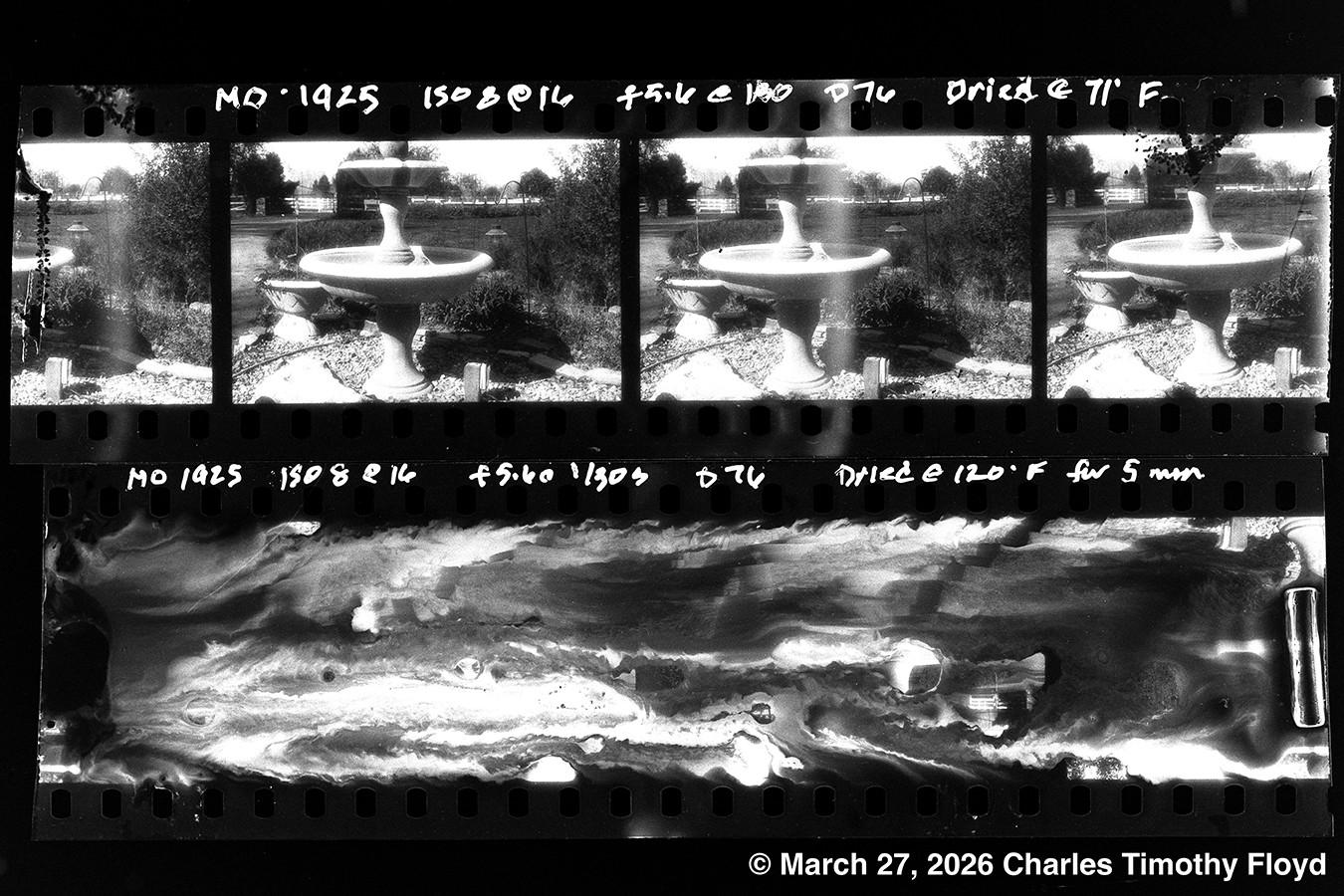
Note that I was able to pull the film out of the oven before the emulsion completely ran off the acetate. It quickly stabilized in room temperature and had the appearance of grey mud.
Conclusions
This experiment challenges the assertions by Coleman et al. that the darkroom mishap was a myth promulgated by Robert Capa and John Morris. This myth was created, according to Coleman et al., to cover for Capa’s failure to expose a second roll on Omaha Beach, which I have shown to be entirely possible and plausible. The darkroom mishap also is entirely possible and plausible, given the unhardened nature of photographic emulsions in 1944.
Coleman has been critical of Capa, Morris, and the people in his Capa Consortium.[9] He referred to Capa’s story as “photojournalism’s most potent and durable myth.” Referring to himself as a scholar, he said that he was shocked by the wide recognition of Capa’s story. One wonders why a scholar would not do a more critical analysis of Capa’s arrival time and early emulsion formulas, as well as other discrepancies that are covered in a soon-to-be published book. Without any evidence, Coleman said that “black & white film emulsions of that time did not melt even after brief exposure to high heat.” He considers the story only “one of several big lies permeating the literature on Robert Capa.”
Under the scenario I described it is entirely plausible that Capa remained at Omaha Beach for one hour during which time he photographed both in the water and at the shingle, and that most of his images were ruined by overheating. In fact, it is not only plausible, but likely. In this scenario, no one lied and no conspiracy exists to perpetuate the lie. It is entirely possible that it happened exactly as Capa and Morris described it, bringing Coleman’s twelve-year exposition under new scrutiny.
——
The above article was drawn from Timothy Floyd’s book, Easy Red: A Critical Analysis of Robert Capa’s Iconic D-Day Pictures, to be published later this year. Dr. Floyd was Assistant Clinical Professor of Orthopedic Surgery at the University of Washington School of Medicine and Instructor of Orthopedic Surgery at the Johns Hopkins University School of Medicine. He has authored nineteen peer-reviewed journal articles, over one hundred abstracts and presentations, and a photo essay book titled, Aid and Comfort to the Enemy: A Surgeon’s View of the War in Iraq. Dr. Floyd has a strong academic interest in mid-twentieth century documentary photography, especially war photography. He is the recipient of numerous awards in medicine and photojournalism.
©2026 Charles Timothy Floyd
[1] Robert Capa. Slightly out of Focus. 1947, Henry Hold and Company, New York.
[2] Phillip Toledano. We are at War. 2024, L’Artiere Edizioni, Balogna.
[3] A.D. Coleman. Alternate History, Robert Capa on D-Day. Photocritic International. https://www.nearbycafe.com/artandphoto/photocritic/major-stories/major-series-2014/robert-capa-on-d-day/
[4] Landing Craft Infantry (Large)–94
[5] Charles R. Herrick. Back into Focus. The Real Story Behind Robert Capa’s D-Day Pictures. 2024, Casemate, Havertown, PA.
[6] Carole Naggar. George Rodger: An Adventure in Photography, 1908-1995. 2003, Syracuse University Press, Syracuse, NY.
[7] George Rodger. Desert Journey. 1944, The Cresset Press, London.
[8] John Morris. Get the Picture: A Personal History of Photojournalism. 1998, Random House, New York.
[9] A.D. Coleman. Alternate History: Robert Capa on D-Day. Exposure Magazine. https://medium.com/exposure-magazine/alternate-history-robert-capa-on-d-day-2657f9af914. Accessed 12/5/2025, 3:08:19 pm.