In a former wine estate in the Beaujolais region, a collective of eight photographers has formed around a place that has become a studio, a laboratory and an open-air exhibition space. A conversation with Michel Paccalin, the founder of the project.
The collective was born from a place. Can you tell us about it?
It existed long before the collective came into being. It is my house in the Beaujolais, a former wine property in the heart of the vineyards, 867 meters from the center of Saint-Étienne-des-Oullières.
Why did you turn it into a place for creation?
After studying at the Beaux-Arts, I worked as a photographer until 1984, then I changed paths. I returned to image-making four or five years ago and refitted my house with a darkroom and a studio. I took part in a workshop in Lyon run by the photographer Sarah Mulot. At the end, I wanted to keep going. Since I had enough space to accommodate a few people, I decided to create a place where we could meet. That is how 867 was born.
Who are the people who joined the collective?
It happened through encounters. Denis Laveur and I had been neighbours for years but had never met, until we ran into each other in Arles. He was the one who brought in Gilles Pautigny. At an exhibition by Sarah Mulot, I spoke with Nadine Lecoeur. During professional meetings in Arles, I met Estelle Rebour and Marie-Jo Magnière. We didn’t know each other well, but we got to know one another through shared creative time.
How did you formalise the creation of the collective?
My idea was to use the four hectares around the house to exhibit work. From the first meeting, we agreed to work on two themes: the field of possibilities and the wound, with a schedule of seven gatherings per year to get to know each other, show images, work together, with the idea of presenting a result each year.
What form have these presentations taken?
We occupy the space with different media linked to photography, from collodion to performance and writing. Everyone works and exhibits in their own way. The first exhibition was called Le passage des sarments. A route was created between the different spaces. The following year, we continued to occupy the field by expanding the area, and this year an eighth person joined to work on writing with me for our new exhibition Champs libres. We also held an evening in Arles for La Nuit de la Roquette and published a zine.
You began a new season of the collective last October and have just finished a working weekend. What are you working on?
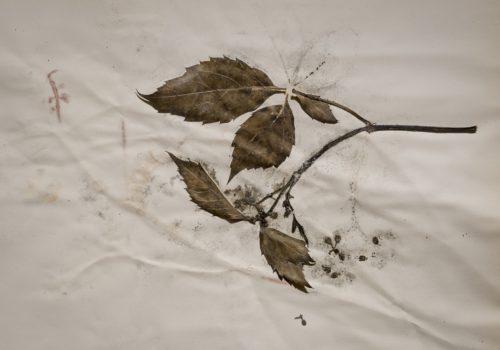
We did some photographic technique around lumen printing, some darkroom work. Part of the work will be linked to the field, its nature, its composition, how it evolves. We are trying out analog techniques. We experiment on site, but the new development is that our next presentation will not take place at 867. We will move to Lyon, at the Orangerie, at the end of summer 2026.
How does the place live when you are not creating collectively?
It will soon be welcoming other artists. I live on site, I have time, and I enjoy it. It is a return to my years of experimentation. We are in discussion with a gallery in Marseille, the idea being to make the place available for coherent projects, for example around the relationship between writing and photography, or painting and photography. I have also offered to make the place available to members of the collective who want to run workshops. Gilles Pautigny, Denis Laveur and Estelle Rebour have already organised workshops there. It is in the countryside, so bringing people in is not always easy. But once you get there, it is perfect for working.
More information