Our “Coup de Coeur”.
These images by Obie Oberholzer and the text that accompanies them.
It’s 1954 on a farm in Africa, some 20 kilometres north-east of Pretoria, bordering the Baviaanspoort high security prison. Besides me running around my mom’s rhubarb plants and my dad’s persimmon trees, there were veld fires, thunderstorms and the occasional black political prisoner escapee, nothing much else happened. At that time, in Decca Records studio in New York City, Bill Haley and his band called ‘The Comets’, were about to release the song “Rock around the clock”. This would, to coin a phrase about to become popular, —— ‘Shake, Rattle and Roll’ —- the world’s pop music industry for ever more. It took a year for the rocks to roll along our farm’s little gravel track. By then, I had turned eight years old, my mom had planted asparagus, my dad had added some Cumquat trees, we had had a cloud burst or two and the black prisoners still occasionally escaped through the lower end of our farm. When ‘Rock around the Clock’ finally landed, it smashed into my ears and exploded, bringing rocks that rolled almost every tick around my clock. My dad sighed and planted figs, my mother rolled her eyes, pulled out the asparagus and planted carrots, and the escaping prisoners shook off their prison stripes, running naked with an extra roll in their steps. I reached my first great academic achievement, by memorizing the first verse, as difficult as it was:
“One, two, three o’clock, four o’clock rock
Five, six, seven o’clock, eight o’clock rock
Nine, ten, eleven o’clock, twelve o’clock rock
We’re gonna rock around the clock tonight.”
That’s when, I think, this “Rocks in my head”, thing started. This was followed by Chuck Berry, Jerry Lee Lewis and the King himself, Elvis Presley. I played his ‘Jailhouse Rock’ so loud that my parents drove away in their Vauxhall Velox, lightning struck thrice, the thunder rolled and prisoners outran the chasing wardens, by far. It was 1957, I was 10 years old, and I could sing every word of that song, which in retrospect was one helluva achievement for a young boy with rocks in his head:
“The warden threw a party in the county jail
The prison band was there and they began to wail
The band was jumpin’ and the joint began to swing
You should’ve heard those knocked out jailbirds sing.”
As the years ticked around and around on my dial, I came to realise that the rocking clock had become a camera, the rolls of film had stopped time, which froze its moments. Those rocks in my head anchored my waywardness, stabilizing my vision. Over time the rocks receded somewhat, lightened, lifted and found space as I used light and line, with vibrating hues of colour, some shadowy, others subdued and others rocking red. The rocks that rolled into me all those 70 years ago, have mellowed now, found purpose in the weight of alignment and purpose of design. Time is consistent and predictable. In my pictorial case, I continually search for the oddity and originality of instantaneous moments in fractions of seconds and right along to extended time exposures. For me it’s not the uniformity of time, its precision of passing, but small fractions, histories, and memories called photographs. Age has slowed my rocking and rolling, but I have tried never to lose the beat that rocks my imaginative rhythm.
Obie Oberholzer
Photo Captions :
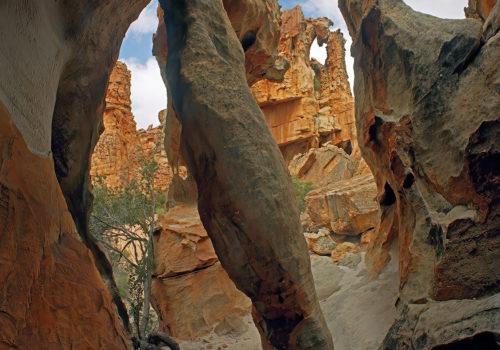
2. The Cederberg is famous for its spectacular, weathered sandstone rock formations, including the Wolfberg Arch, the Maltese Cross, and the ‘Stadsaal’ Caves, which are the result of centuries of chemical erosion from rainwater. These formations are part of the ancient Cape Supergroup, with a geology that includes rich deposits of quarzitic sandstone and shale. The dramatic and unique shapes have been carved into fantastical forms over millions of years.
6. The “Remarkable Rocks,” as they are called, are a collection of enormous eroded granite boulders made up of bluish quartz, black mica and pinkish feldspar. Rainwater worked its way down through the rocks and carved them into pieces. From there, more rain and wind eroded bits and pieces as the years went by and they now lie atop a giant dome of lava coughed up about 200 million years ago. Wind and sea spray have since carved the chunks into what look like monumental Henry Moore sculptures perched 200 feet above a crashing sea. Kangaroo Island. Australia.
9. Large sandstone outcrops in the rugged mountains of the southern Drakensberg on the Balloch Farm. These last reaches of the Drakensberg Mountain range can be found near the towns of Rhodes and Barkley East in the Eastern Cape Province of South Africa.
10. “Symphony of Stones” or “Basalt Organ” is one of the most famous and impressive natural monuments in Armenia. It is located in Garni Gorge, on the right bank of Azat river.
The monument is made up of thousands of columnar basalts stuck together up to 50 meters high. In its appearance it resembles an organ musical instrument, and therefore received the official name “Basalt Organ”. However, it is better known as “Symphony of Stones”.
11. Tufted Bullrush grass grows in front of the gnarled and twisted sandstone shape of the Groot Winterhoek Mountains in the Western Cape. South Africa.
12. Coastal rock formations Atlantic Ocean near Grosse Bucht, south of Lüderitz. Namibia.
13. The “Remarkable Rocks,” Kangaroo Island, Australia.
23. Wadi Shab is a very popular wadi located in the Al Sharqiyah Region in Oman. The wadi cuts through the limestone cliffs of the Eastern Hajar Mountains.
(A wadi is a low, dry valley. The term wadi is most commonly used in Arabic-speaking parts of the world. This word wadi is mainly used to describe valleys and dry creeks and riverbeds in the Middle East and North Africa. A wadi might be a stream during the rainy season and a dry ravine during the rest of the year.)
26. The limestone Monolith of Pizzomunno on the beach of Vieste. Italy.
(The story of the Pizzomunno rocks is a tragic legend about a young fisherman named Pizzomunno and his love, Cristalda, who were separated by jealous sirens. The sirens, who wanted Pizzomunno for themselves, abducted Cristalda into the sea, leaving him to be transformed into the imposing monolith that stands on Vieste’s Castle beach today. A variation of the tale suggests Pizzomunno’s love was so strong that he resisted the sirens, leading them to punish him by turning him to stone. )
30. The White Desert National Park is in the Farafra depression of western Egypt. This protected area is about 45 kilometres north of the town of Farafra. It’s famous for its surreal, white chalk formations. These rocks show the area’s ancient geological and paleontological history. The landscape reveals how climate changes and geological forces shaped Earth’s past.
31. Rock formations in a bay along the coast near Doringbaai form interesting shapes at low tide. West Coast. South Africa.
41. The White Desert near Farafra Oasis in Egypt.
45. Huge incoming Atlantic Ocean breakers crash onto the coastal rocks at Hondeklip Bay along South Africa’s West Coast. This particular set of large rocks is called ‘Spitfire Rock’ by the locals.
46. The Spitzkoppe is a group of bald granite peaks or Bornhardts located between Usakos and Swakopmund in the Namib desert of Namibia. The granite is more than 700 million years old and the highest outcrop rises about 1,784 metres above sea level.
47. I enrolled for a BA degree in Graphic Design at the Fine Art Department at Stellenbosch University in 1967. That was after I had spent a year in the South African Air Force. (When we still had one). I failed my final written exam in History of Art, so I had to settle for a diploma. Reason: “Rocks in my head”. (This Stellenbosch diploma is now proudly displayed above my guest room toilet in Natures Valley)