She is one of the most formidable photographers of the 1930s and remains little known today.
Forty years ago, publisher José Alvares dedicated a sublime book to Rogi André, which went largely unnoticed.
An exhibition of her work is on display at Mai Manó Ház in Budapest, with the exceptional support of the Bibliothèque nationale de France.
Born in Budapest at the beginning of the century, Rogi André (née Rosa Klein, 1900-1970) moved to Paris, the European center of avant-garde art, in 1925 after initial studies at the Budapest Academy of Fine Arts. There she met, among others, her fellow countryman, the artist André Kertész (1894-1985), whom she married in 1928 and alongside whom she discovered photography. She then achieved her first commercial success as a nude photographer. They divorced in 1932, which did not prevent Rogi André, as she now called herself, from pursuing her career as a photographer.
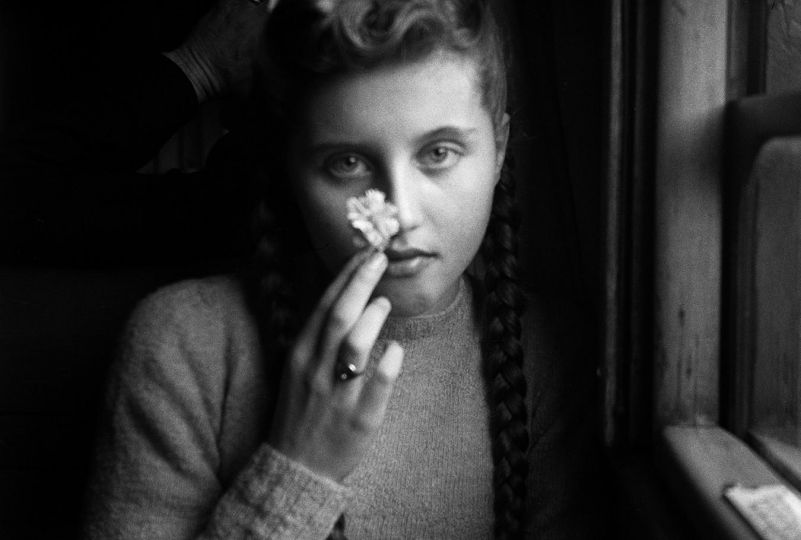
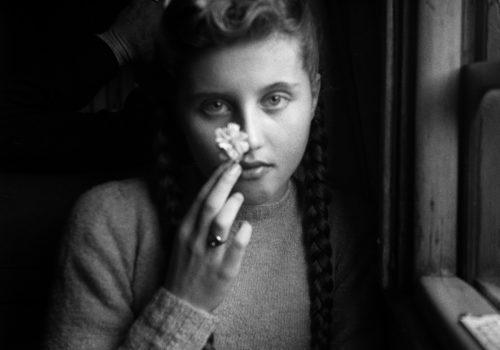
Her photographs are characterized by the calm and concentration of her models. Many of them reveal defining character traits: intellectual superiority for Marcel Duchamp, artistic austerity for Mondrian, or the elegant gravity of Dora Maar. This precise capture is partly due to the Hungarian photographer’s use of a large-format camera with long exposure times.
Rogi André also worked on her negatives in the darkroom, scratching and drawing on them to achieve special effects such as the radiant pupils in one of Picasso’s portraits. In addition to the carefully measured lighting, it was undoubtedly also the photographer’s personality, her disdain for instant photography, and the attention she paid to her models, which resulted in images that have been compared to those of Nadar, the great 19th-century portrait photographer.
Rogi André also made her mark on the history of surrealist photography. In 1937, she appeared in André Breton’s book L’Amour fou (Mad Love), alongside Brassaï, Henri Cartier-Bresson, Man Ray, and Dora Maar, for whom she also created a brilliantly composed portrait.
The exhibition will present her entire body of work, from her newly discovered photographs to those who knew her (Pablo Picasso, Alberto Giacometti, Dora Maar, Peggy Guggenheim, etc.), from evocative portraits to studies of social life.
Colette’s joy at André’s portrait of her in 1947 the writer was 74 is an eloquent testament to the empathetic intuition of a still-too-little-known photographer:
“For Rogi André, to whom I owe the fact that I still look like a woman.”
Rogi André: More Light, More Shadow
July 2, 2025 – August 19, 2025
Mai Mano House – Hungarian House of Photography
Budapest, Nagymező u. 20
1065 Hungary
www.maimano.hu
Tuesday to Sunday, 12 p.m. to 7 p.m.
Closed Mondays and public holidays