Up to now, over the course of my fourteen chronicles, I have mostly contented myself—besides highlighting specific aspects of the work of photographers who are very well known today such as André Kertèsz or Bill Brandt—with bringing to light photographs and photographers of the past (de Clugny, Julien Mandel, Zoltan Glass, Zdenek Virt, Sanne Sannes and Marcel Meys recently) who are relatively little known or forgotten—unjustly of course, but the world is cruel and only the best (and/or the luckiest), in our era of documentary overabundance, can hope for the perpetuation of their creative work. One might describe my stance as didactic; I would be neither surprised nor displeased, for even if it bothers me, it is undeniable that I have a teacher’s soul; and I accept it. Today, I am preparing to get to the essential, to finally get down to the nitty-gritty, if I dare say, about an organ that is so cushy and, allow me, to finally put the backside at the forefront of our curiosities.
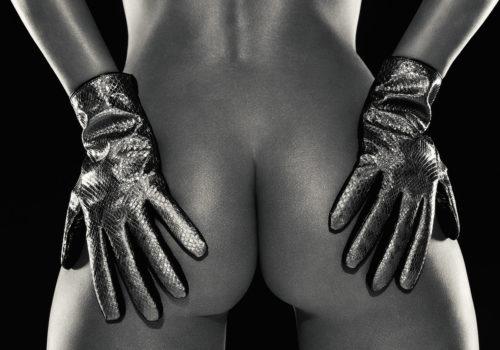
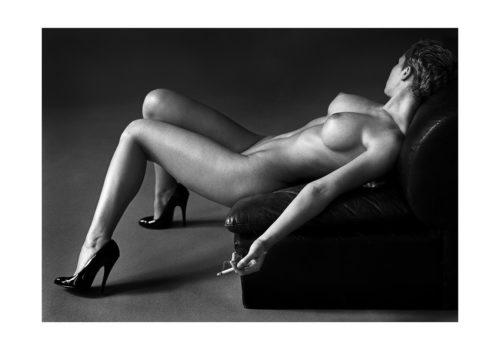
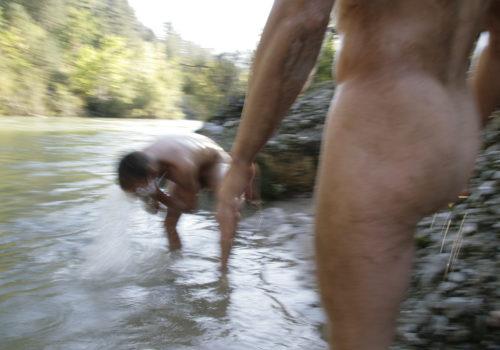
For if there is one object that is particularly attractive to the nude photographer, it is indeed the one that frontal views eclipse, and that is, in principle, visible only to other people’s eyes; and without making a show of it, practically all nude specialists have incidentally touched upon that part of the body that propriety had long relegated—backed by strong moral and religious justifications—among the untouchables.
Let us go back, if you don’t mind, to the very end of the nineteenth century and the early twentieth—the era of the incunabula of nude photo books, almost all presented then under the pretext of being aids intended for artists—let us return, then, to practitioners I once had the pleasure of bringing to the fore (chronicle no. IV); we are forced to note that neither Louis Igout, in his albums published by the Calavas press (1885–1890) [Ill. 1-2], nor the Berlin duo Koch-Rieth (1895) [Ill. 3-5 ], nor—over in the New World—the wealthy amateur Charles Schenck, self-publisher of the elusive portfolio Draperies in action (New York, 1902) [Ill. 6-7], refrained from these “rear-views”. Nor, moreover, here in France, in Paris itself: Émile Bayard, over the five years (1902–1907) of publication of Nu esthétique [Ill. 8-10] and Amédée Vignola—an editorial promoter, but absolutely not a photographer—behind multiple periodical publications more or less disapproved of by proper-minded modesty, notably L’étude académique (1904–1913) [Ill. 11–18], of which he is generally considered the publisher, as well as Mes modèles (issued every ten days, 1905–1906) and Toutes les femmes (1901?), three small in-12 volumes of pan-racist ruminations now become ridiculous, in which rear views—which make up almost half the illustrations—would like to convince us that a Breton backside [Ill. 19] differs markedly from that of a Parisian, a Czech or a Madrilenian… In an obvious similarity of concept and layout, competing publishers also brought to market comparable publications, including the series entitled La beauté plastique (c. 1905), issued in installments of 16 pages each devoted to a theme, which drew in part on the same photographers as those commissioned by Vignola [Ill. 20-22].
A few years later—still before the First World War, however—German publishing, far more prolific on this nude theme and undeniably of higher quality than in France, provided members of the Photo-Club de Paris with a valuable outlet, more artistic than financial, in rather luxurious books with impeccable production. Thus René Le Bègue—who devoted himself with remarkable fervor to rear views of his models, preferably immortalized in natural settings [Ill. 23-28] —and Achille Lemoine, both highly sought-after by German publishers, entrusted them with numerous photographs, as did Jean Agélou. And among the dozen or so compilations of nude photographs published before the war during the Second Reich (to which anatomical or ethnographic publications should be added), our compatriots stood alongside and competed with their counterparts across the Rhine—creators of images I will present soon, before later turning to the photographers who, at the end of the century, made this subject the exclusive focus of their study.
Alain-René Hardy
L’ivre de nus
[email protected]