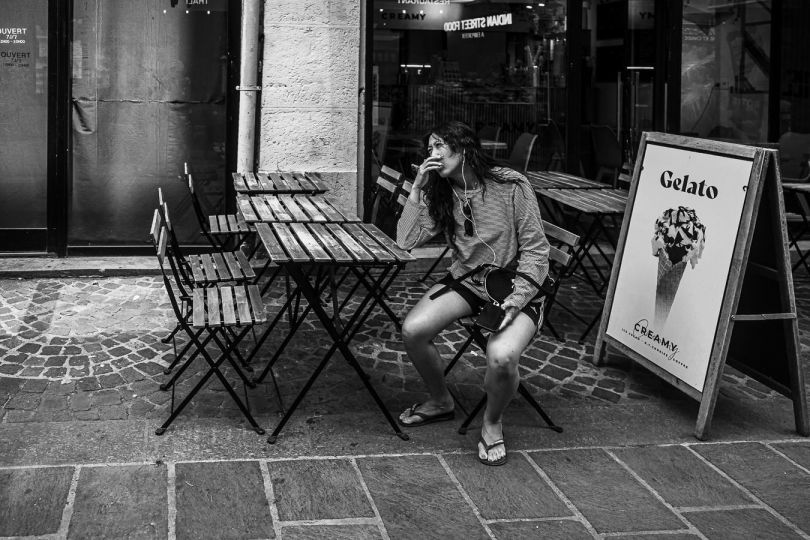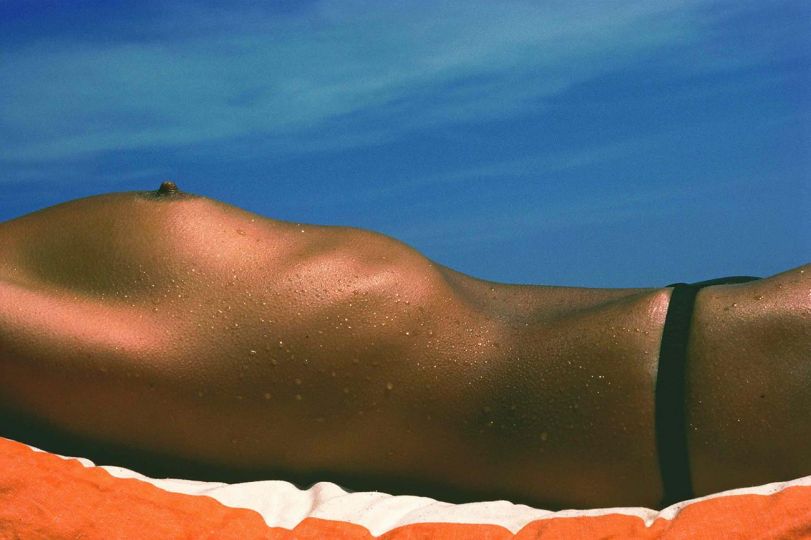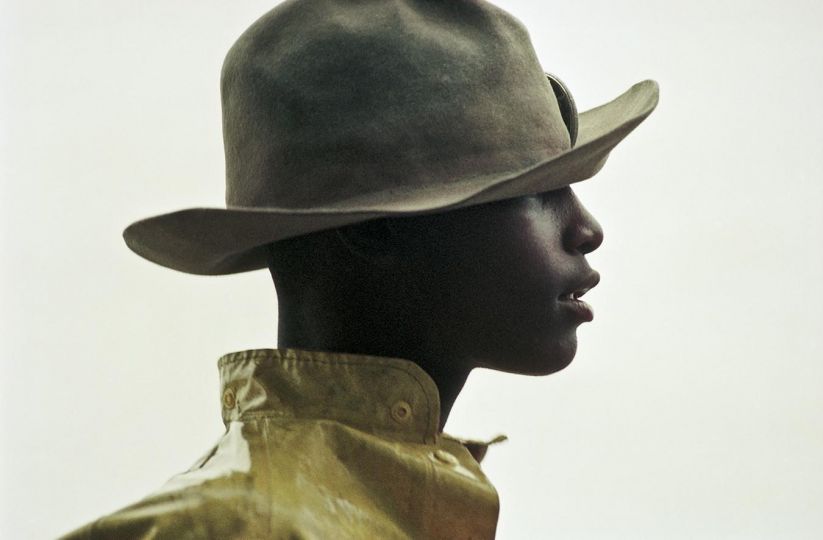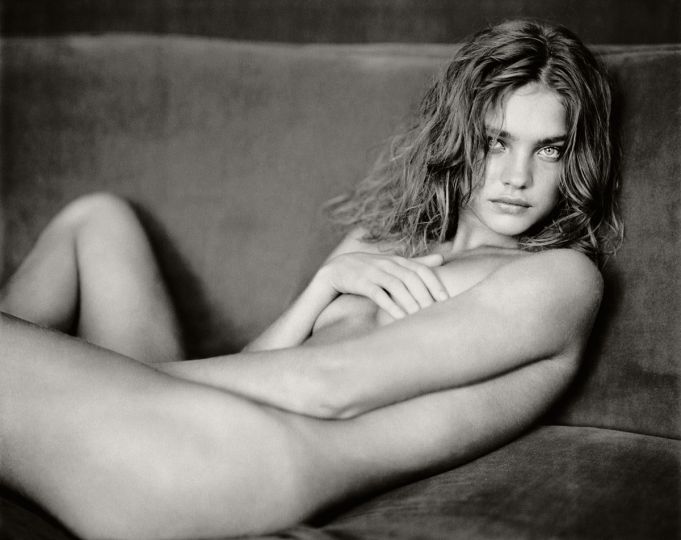
The exhibition at Jeu de Paume – Tours is the first retrospective devoted to Madeleine de Sinéty (1934–2011) – presented at the Château de Tours in 2025, then in Paris in 2026 – whose singular and still little-known photographic work, in colour and in black and white, spans four decades between France and the United States.
Madeleine de Sinéty began her artistic career as a fashion illustrator for magazines, having trained at the École des Arts Décoratifs in Paris and coming from a family of impoverished aristocrats, before teaching herself photography at the end of the 1960s. At first, tentatively, in 1970, she photographed her own neighbourhood around the Montparnasse train station, then undergoing major transformation: a few street scenes, already a few faces caught on the fly. Then in the streets of New York, where she travelled with her husband, Daniel Behrman, an American journalist she had met in Paris. Together they nurtured a childhood passion for steam trains, which she photographed tirelessly. It was there that she found another distance to her subjects: she became friends with railway workers, made their portraits, shared their downtime and discovered the realities of the working-class world. This closeness, a true hallmark of her work, would intensify further when, on a whim, she decided to abandon her Parisian life to settle for ten years in the small village of Poilley in Brittany. She befriended its inhabitants, helped them with work in the fields and gradually became part of this community, which welcomed her with curiosity and kindness. From the outset she had the intuition that she would stay there for a long time; this was where she wanted to live and create.
She photographed from the inside this score of families, these farms and those men and women who had become her own. The resulting record is unique: more than 50,000 images trace the life of this village where men and women still combine their labour with that of the animals and submit to the rhythm of the seasons.
She took this vast archive made in Poilley with her when she followed her American husband to start a new life in the United States, notably in the small town of Rangeley in Maine, once again photographing a community and, in order to earn a living after her husband’s death, turning herself into a wedding and event photographer.
Following the major stages of her life, the exhibition highlights several series of photographs, most of them unpublished. Their common denominator is a desire to document ways of life, practices, trades or places destined to disappear or already in the process of disappearing.
In her early years in Paris, she became fascinated by the old Montparnasse district and its artists’ studios, which were on the verge of being demolished to make way for the tower and the new station.
Under the title « Paris démoli » she would bring together these photographs of a Paris whose streets still bear the presence of its working classes, workers’ cafés and children playing, and whose memory she would like to preserve. At the same time, together with her partner she set about travelling through stations and secondary railway lines, photographing locomotives and railway workers, driven by her enthusiasm for the last steam trains still in operation, which for her embodied a romantic dimension of travel.
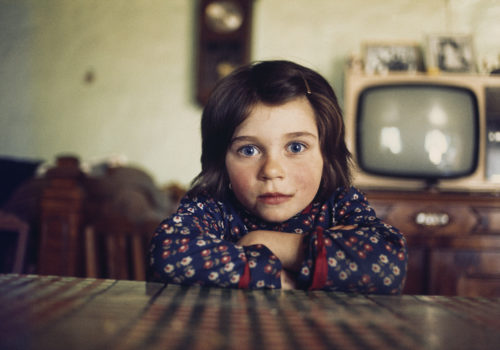
In New York it was in the Meatpacking District, the slaughterhouses in the south of Manhattan, that she chose to wander at daybreak, capturing the small trades: animal carcasses being loaded, a handcart piled high with a vendor’s fruit, workers warming themselves around makeshift fires near the tracks. In Poilley, a small village in Ille-et-Vilaine, it was the rural world in full transition whose gestures she sought to fix: the slaughter of the pig, working with the animals, the harvest. Accepted by everyone, she photographed inside people’s homes and at village fêtes, occasionally organising screenings of her images in the village hall. Finally, in Rangeley on the other side of the Atlantic, from the 1980s onwards, she encountered another tightly knit rural community and, over the years, became its de facto photographer, immortalising its rituals, both private and public: weddings, graduation ceremonies, school outings.
In the early 1970s, Madeleine de Sinéty wrote in the diary she kept for several decades: “Perhaps I should do only photography, not drawing? And yet I would really like to be able to render life with a piece of paper and a pencil; photography is quicker than my hands, what I see is the same and it is the same things that move me.” Her entire photographic oeuvre indeed describes a singular trajectory and deeply rooted documentary and social concerns.
The fragility of people, of lives, of places and practices appears there as a leitmotif, magnified by a poetic use of colour and light.
Her photographic attention turns to the ordinary lives of ordinary people, the invisible ones whose stories are not told or who do not have the means to write them themselves: workers, farmers, women living alone or dependent on social assistance. During her lifetime, few of her images were shown to the public: Madeleine de Sinéty photographed all her life in solitude, without responding to commissions, without publishing in magazines and exhibiting only twice, at the Bibliothèque nationale in 1996 and at the Portland Museum of Art (Maine, United States) in 2010, in both cases showing only her black-and-white work.
It was not until 2020 that the art centre GwinZegal devoted an exhibition and a book (Un village) to her, based on a group of colour images donated to the Musée Nicéphore Niépce in Chalon-sur-Saône, thereby opening up the discovery of her work. Today, the archives, comprising several hundred thousand images,are held by the Médiathèque de la photographie et du patrimoine, with which this exhibition, the first on such a scale, has been organised.
Curators: Jérôme Sother et Quentin Bajac
Madeleine de Sinéty. Une vie
Until 17 May 2026
Château de Tours
25 avenue André-Malraux
37000 Tours
02 47 21 61 95
www.chateau.tours.fr
#ExpoDeSinety