This is one of the most touching submissions received this week. A tribute in text and images to George Tice, who died last month, by his friend and collaborator William Abranowicz.
When I learned George died, my first feeling was terrible guilt. A few days earlier, I had made a note to call him. He’d been on my mind for weeks. He was in his 80s and I knew he was . I had called him every few months, and had visited him at his home in Atlantic Highlands last year, yet in many ways, like avoiding a stern parent, I regretted my delay.
I first heard of George Tice after his book “Urban Landscapes” was released in 1975. I was then a student at Rutgers College, blindly headed towards a degree in accounting. I was in a poor mental and emotional state. My father had recently died after ten years battling me and his alcoholism. I was 17, my father was 42. Nothing was clear at the time, except within George’s prints, deep, dark, silver-rich tonality; that 8 x 10 precision and detail underscored by the quiet, darkened space of the gallery. My eyes widened and and my mind broke open. His print of a gleaming white White Castle hamburger joint at night changed my life then and there. I knew the place. It was near my home. A single moment in front of his surgically simple photograph imbued in me a sense of kinship and belonging. The shame of being the child of an alcoholic and growing up in that homely landscape in New Jersey stung. “Jersey” — a place I am now very proud to call my home state—was the butt of so many late night jokes on TV. George’s photo changed that for me.
The only photographer I knew by name was Ansel Adams. In George’s magisterial composition and technique, I recognized the same grandeur Adams presented of the American West, yet this was in New Jersey, right on Route 1, a bland, buzzing, decrepit four-lane highway with a concrete median, loud, speeding, diesel-fume-spewing trucks and muscle cars, and gas stations on every corner. It was the heartland of the Jersey urban landscape, where George and I both lived and worked, just a stone’s throw from the area on the New Jersey Turnpike known as cancer alley.
I saw the print early in my second year at Rutgers college in The Voorhees Gallery on campus. Photography had been a hobby for me, but after seeing George’s prints, and with two completed classes of basic photography, I decided to transfer to art school and was accepted to The School of Visual Arts in NYC.
Back in the Voorhees gallery, another of George’s epic images rocks my world: Petit’s Mobil Station, Cherry Hill, NJ 1974, a nighttime image in which an immense water tower looms over a lit Mobil gas station, and composed to include a ‘70s Dodge Challenger, the ultimate New Jersey muscle car. Masterful, Wagnerian. The complete spectrum of grays and blacks and whites forever altered my impression of my home state and what photography could be. Around the same time my eyes are opened to George’s work, another New Jerseyan crashes the scene: Bruce Springsteen’s “Born to Run” was released. To me, George’s work was the imagery to Springsteen’s soundtrack. Poetic, romantic, occasionally dire or hopeless, hard-edged and honest, and stunningly beautiful in the portrayal of the ordinary. George used to say that images had to age sometimes to be fully understood and seen, but I saw it all immediately.
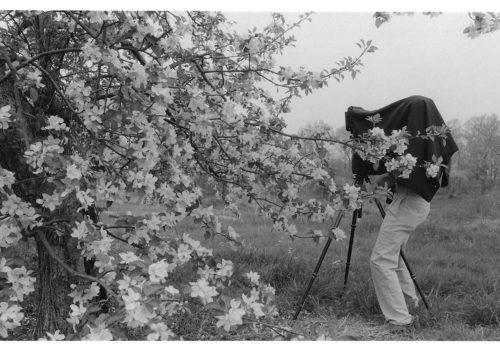
In my second year at SVA, I took George’s Thursday night class, ‘Making the Fine Print’ at the New School. It was considered a master class and he was the master. He lived in Iselin, New Jersey, ten minutes from where I lived in Perth Amboy. I offered to sweep his darkroom floors and help in any way I could, if I could spend time watching him work. His influence on my work and the gifts I walked away with eight years later, shaped what was to come for me. He gave me the technical skills and a means to survive. The nuggets—little and big—he shared made me determined to further master not only the craft of photography but the understanding to beg, borrow, and steal knowledge from anyone, roll it further into my work, and make it mine. The history of photography became a critical part of my education. George would quote Jackson Browne in nearly every lecture I saw him give, “do the dance that you’ve been shown by everyone you’ve ever known until those steps become your very own”. George could be curt, direct, blunt, often offensive in assessing my life as a young artist. He tested me constantly, chiding me to put the time into my own work after I left working in his darkroom or carrying his huge 8 x 10 Deardorff and immensely heavy wooden tripod.
He was a father figure, speaking at my first wedding, then helping me through a divorce three years later in his true Navy disciplinary style: telling me to buckle down and work. Shortly after my wife left me, George had me hand-scrub the darkroom and office floors—cleaning with a small brush and then Simonizing the office’s Marmoleum floor tiles by hand. It was key to my moving through the pain, and fed my desire to excel in everything. I hated it, but the distraction did just what George knew it would. George drilled into me that no matter the task, you still pursued perfection. I continue to teach and abide by the same principle. He was not a fan doing commercial work: energy is a limited thing he would say, you give it to commerce, and you lose it for yourself.
After my graduation from SVA, George asked me to stay on. He had been asked to print a series of limited edition portfolios of the work of the late Edward Steichen. Early in his career, George had printed for Steichen. Under George’s exacting eye, I was now handling the estate’s printing. I became a machine in George’s darkroom, I was “his hands” he would say. I handled hundreds of Steichen’s 8 x 10 negatives, some very well known, like his portraits of JP Morgan and Brancusi. I perfected my ability to process piles of ten or twelve wet prints at a time through the ten or so trays of chemistry and to wash and dry them without a single mar or crease. My green fingernails and sallow skin worried my mother, but I loved the work, loved mastering the craft, loved being literally “hands on” with this icon in the still mostly unrespected field of photography as an art form. In 1978, at only 150 years old, photography was still an upstart. At the time, I could purchase an original, signed Edward Weston print for a few hundred dollars.
Photographers who were of great importance to me were still living and part of a small community, and George was generously linking me to them. I met Lillian Bassman, Sid Kaplan, Andre Kertesz, Lissette Model, Arnold Newman, Ruth Orkin, Lilo Raymond, Aaron Siskind, Eugene Smith, and others, all heroes of mine. I was given shows at the galleries that represented George, including The Witkin Gallery, which at the time, was one of the preeminent photography galleries in the world. We appeared together in a TV interview on “Today” in New York and I was included in Museum and gallery shows with him. I interviewed him for a photography journal. His family, four daughters and a son, his ex-wife, Marie, and his mom Margaret, became a second family to me. At the New School, George introduced me to Ben Fernandez, the celebrated documentarian of the civil rights and anti war movements of the 1960s and 70s and was now head of the Photography department. George told Ben I should be teaching and for 7 years I did, teaching large format photography and printing. I was 23 years old and the faith he showed in me is still humbling.
George had a good sense of humor. I pulled up to his home one day and at the front door sat an old toilet. He found on the street somewhere and encouraged me to take it home and photograph it as Weston had. I refused but he inspired many other images I may otherwise not have attempted. I had a key to his home, I’d make his coffee at 10am, and stay until six five days a week, printing, invoicing, organizing, developing film, running errands, and learning.
Some evenings, I pin my work up on his small but well-lit viewing board, he’d roll a joint, and we’d smoke and talk into the evening. My goal was to earn the honorific master printer and establish myself as a respected photographer, worthy of George’s pride.
After eight years, as is the way of the apprentice, I began to get restless, finding the influence from George stifling. I could now take the skills I learned and survive. I began to print for other photographers including Horst P. Horst whom I then assisted for three more years, who gave me another set of wisdom and practical know-how. I stole whatever knowledge I could. I still steal.
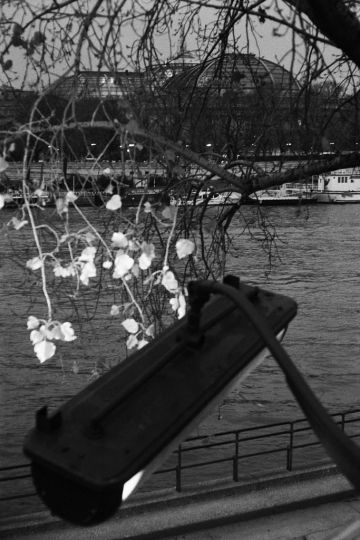
A few weeks after George passed away in January 2025, I asked his daughters if I could document his Atlantic Highlands home before it was altered. I made photographs of places where I could see George’s hand. While this was a different house than the one I had worked for him in, he arranged his things in the exact same way. I photographed vignettes he created with trinkets and curios and ephemera he collected throughout his life and related to his work; I photographed his darkroom and workspaces; his monastic bedroom and his clothes, the Navy man he was, always neatly hung and organized; his books, mostly on the history of subjects he chose to photograph, Lincoln, the Amish, Maine, Ronald Reagan, James Dean, Mark Twain. He produced 26 books in his life on a range of subjects. He is described by the late Michael Miller in the introduction to his last book, Lifeworks, as a photographic Herodotus, the Greek historian.
George saw beauty in ordinary things (including me) and gave me hard lessons but it got me through a traumatic time proving that something I have heard often from others, ‘photography saved me’. The lessons I learned became part of all the rules I learned throughout my early photographic education but in those lessons I was also taught to break those rules whenever I could.
William Abranowicz
William Abranowicz is an American photographer. He is the author of eight monographs on domestic life, voting rights, the environment, and travel. His most recent book is Country Life / Homes of the Catskill Mountains and Hudson Valley (co-produced with his son, Zander). He has also co-authored more than a dozen other books including publications with Ellen DeGeneres, and Martha Stewart. He is currently at work on two more books, a new survey of The Biltmore Estate in Asheville, NC, and a monograph of travel images made over the last fifty years.
His prints are in public and private collections including the Metropolitan Museum of Art, The Smithsonian, National Portrait Gallery in London, The Corcoran Gallery, and The DeMenil Collection.
Abranowicz was a contributing photographer to Condé Nast Traveler for 25 years. His work has appeared in nearly every major publication in the United States, Europe and Asia–including The New York Times Magazine, WSJ Magazine, Vanity Fair, Elle Decor, Architectural Digest, Vogue, Town & Country, Bon Appétit, More, Real Simple, Martha Stewart Living and Travel + Leisure.
He taught at Parsons School of Design and lead workshops in The United States and Europe.
Abranowicz’s work is carefully framed and considered. Cinematic, historical, and humanistic references are always at play and while a single image is the focus, it’s the larger narrative that builds from each image.
He lives in Margaretville, NY. He is a father and husband, manages a forest, is active in social justice issues, a licensed falconer, and a former firefighter.