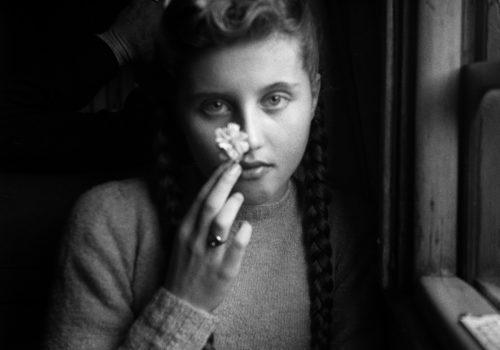
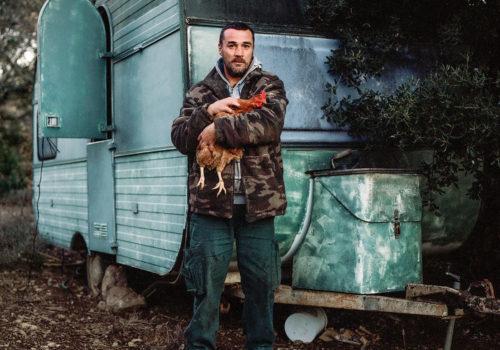
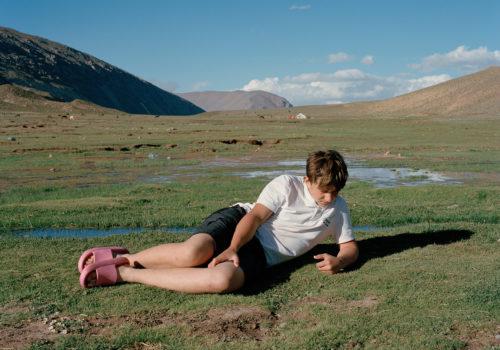
The book is sublime. It is titled “In the American West”. It is by Richard Avedon.
The French edition has just been published by Éditions du Chêne. It will surely remain one of the photographic monuments of this decade. Bernard-Henri Levy tells us about it: “He’s there. Facing me. Not, like all the photographers in the world, behind his camera, but beside it. And there is in this very fact, in the very choice of this position, in the way he stands one or two meters from the camera and operates it remotely with the strange little bulb he clutches in his left hand, something that, from the outset, makes me very uncomfortable. I remember this unease. I remember this tension. I remember—I will remember for a long time—the heavy, frozen atmosphere, laden with pitfalls and threats, that reigned that morning in the studio.” And he himself, when he speaks about it – when he speaks, in a general way, of the relationships that were established between him and his models he does not fear to speak of “tension”, “submission”, “manipulation” or “domination”.
Avedon conceives photography as an art of war
Avedon, or the art of photography conceived as a variant of the art of war. Avedon, or the only photographer who, consciously, inflicts violence on his subjects. At the beginning, this simple idea, but which already suffices, it seems to me, to specify the Avedon effect: between the photographer and the photographed, the only relationship that matters is still the relationship of power. In short, this means that we are at the antipodes of that good old idea, with which we have lived for ages, of the photographer as an accomplice, communing with his model and constantly watching, with tireless and sympathetic patience, for the miraculous moment of grace when he can meet them. Avedon, for his part, does not “meet” anyone. He couldn’t care less about all this talk of sympathy, connivance, or harmony. And you only have to open his book, just leaf through it, just review this succession of broken faces, dislocated bodies, deformed and crooked silhouettes to see that if he’s on the lookout for something, it’s less, in any case, grace than disgrace; meeting than misfortune; communion than failure, discord, separation.
Avedon, the anti-Doisneau. Avedon, or the opposite of our lovely French school of poetic-lyrical reportage, committed to capturing the “intimacy” of his characters. Avedon, or the only photographer who, to my knowledge, seems to have made it his rule to film, strictly speaking, only misunderstandings. There is an Avedonian metaphysics whose first dogma could be that of the irreparable misunderstanding between beings. Besides, what is he doing? What the hell is he doing, there, off to the side, a meter or two from his camera? Someone else, in his place, would observe. Study the model. Already before the shot, would be on the lookout for the tics, twists, and turns of the physiognomy to be penetrated. Another person anyone else, provided they believe, like everyone else, that people are photographed to listen to a bit of their truth, would use this precious moment to prepare for the encounter, perhaps to get used to it or frame it. He, clearly, doesn’t care. He barely looks at me. He barely knows I’m there. He barely knows, perhaps, that I’m a writer and not a politician, a still life, or an unlikely farmer from the “American West.” And I soon realize that the only thing that interests him is knowing where he’ll place his camera, how he’ll arrange his double reflector, at what exact height he’ll position his lens—I soon realize that, in his perspective, which excludes all ideas, and therefore, in profound agreement with the model, the only questions that are worthwhile and around which all the artist’s attention and talent flow are, at bottom, questions of space. Photography-topography. Photography-geometry. It is as if, for the photographer who, like Avedon, has mourned the loss of truth and intimacy, all that remains is to become the most consistent, the most rigorous, the most manic of surveyors. Better still and to give the matter a perhaps more positive twist it is as if, for this pessimistic and subtly disenchanted photographer, it is up to him to transform himself into a sort of stage manager, choreographer, scenographer it is as if, behind each of his photographs, constituting his framework and his most secret cipher, there is a kind of scenario with a very imperious text. The fact that this scenario is invisible changes nothing. The fact that it is brief, almost silent, is of no great importance either. Because the essential thing is that he is there, that he sets the scene, that he commands this swaying of the hips, this twisting of the head, this position of the foot or the hand that Avedon will suggest, casually, sometimes half-heartedly and without ever giving the impression of attaching too much importance to it whereas the genius of the scene lies in this detail, in this laconic and minuscule indication.
Error, said Barthes in Camera Lucida, of those who, from the beginning, describe to us a photography tormented by the model of painting when it is rather through theater that it actually touches art. Never has this notation seemed so accurate to me. Never has this originally scenographic truth of the art of photography jumped out at me so strongly. Never, in fact, has a photographer so definitively convinced me that his art is staged much more than put into images. We understand nothing about Avedon, as, indeed, most of the other greats if we forget this dimension, fundamentally, dramatic, of each of his compositions. We understand nothing, therefore, if we forget all the concerted, programmed, even prejudiced or premeditated aspect that they will inevitably have. Most of the photographers we know are people who, deep down, always rely a little on chance, fortune, the miracle of a decisive moment or a providential accident they are people who, in fact, harass their model, bombard them from all sides, endlessly multiply the angles, the shots, the play of shadows, the types of light, as if, by manipulating the parameters in this way, by making them play or vary, by modifying the circumstances and contingencies of the photo, they multiplied their chances of capturing the right image.
Avedon, once again, does not move. He varies neither the angle nor the perspective. We can guess that he is rebellious, once his scenario is in place, against anything that might resemble a trembling, a blunder, an improvisation, or an adventure. And the very idea of capturing anything even, of course, the miraculous image is as manifestly foreign to him as it is to a man of letters or of the theater, that of adjusting his text according to opportunity or mood. His photo, in other words, is preconceived. It is thought out a priori. It is instantaneous, certainly, since such is the essence, the lot of every photo—but its instant is so extraordinarily regulated that one would say it is weighted with a kind of eternity. If Avedon, unlike most others, is generally content with one or two shots, it is not because he is more skillful or his gesture is more sure: it is because in the universe he has chosen and whose laws he has imposed on himself, the very act of photographing becomes almost derisory compared to the long work of elaboration which, in his head, preceded it. For others, of course, is the care of detailing this work. For others the difficult and perhaps, in fact, impossible task of identifying, in each case, the laws and principles which presided over the photo. What I know, simply, is that these principles exist. It is that they are as numerous, as precise, as precisely articulated as those which, in literature for example, preside over the genesis of a text. What I know is that there is, behind the scenes of a photograph and as in its afterthought, a whole culture, a whole history, a whole system of references or reminiscences. And what I also know is that there is, beyond these systems of reminiscences, a whole part of desires or fantasies, of hauntings or repulsions for which the photograph will do nothing more, than exorcise the insistence.
Wasn’t it Kafka who said that we photograph things to banish them from our minds? Nothing less pure, in any case, than the eye of a man like Avedon. Nothing less spontaneous. Nothing less innocent. And nothing more talkative, nothing more terrifyingly eloquent, than these gray images, wisely laid down on paper but which, beneath their apparent flatness, betray all the depth of an imagination. Portraits, really? Before the most singular of them, these self-portraits as we would like to call them so much do they cry out for a truth that we have difficulty relating with, the reality that inspired them. Avedon, moreover, says so. He even says so expressly. And this is the meaning, in my opinion, of this short but astonishing preface in which he warns the reader that the portraits he presents are I quote”opinions” and this American West a “fictional west.”
If words have meaning, it means, I’m afraid, that these creatures do not exist. That nowhere, in any region of reality, do they have a foundation or a base. That they are images, mirages, specters perhaps, or chimeras. If words have meaning, and if the term “fiction,” in particular, is not there by chance, it means that, having emerged from the artist’s camera, they vanished after him, and that we can travel this American West in all directions without ever finding a trace of the beings who inspired them.
Images without an object… Clichés without a referent… Enigmas of a representation where everything we thought we knew about the relationship between reality and the forms it foments is blurred…
To open a book by Avedon is to enter a strange and slightly aberrant universe where one should no longer, strictly speaking, have the right to say of the models that they “posed”; of the film that it is an “inprint” of this pose; of their gaze, their air or their turn that they are “expressions”. The gyst of Avedon’s world, speaks to us of Avedon more than of the world; and when it does speak to us of the world, it is in the subtle, distorted and denaturing manner of the very great abstract art. Concretely that is to say technically this effort to denature reality presupposes a certain number of procedures which are, of course, at the very heart of Avedon’s style and which are perhaps never so manifest as in this new book. It is the topographical marking, for example, that I spoke about at the beginning. It is the practice of the full-face portrait, with no evasion nor freedom, with the inevitable effect of strangeness that it cannot fail to have. It is his refusal of a “natural” light the uncontrollable freedom with which it will draw, outline, shade or color the face he fears. It is the concern he has to create his light, to compose it, to sculpt it, light without shadow now, without nimbus or halo whose artificiality becomes hallucinatory. And then it is finally this extravagant practice whose consequences I am not very sure we always fully measure and which consists, for each photo, of placing the model in a sort of total void, perfectly white and transparent which is, when you think about it, the most denatured of settings.
The first consequence of this singular bias is that by emptying his scene in this way, by exhausting all its substance, by erasing everything which, from near or far, could recall a thing or a landscape, in short, by constructing this bare and, consequently, fictitious decor, he isolates his subjects above all, he removes them from reality: he amputates from them everything which, usually, concretely supports an existence; The first consequence is that, in the proper sense of the term, he makes them abstract subjects, perfectly indeterminate, whose very indeterminacy condemns them in some way to float suspended between being and not being, hesitating between a precarious consistency and an almost certain disintegration, it creates men without name, without anchorage, without lineage, of whom one cannot help but dream, so fragile do we suddenly guess them, “survivors without doubt, escapees without age or home witnesses of who knows what shipwreck, where all their signs of belonging to the civilized universe would have been swallowed up”.
The second consequence is that, by an effect of elementary contrast, the empty decor underlines and accentuates the fullness of the central motif; that everything that the photo has let escape through its margin, seems find itself again at the heart of the portrait, if you prefer, that this prodigious quantity of being which has vanished from the landscape, strays like a vapor in I don’t know what darkness outside the photographic frame, it seems to flow back onto the face, coagulate around its features and confer on them, by this fact, a prodigious overcharge of being; The second consequence is that everything happens as if the Avedonian faces, burdened and as if overwhelmed by all the heavy substance of which their environment has been lightened, acquire a terrible, indecent, scandalous thickness – everything happens, yes, as if they acquire this obscene density that Baudelaire noted in the portraits of Nadar and which already gave them the same massive and monstrous presence. It wouldn’t take much pushing of Avedon to make him take the exact opposite view, then, of the old dream of truth that has haunted photography since its beginnings and made it dream of going, beneath appearances, to pierce the secret of beings. No longer, therefore: beneath the mask, the face. But: on the face, added to its authenticity, henceforth indifferent, the hardness of a mask of which the artist does nothing other, ultimately, than compose the grimace.
And then the third consequence finally is that by virtue of another reversal, just as predictable even if apparently more paradoxical, this extreme density of being ends up inducing, once again, a sort of inverse effect; that as this excessive pressure of being is accentuated on the features, one would say that they become stripped, reduced to infinity; one would say, more exactly, that in the manner of these aging faces of which we know that instead of enriching them the sediment of the ages strips them on the contrary and purges them of their luxury, the Avedonian faces, as they gain in thickness, lose in determination; one would believe, even more precisely, that it is with these creatures like those Proustian figures of whom La Recherche tells us that the more nature or time types them, marks them or stigmatizes them, the more the rich precision of the individual fades in them to assert itself on the contrary to the poorer, more skeletal truth of the species. Avedon’s photos, in other words, and contrary to what is sometimes believed, do not give us individuals but species; subjects but archetypes; men of flesh and blood but samples of humanity…
That this humanity is nameless, that these strange prototypes are nowhere else but duly catalogued in the book, only adds, of course, to their disturbing beauty.
Faced with these catalogs of specimens so blatantly false and as if tortured by their cliché, it’s almost as if, at times, one doesn’t find oneself losing one’s reason—and imagining, all the same, somewhere in the real American West, men and women of flesh who, trapped by the photographer, would suddenly begin to resemble their archetype.
Bernard-Henri Levy
“The Art Institute of Chicago will exhibit the photographs from the book from May 29 to August 3. If you’re not too far away: hurry! (Coright © 1985 by Richard Avedon. All rights reserved.)